A to Z: Bonding as a family through books

For the next 30 days, I’ll be tackling 26 A to Z topics related to children’s literature. As Sesame Street would say, today is brought to you by the letter B, and we’ll be talking about bonding as a family through books.

Since today also is International Children’s Book Day, this seems an especially appropriate day to bond with your kids over a few children’s books!


There are a lot of ways for families to bond.

Family dinners. Game nights. Backyard games of catch or basketball. Cookouts and bonfires. Trips and outings.

But my favorite by far — the activity that can be practiced anywhere at any time of year — is reading.

Popular children’s book publisher Scholastic shared an article on its website, “Make the Connection: Read with your child – it’s the perfect way to bond,” which shares the following insights:

“The intimate experience of reading yields important lessons about behavior, feelings, and the enduring bonds of relationships. It’s a gift for time-challenged parents. … Snuggle together before lights-out, or schedule a Sunday morning reading hour, and you rekindle emotional closeness as well as impart important lessons, ease difficult transitions, heal personal pain, and celebrate family life.

Colorful illustrations draw a child even further into the story, allowing him to make a stronger connection between his personal experience and the story he’s hearing. Remind him of similar times you’ve shared together and you strengthen the link: “Remember when we saw the monkeys at the zoo?” “Remember when we splashed in the ocean?”

Experts recommend reading to children from the time they’re born to help parents and infants bond. In a Parents magazine slideshow (“The Benefits of Reading to Your Newborn“), Dr. Mary Ann Abrams says reading exposes infants to the sound of a parent’s voice, which is soothing for them. Reading also helps babies in neonatal intensive care wings develop the same intimacy as babies and parents who are home together after birth.

For older children, reading sessions can be healthy one-on-one time with a parent or an opportunity to spend time with the entire family. It’s a relaxing activity for winding down at the end of the day (hence the popularity of storytime coinciding with bedtime).

Activities to bond over books

Want to go a step beyond bedtime stories and family reading night? Here are a few family reading activities to get everyone involved.

  • Family book club: Create a family book club. Each evening, a member of the family gets to select a book for the family to read together and lead the discussion. Giving kids the chance to choose titles and guide a discussion gives them healthy opportunities for decision-making and group leadership. A family book club also offers nightly or weekly gatherings of relaxing activity.
  • Create a reading nook: You know what they say. Location, location, location. Having a creative designated spot at home for reading sessions can add a twist of fun. Especially when they’re comfortable and good for snuggles. Check out these closet reading nooks on Pinterest for ideas. Everyone in the family can pitch in for how to decorate and which books to stock in the nook.
  • Book review website: Break out your blogging skills and set up a simple site on WordPress, Blogger, Tumblr, or another free platform. Families can read a book together, then write and post a review together on the website. The bonus: This activity enhances reading as well as writing skills.
  • Reading with relatives: Does a grandparent or aunt/uncle live far away? One way for kids to keep in touch, establish a bond, and strengthen literacy skills is to read via phone or Skype. Who said book bonding has to be done in person?
  • Book and a movie night: Carve out a few hours on a Friday or Saturday night to do a book and movie night. Read a book together, then watch the movie version. Grab a bowl of popcorn and a blanket and snuggle up to the story. Talk about their similarities and differences. What do you like or dislike about each? (Dr. Seuss books and films are a great starting point.)
Posted in children's literature | Tagged , , , , | 7 Comments

A to Z: Art in children’s literature – a look at picture books and illustrated books

April is here, and with it comes the Blogging from A to Z Challenge.

This is my first year participating in the challenge, which will feature blogging on topics daily (except Sundays) corresponding to each letter of the alphabet, starting today with A through April 30 when I end with Z.

For the next 30 days, I’ll be tackling 26 A to Z topics related to children’s literature, beginning with art in kid lit.

So, as David Tennant’s version of The Doctor liked to say … allons-y!


I’m kicking off the 2016 A to Z challenge with a look at art in kid lit.

When it comes to children’s books, authors are only one of the important “A” words. Artists are the other (and equally important) “A” word. Particularly in two categories of kid lit: picture books and illustrated books.

I can feel the brain waves as some of you think, “Aren’t picture books and illustrated books the same? After all, a picture book is an illustrated book.”

If you’re among those thinking that, I used to believe the same thing. But while listening to one of my favorite free iTunes lecture series by David Beagley, a professor of children’s literature at La Trobe University in Australia, I learned picture books and illustrated books are very different categories of children’s books. And artists play a vital role in each.

Let’s take a look at both.

Picture books

In picture books for beginning readers, artists don’t merely draw pictures to correspond with the story. Their artwork shoulders a hefty portion of the storytelling.

In fact, in picture books, sometimes the artwork tells more of the story than the words.

There’s the example of “Rosie’s Walk,” which I mentioned back in a September blog post. The text of “Rosie’s Walk” consists entirely of the following sentence:

Rosie the hen went for a walk across the yard, around the pond, over the haycock, past the mill, through the fence, under the beehives, and got back in time for dinner.

The real storytelling in this book comes from the artwork. A fox stalks Rosie throughout her walk around the farm, but he encounters obstacles every time he attempts to pounce. Meanwhile, Rosie is oblivious to his presence.

Rosie the HenThe artwork lets the reader in on the secret, but only the visual reader. To listen to the story without the context of the pictures is a drab experience. There’s no conflict, nothing at stake. Only the person seeing the pictures will be in on the real story. In fact, in the case of “Rosie’s Walk,” the artwork could tell the story with or without the words on the page.
That’s the power of a picture book. The pictures are half (or more) of the storytelling experience. The art has a storytelling structure of its own, separate from (but working in coordination with) the words.

In picture books, the artist also defines much of the story. A few months back, I read a blog post by “Normal Norman” author Tara Lazar, who said she gave artist S. Britt the freedom to decide what her characters would look like.

So Britt made titular character Norman a purple orangutan who wears glasses.

Normal Norman

The book cover is memorable to me because of the artist’s concept of Norman. And I bet Norman is memorable to young readers as well because of Britt’s characterization. Typically we think of writers as the ones who use characterization, but in picture books, much of that task falls to artists.

Illustrated books

interior04_Pirates Parrots

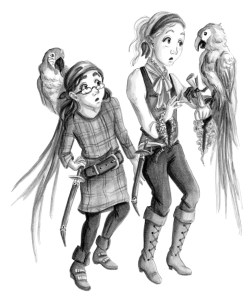
Hannah Jones’ illustration in “Sarah & Katy and the Imagination Blankets”

An illustrated book’s artwork plays a different role than a picture book’s art. Illustrations serve as emphasis: They emphasize a piece of the story, but they don’t offer new information.

Another way of looking at it: Readers don’t “read” the picture in illustrated books. The same content and context they find in the illustrations is available in the text.

The example nearest and dearest to my heart of illustrated books are the Sarah & Katy books. Hannah Jones illustrated scenes in “Sarah & Katy and the Imagination Blankets” and “Sarah & Katy and the Book of Blank” using information I provided from the text. No new information contained in the art. The characters’ appearances and what’s happening in the scene are clear through both the artwork and the words. Neither has more or less information than the other.

Coraline_02

David McKean illustration from Neil Gaiman’s “Coraline”

Although readers don’t necessarily “read” the art in an illustrated book, I can’t sell short the importance of the artwork. It offers visualization of the story. It also helps reinforce the mood of a book.

Earlier this year, I read Neil Gaiman’s “Coraline,” which is illustrated by Dave McKean. His illustrations enhanced the spooky mood of the book. Gaiman’s writing supports what’s happening in McKean’s illustrations and helps me interpret the art. Likewise, McKean’s art intensifies the dark fairy tale nature of Gaiman’s writing.

One more thing …

I’d be remiss if I didn’t mention the importance artists play in peritext.

Peritext consists of images and textual elements surrounding the main body of a published work. This can include front and back covers, back cover text, introductions, footnotes, etc.

When it comes to the peritext of any children’s book — be it a picture book, illustrated book, or completely devoid of interior artwork — the cover art is the first impression. The artist’s work on the cover sets the stage for the book, hinting at its plot, setting, mood, and characters. The peritext of “Coraline” already tells me it has the potential to be spooky because of the dark colors and shadows and Coraline’s expression. The peritext of the “Sarah & Katy and the Imagination Blankets” cover tells readers it’s a lighthearted adventure for two young girls.


Posted in children's literature | Tagged , , , , | 6 Comments

Balancing time as a working author

Successful writers have mastered a key element of the writing process.

It’s not characterization, or pacing, or voice, or outlining. All of those are important, but there’s an essential cornerstone that the best authors lay.

Time management.

When I give classroom presentations about the steps to becoming a writer, I tell students the final step is the most obvious: write. Inspiration and research and outlines are helpful, but they’ll get you nowhere without sitting down at a keyboard or blank page to put down words.

It’s all comes down to taking the time to write.

My latest work-in-progress, “The Mountain of Dempsey Molehill,” has an outline. It has plenty of inspiration and ideas jotted in a journal. Its characters are fleshed out with backstory and maps for how they’ll grow during the book. But it doesn’t have many words on the page. I haven’t followed my own advice. I haven’t buckled down to write.

As always, there are plenty of excuses I could make. My car had to be taken in for an oil change, then taken back for brakes, which turned into a bigger job than expected and involved some odd hours lost in finagling rides to and from everywhere. My day job is smack-dab in the middle of its most stressful time of year (in the newsroom, we call it Progress, which consists of publishing four weeks of extra 30+ page broadsheet sections about area businesses and services). We’re also approaching magazine production week, which falls squarely on my shoulders.

But a voice in mind still whispers, “You have to make time to write.”

“I did make time,” I want to argue. “I scheduled ten days off in April to jointly tackle Camp NaNoWriMo and the A to Z blog challenge. It’s not my fault I was asked to postpone that time off to work on Progress and the magazine.”

But the whisper replies, “No, that’s not your fault. But it is your fault you aren’t making time any other day.”

“I picked up a part-time design job that eats all of my former writing time,” I want to complain. “We need money, and writing isn’t much of a moneymaker at present.”

The whisper says, “Nor will it ever be if you don’t focus on it.”

It’s tempting to wallow in writerly self-pity. But I’m in the position every writer everywhere has been in. Time is precious. Many day, it’s hard to come by. And when a spare few minutes do turn up, it’s tempting to faceplant into bed for extra sleep, or curl up with a book written by someone else for comfort, or take an extra-long bubble bath.

Yes, every writer has been there. The difference is, successful writers manage their time; they don’t let time manage them.

Posted in Writing | Tagged , , , | Leave a comment

Rainbow colored men, ‘boom’ blankets, and interrobangs: These stories are worth a read

What do rainbow men, “boom” blankets, and interrobangs have in common?

The answer may not be clear, so I’ll give you a hint: They’re elements among the winning stories in the Sarah & Katy essay contests.

While the answer to that riddle may not have been clear, one thing is apparent from the results of the Sarah & Katy essay contests: McKinley School in Ottawa is a hive of young authors.

Of the eight stories honored in the essay, five came from McKinley School students. Other winning essays cam from Kimes Elementary, Centennial School, and Woodland School, all of Streator.

The range of stories is impressive, not to mention enjoyable. The young authors sprinkled a lot of personality into their writing, from using words like “flabbergasted” and punctuation like interrobangs (because who doesn’t love a good interrobang?!) to adding a dash of what I expect is personal experience. In “The Picture that Came to Life,” I laughed out loud at this exchange:

I walked down to the living room where she was watching TV and I told her that I drew on paper and … IT CAME TO LIFE! My mom kind of thought I was crazy, she said I watched too much TV, but I don’t think that’s true. So I was sent to my room to have “a little break.”

Why do I get the feeling the author has been sent to her room to have “a little break”? The authenticity of that phrase made my day. And the remainder of the story has a delightfully sassy humor.

There’s a lot to love about the stories. The first-place story in the fourth-grade contest, “The Rabble-Rouser,” gives a whole new “yikes” factor to the idea of an evil twin. Then there’s “The Man of My Imagination,” which begs the question: If you could dream up the perfect man, what would he be like? For the fourth-grade author, he’s rainbow colored, about two inches tall, and named Alberto.

There are action scenes — such as those in “Boom Blanket” and “The Book” — as well as a calmer, bedtime story style writing in “The Adventure to Blanket Town” and “The Snow Blanket.” And then there are tidbits that are just so authentically, wholly a childhood slice-of-life, such as that displayed in “The Snow Blanket” and “The Special Blanket.” (And let’s be honest: The closing line of “The Special Blanket” is the perfect childhood stream-of-thought tidbit: He had a bologna sandwich, his favorite. I love that closing line.)

All of the winning stories are published on this website. A complete list of winners and their stories is below.


Sarah & Katy and the Imagination Blankets Essay Contest Winners

  • 1st: Kaylee Monroe, “The Adventure to Blanket Town” McKinley Elementary, Ottawa, IL
  • 2nd: Allison Smith, “The Snow Blanket,” Kimes Elementary, Streator, IL
  • 3rd: Ty, “Boom Blanket,” McKinley Elementary, Ottawa, IL
  • Honorable Mention: Clayton Lehman, “The Special Blanket,” Centennial School, Streator, IL

Sarah & Katy and the Book of Blank Essay Contest Winners

  • 1st: Lilliana Samolitis, “The Rabble-Rouser,” McKinley Elementary, Ottawa, IL
  • 2nd: Daphne Uhl, “The Book,” Woodland School, Streator, IL
  • 3rd: Hailey, “The Man of My Imagination,” McKinley Elementary, Ottawa, IL
  • Honorable Mention: Sarah McGrath, “The Picture that Came to Life,” McKinley Elementary, Ottawa, IL


Book of Blank:

Posted in Writing | Tagged , , , | Leave a comment

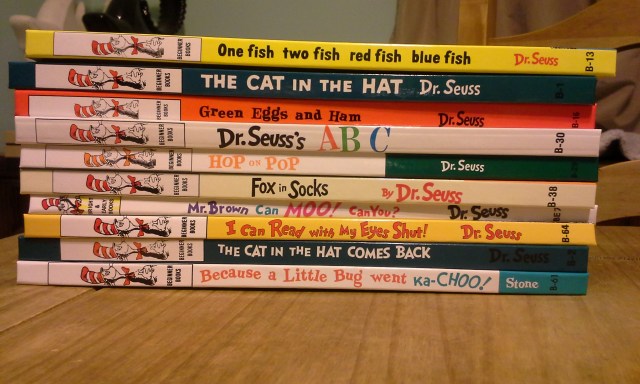
Impulse buying 10 Dr. Seuss books with no regrets

I went into Wal-Mart this weekend for $35 worth of oil.

I walked out with $50 worth of children’s books instead.

20160314_015745

I had the best intentions when I entered the store. Things went awry when I got to the automotive section and discovered no Valvoline 5W-20 was in stock. My plan was to leave and pick up the oil the next morning when AutoZone opened.

The thing about Streator Wal-Mart is that the automotive section is next to the clearance section. On my way out of the store, I walked by a display of Dr. Seuss books on sale for half price.

I’ve been meaning to build a complete Dr. Seuss collection for our home library. Our plan for a future nursery is Dr. Seuss-themed nursery, after all. (Fun and gender-neutral … it’s win-win!) Stumbling upon a half-price offer of several fundamental Dr. Seuss books — like “The Cat in the Hat,” “Hop on Pop,” and “Green Eggs and Ham” — was too good to pass up.

Now we’ve got a 10-book head start on our Dr. Seuss collection.

(And AutoZone had my Valvoline 5W-20 in stock.)

Posted in Writing | 3 Comments