(That’s the answer to the headline, in case you were wondering. Sorry … I didn’t give you a chance to guess.)
Zero is the sum of words I’ve written in “The Mountain of Dempsey Molehill” this month.
You’d think I would use a sad face or ellipsis behind that zero instead of an exclamation point. Writing nothing for three weeks isn’t exactly something to gloat about.
But there’s a silver lining to the periods when writers aren’t writing.
After being away from writing for 20+ days, my desire to hit the keyboard is re-energized. The time between writing sessions is a good time to stockpile ideas, and I’ve got a notebook full by this point. (Although a good chunk of them are ideas for new writing projects that I want to tackle …)
The down side is I’m behind schedule on meeting a couple of deadlines, so I need to use that excitement to make up some ground in the coming three weeks.
I grew up in a rural Midwestern elementary school district primarily comprised of white middle class students. A portion of the student body was Hispanic and Latino.
Throughout my entire grade school and junior high career, we had one black student. Her family moved to the area, stayed for about a year, and then moved out of the district.
It was easy for me to find likeness all around me. In my classroom, in my community, in literature, in television shows. It took effort to find differences. I never lacked a sense of belonging over issues like my race, religion, gender, physical abilities, etc.
I didn’t know that there were thousands of students elsewhere in the U.S. without that luxury.
Why representation matters
This is Exhibit A for why representation is important.
At first glance, Emma Bennet looks like an average 10-year-old girl. It’s on second glance that you can spot she wears a prosthetic right leg.
Emma’s parents reached out to a prosthetic company to make a smaller scale prosthetic leg so she could have a doll that looked like her. A Step Ahead Prosthetics accepted the request and sent the lookalike doll to her with a note saying the doll was ready to live “without limitations,” just like Emma.
Her reaction says it all. For the first time, she finds herself reflected in a doll. The emotion is overwhelming for her – and, quite likely, for those who see the video.
This is Exhibit B, shared by a friend on Facebook.
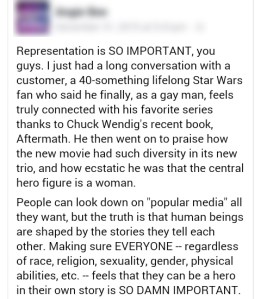
Here’s Exhibit C, a viral anecdote making the rounds on social media.
Exhibit D comes from Jacqueline Woodson’s poetic memoir “Brown Girl Dreaming.” Woodson grew up in the 1960s and 1970s, living part of her life in South Carolina and part in New York. Her words let me step into her shoes and take a few baby steps toward understanding what it meant to be a black child in those decades.
One particular passage in her poem “stevie and me” stands out:
If someone had been fussing with me to read like my sister, I might have missed the picture book filled with brown people, more brown people than I’d ever seen in a book before.
The little boy’s name was Steven but
his mother kept calling him Stevie.
My name is Robert but my momma don’t
call me Robertie.
If someone had taken that book out of my hand said, You’re too old for this maybe I’d never have believed that someone who looked like me could be in the pages of the book that someone who looked like me had a story.
I had to set the book down when I read that last stanza for the first time. “If someone had taken that book out of my hand … I’d never have believed that someone who looked like me could be in the pages of the book.” She’d never have believed that someone like her could have a story.
But we all have stories. Every single person who lives has a story. And every one of those stories is important. Those stories need to be told so others can say, “That’s just like my story. I can relate.” And so others beyond them can say, “I never knew your story – it’s different than mine, but it helps me find our mutual ground. It helps me understand you. It helps me respect you.”
Why diversity matters to the already-represented
I mentioned earlier that I never had problems finding myself represented in the community, books, TV shows, etc. So why should I care?
For years, I didn’t know I was missing out on anything. But what I didn’t know did hurt me, in a way. Not as much as it hurt the others who struggled to find themselves reflected in media and community, but it stunted me.
Representation in media builds empathy and understanding. Representation builds perception. It matters to have the Mexican man cast as the hero and not always as the villain so society doesn’t subconsciously (and unjustly) characterize Mexicans. It helps me understand a fraction of what it meant to grow up black in the south during the 1960s and 1970s.
For a long time, “diversity” seemed to be little more than a buzzword. College admissions essays asked for descriptions of diversity in my life. Workplaces discussed how to hire a diverse staff and why it was important. It wasn’t until I immersed myself in children’s literature that I truly began to grasp why diversity is more than a buzzword.
Children need to see themselves reflected in the world around them. They need to know there is a place for them – a welcome place. They need to know there’s a seat at the table. And those who are already at the table need to know it only enriches them to make room. It truly is “the more the merrier.” The more we know of each other, the more we learn about the each other, the happier and more harmoniously we’ll live.
I can’t recall if any of my childhood wishes on candles included seeing my name on a book cover; if it was, then there’s definitely some reliable magic in birthday wishes.
Birthdays are a big deal when you’re a kid. Once the 30th one rolls around, though, they lose a bit of their shine. Still, they can still be fun … I especially love other people’s birthdays because the fun is in the giving.
To celebrate this year, I’ve decided to forgo the gifts and instead be the giver. In honor of my 30th birthday, I’ll be giving away 30 books. Enter by filling out the form below between Jan. 7 and Jan. 14, 2017, and 15 winners will be drawn to receive one copy each of “Sarah & Katy and the Imagination Blankets” and “Sarah & Katy and the Book of Blank.”
Information in the form above will be used only to ship books. Information will not be kept on file and will not be used for future marketing or mailings.
Let’s take a moment to call New Year’s resolutions what they really are: goals.
Even though goal-setting is applicable in any season, the new year is as good a time as any to look ahead, make plans, and set goals.
Here are my 2017 goals as a writer. If I remember once December rolls around (I make no promises, and if I were you I wouldn’t place any bets …), I’ll come back to this list and see how well I’ve fulfilled my plans.
Have more of an online presence on my blog, Facebook, and Twitter pages.
Dabble in other forms of social media … maybe it’s finally time to check out Instagram and tumblr.
Write more stories in between chapters of longer projects.
Finish writing “The Mountain of Dempsey Molehill.”
Take more solitary walks. (These are great brainstorm sessions … the blood starts flowing, and so do ideas.)
Read more books with diverse casts.
Write more with diverse casts.
Focus on regularly networking with other children’s authors.
Attend a writing conference.
Get organized with a monthly plan for blog posts and website content.
Spend more time engaging with young readers and getting to know them.
Also spend more time at the keyboard writing.
Don’t let writing time come at the expense of ignoring family time … and vice versa.
Get out of the house. (I’m something of a hermit by nature, but there are loads of story ideas out and about in the community.)
Travel more. (Again … loads of stories beyond home.)
Just write. Write badly. And brilliantly. Write when inspired and when I absolutely do not feel like it. Write when I have time, and make time when I don’t have it.
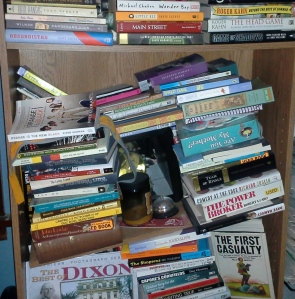
And one last general goal: Buy new bookshelves, because the old one finally collapsed.
It’s one of the few times of year I see adults partake in a mass effort to bring imagination to life. Elf on the Shelf, Santa Claus, flying reindeer …heck, even shopping malls, NORAD and the U.S. Postal Service join the make-believe and provide proof of Santa’s existence.
While we say it’s all in good fun for the kids’ sake, the truth is it’s just as much fun for the adults.
It’s one of the many reasons I love this season. Everyone gets a free pass to believe in magic and miracles. Growing up, there was no excitement that compared to Christmas Eve excitement. The presents were only a portion of the excitement … I’m not sure receiving gifts would have the same romanticism if it wasn’t for the idea of a man flying through the snowy skies in a sleigh powered by flying reindeer.
On Christmas Eve, magic was real. It wasn’t like Halloween, when the magic was just pretend. At Christmastime, even the adults believed. And belief is a powerful thing. I knew this to be true from watching “Peter Pan” … belief was a matter of life or death for fairies.
There’s a corner of my heart that aches a little as an adult. I’ve outgrown believing in Santa (and, sadly, so have my nieces — this year turned out to be the year skepticism sniffed out the truth about the big guy in the red suit and their Elf on the Shelf). I miss the wholehearted belief in magic.
That’s one “Peter Pan” lesson I failed to learn. I grew up.
Adulthood doesn’t completely quash the Christmas imagination, though. Creativity abounds for new, clever ways to arrange an Elf on the Shelf (like this list from Buzzfeed … the Elf playing basketball with the Three Wise Men is my favorite), sneaking presents under the tree to keep belief in Santa alive, and even making up stories to perpetuate belief in Santa a little longer. Two years ago, when my nieces visited my town for its annual Christmas kickoff, Katy grilled on whether the Santa Claus at City Park was the real Santa. I rambled off a spur of the moment, five-minute speech about how the mayor of Streator has to call the North Pole in June to make sure we arrange to have Santa in town the first Saturday after Thanksgiving, because once August rolls around Santa’s calendar gets booked. Our city council goes out of its way to get the real Santa and not one of his helpers, after all.
It wasn’t the most elaborate or clever story, but the following year she asked if the mayor remembered to call Santa over the summer. So at least it was a convincing story. (When in doubt, throw a city official in the tale to make it believable.)
I hope everyone is having a bright, merry, imaginative Christmas season. And I wish you all — no matter your age — a few moments of genuine belief in magic, haven in imagination, and much joy.