My blog has been mostly cricket chirps lately … it’s been silent. There are two good reasons for that, though.
Reason 1: Tapping out more chapters of “The Mountain of Dempsey Molehill” during Camp NaNoWriMo .
Reason 2: I’ve been setting up a new writing space. A really big writing space.
At the end of April, this happened:
That’s the husband and I in front of our new house. And it’s full of great writing spaces: A big front porch, a backyard deck, a sunroom, a room we set aside as an office.
It also has a great reading spot: There’s a window seat in the stairwell.
One of my favorite things about the new house is that I’m not the only one telling stories here. The house itself has dozens of stories to tell.
There’s a redbud tree in the front yard that was planted the day the previous owners’ son was born. The basement door is a timeline of children’s heights, with a name and date penned beside each mark. There’s a mural in the basement and the name’s of daughters’ junior high crushes scrawled on the underneath side of the breakfast nook’s table.
And there will be more stories written here — not on paper, but in our family history. These walls hold tales and secrets from families and generations before ours, and we’ll add our own to the mix.
I’ll have more updates from the big white house soon. In the meantime, I have to finish unpacking and catch up on some reading and writing.
How many times do you set an alarm on your phone as a reminder to complete a task?
I do it frequently, although not as often as I should. Because there should be an alarm going off every morning saying, “Get out of bed. It’s time to write.”
But I don’t set that alarm. And by the time my feet hit the floor, there are so many distractions it’s easy to forget all about writing. I can’t count the number of mornings my day begins with my husband asking if I’ve seen his keys, or his belt, or his wallet, or his [insert belonging here]. After the scavenger hunt is over, there’s cat puke to clean up, a litter box to empty, dishes to wash …
You get the point. Life as we know it.
The times I remember to write are when I have time alone to think. In the car, in the shower, in the waiting room while my oil gets changed. But those moments and environments aren’t exactly conducive to writing.
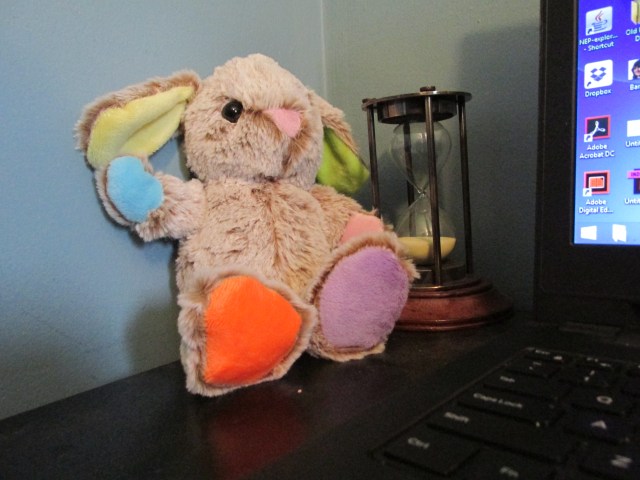
So I got a visual reminder. Meet Plot.
Plot sits on my desk as a reminder: “Hey Julie. Get over here. It’s time to write.”
In NaNo writing circles, the phrase “plot bunny” gets tossed around a lot. A plot bunny is a story idea that stays lodged in your mind and nags to be written. Like real-life bunnies, plot bunnies have a tendency to multiply … one idea leads to the next.
The plot bunnies for The Mountain of Dempsey Molehill have been hopping around my brain for a long time, and I need to get them on paper so I can set free other plot bunnies that are starting to clutter up my head. So I decided it was time to get a writing mascot to catch my eye and keep me on task.
And what better mascot than Plot Bunny? Especially since 70 percent of the toys for sale right now are Easter bunnies.
Thank goodness for paid vacation time and Camp NaNoWriMo.
It’s been weeks since I’ve written a word. The last time I had a productive day of writing was February 2. Since then, progress has been minimal.
But this week, I have five days off work. Camp NaNoWriMo is underway. And I’ve got a goal to knock out 30,000 words. Whether or not that happens remains to be seen, but at this point any amount of writing will be a win.
The original timeline for “The Mountain of Dempsey Molehill” was to release this summer, but each deadline got delayed. From September to December, I told myself it was okay to put the book on hold because I was picking up six-day weeks and overtime at work. Then I told myself it was okay to skip writing sessions because the husband and I were house hunting – and currently in the middle of housebuying, and then moving.
I almost talked myself out of working on my book this week. I scheduled vacation time for the first week of April months ago, specifically to write during the first week of Camp NaNoWriMo. But with a pending move within the next month, I started to convince myself I need to spent the next five days packing boxes.
That’s when the voice in the back of my head started nagging.
“There’s always going to be a reason not to write,” it said. “It’s time to make time.”
So even though I should be packing this week (and hopefully I’ll get some packing done), the first order of business each day is writing.
I don’t have time to write, but this week I’m going to make time.
Despite the fact I kept telling myself, “Just one more, and then I’m going to stop watching these,” I kept watching. (No regrets.)
Below are five talks about children’s literature worth a listen. It will be an hour and 10 minutes well spent.
Can a Children’s Book Change the World? (12:42)
Sue Park talks about reading for the development of empathy.
“Can a book help make a reader a better human being?” Park asks.
Spoiler alert: Yes, it can. Park explains how books like “A Long Walk to Water,” “Wonder,” “Crenshaw” and “All-American Boys” can help young readers understand others with different life experiences … and find in themselves the power to fight against the world’s unfairness.
The Windows and Mirrors of Your Child’s Book Shelf (12:23)
What happens if you never see anyone in a book who looks like you?
Grace Lin discusses how she grew up as the only Asian student in her elementary school. “It seemed like there was nobody that looked like me anywhere,” Lin says. Not at school, in movies, on TV, in magazine … and not in books.
She discusses the bigger picture of denying her heritage in an effort to blend in … and growing up to rediscover her heritage by writing the books she wished she had as a child. Her novel, which stars a minority main character, went on to win a Newbery Medal. The book gives young Asian American readers mirrors to see themselves in literature, and it gives other readers a window into the life of a minority protagonist.
Missing Adventures: Diversity and Children’s Literature (16:20)
Purchasing children’s books is a source of frustration — and even trepidation — for Brynn Welch. That’s because she has a hard time finding books that feature characters who look like her son, who is black. Of 3,200 children’s books received by the Cooperative Children’s Book Center in 2015, only 240 had a black protagonist. Fewer than 80 starred Latinos, and fewer than 30 featured Native Americans. Only 16 percent of children’s books that year featured people of color.
“Most of us don’t notice who’s not there,” Welch said. Until someone points it out, anyway.
It matters who children see represented in children’s literature, she says. She discusses gaps she has found in children’s literature and where she would like to see better, more diverse representation.
Why We Should All be Reading Aloud to Children (9:30)
Rebecca Bellingham, as a teacher and a mother, has read a lot of books aloud to children. To her experience, it’s rare for children not to enjoy the chance to hear a story and “get inside a book.”
Bellingham talks about the impact reading aloud has on young readers’ independent reading lives.
Inspiration Through Children’s Literature (17:35)
Children’s literature has something to offer to readers at many stages of their lives, including adulthood. This video is a bit lower quality than the previous ones listed above, but it’s also my favorite (especially since there’s the bonus of Drew Vodrey reading a children’s book aloud during the presentation, complete with fantastically giddy laughter).
Vodrey describes children’s literature as a Rorschach test for our lives and touches on how we touch back to kid lit and its lessons throughout our lives.
“Don’t discard children’s literature as something simple,” Vodrey says.
(That’s the answer to the headline, in case you were wondering. Sorry … I didn’t give you a chance to guess.)
Zero is the sum of words I’ve written in “The Mountain of Dempsey Molehill” this month.
You’d think I would use a sad face or ellipsis behind that zero instead of an exclamation point. Writing nothing for three weeks isn’t exactly something to gloat about.
But there’s a silver lining to the periods when writers aren’t writing.
After being away from writing for 20+ days, my desire to hit the keyboard is re-energized. The time between writing sessions is a good time to stockpile ideas, and I’ve got a notebook full by this point. (Although a good chunk of them are ideas for new writing projects that I want to tackle …)
The down side is I’m behind schedule on meeting a couple of deadlines, so I need to use that excitement to make up some ground in the coming three weeks.