New year, same old story

2018 is already more than a week old.

Meanwhile, I’m blinking and flabbergasted, wondering, “Where is the time going?”

A year ago, I set a goal to finish writing “The Mountain of Dempsey Molehill” within the 365-day time frame of 2017. A year later, I’m looking at a new calendar but still working on the same ol’ novel. All the while, ideas for new projects are clattering around in my head. It’s getting crowded in there with story ideas.

Today marks the first time I’ve settled in at the keyboard since the holidays concluded. I’m breathing a small sigh of relief now that the Christmas tree is hauled back down to the basement for another year and the nutcrackers and Santa Clauses are tucked away in their respective boxes at the back of a closet. (Although the tree skirt is still in a jumble on the living room floor. At some point I’ll pick it up, fold it, and store it away.) The leftovers are eaten, the fridge is empty (darn it … I should probably grocery shop today), and life is returning to normal.

Phew. Now to get back on track with a regular writing schedule.

I won’t jinx myself this year by saying I plan to finish Mt. Dempsey, but I have a good feeling about 2018 where Dempsey is concerned.

Even though finishing the Molehills’ tale is No. 1 on my writing priority list, a few other projects are in my goals for the year. There’s another middle grade novel competing for my attention, plus a poetry project I hope to tackle in April for the A to Z Challenge. And it wouldn’t hurt to do a better job at keeping up with my blog this year.

So. 2018. Let’s do this.

Posted in Writing | Tagged , , , | 9 Comments

A day at the American Writers Museum

Writers and readers alike, rejoice! Chicago is home to a new museum tailored just for us.

The husband and I spent Thursday afternoon absorbing the halls and galleries of the American Writers Museum, 180 N. Michigan Ave.

An elevator ride to the second floor brings you to the museum, which is small enough to tackle in a day but large enough to be worth the $12 admittance for adults (children 12 and younger enter free). Listed below is my review of several elements of the site.

Family friendliness: A+
awm7.jpg

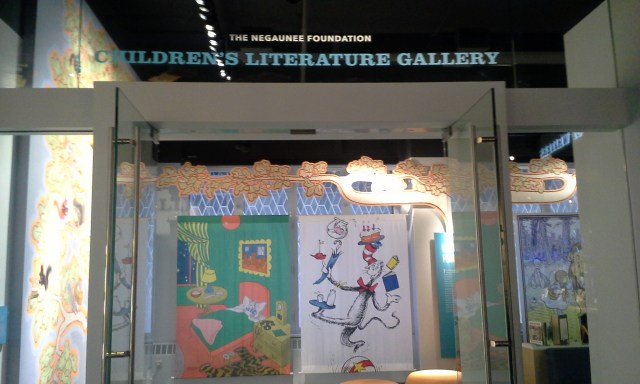
The AWM has displays for all age levels, and the abundance of interactive content is engaging across generations. Upon entering the museum, visitors are encouraged to touch the displays. The children’s gallery is the first one visitors are likely to see, and the room is full of children’s books and kid lit-related art and activities. All books featured in displays are available for reading and thumbing through pages. There are games, quizzes, videos, photographs, audio, touch screens …

The facility size is also a plus for families. The entire museum can be covered in half a day, which leaves time for lunch and another activity in downtown Chicago. Prices are especially reasonable for families with young children, since anyone under age 12 can come in free.

Educational value: A

Every school English class and literature class should visit the AWM. This museum is perfect to keep students of all ages engaged while loading them with knowledge.
AWM1

awm4.jpgFor elementary students, the Children’s Literature Gallery is perfect. Larger-than-life murals and illustrations accompany shelves filled with children’s books for all levels of young readers, from beginner to middle grade. There’s also a fun wheel of emotions kids can spin and then act out the emotion they land on in a mirror. The activity is inspired by Maurice Sendak’s “Where the Wild Things Are,” is which main character Max deals with a variety of emotions.

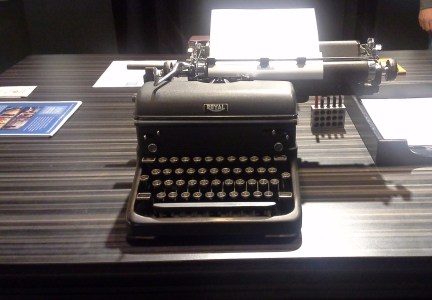
In the Mind of a Writer hall, kids also will enjoy typing on typewriters — probably a first for most of them. The typewriter ribbons are full of ink, and stacks of paper allow anyone to tap away a mini masterwork.

AWM3

awm5-e1510905389990.jpg

For older students (middle school and up), one of the most prominent displays in the museum is the American Voices hall, featuring a timeline of American literature aligning with significant historical events. Each author has a rotating, three-sided display with a short biography and interesting facts. Accompanying these displays are a variety of interactive opportunities, such as a Q&A about who invented five genres and a touch-screen TV allowing visitors to choose from three talks about the development of the American literary voice.

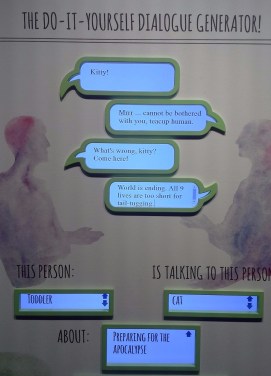
The Mind of a Writer hall offers educational writing tips on the Anatomy of a Masterwork wall and interactive opportunities to write dialogue with the Do-It-Yourself Dialogue Generator, compare your writing habits with famous authors, and play a digital game similar to Mad Libs in which you use a word bank to fill in the blanks of a book passage.

Diversity: A

The AWM gets high marks on two levels of diversity:

  1. The diversity of author voices and backgrounds.
  2. The variety of writing types, including children’s literature, novels, poetry, screenplays, music, journalism, etc.

Overall: A

awm6.jpgThere’s a good balance of representing authors, writing, and reading. The Readers Hall offers a few of my favorite activities of the day, including the chance to rank my five favorite books by American authors and compare those rankings against the books selected by previous visitors. The perimeter of the room also features facts and Q&A trivia about libraries, the launch of kid lit, newspaper readership, the rise of paperbacks, how magazines and literature became accessible to the masses, and more.

In the future, I would love to see more displays added on the literature itself. I felt a strong connection to the authors’ works in the children’s room with behind-the-scenes facts about “Where the Wild Things Are” and a display built around “Charlotte’s Web,” but I felt a disconnect among the adult displays. However, this could be due to an oversight on my part. The nearly 60-foot Surprise Bookshelf display features more than 100 authors and titles, but I didn’t realize the panels of the display slide to share interesting facts about the work or author. I only browsed the titles and authors displayed.

Extra credit

AWM8The gift displays on either side of the front desk may look small at first glance, but they’re full of treasures for readers and writers. There’s a decent selection of literary T-shirts, books on writing, plush toys inspired by famous authors and stories, home decor (I came home with library card coasters and an art print, plus a candle for a friend), mugs, pens, magnets, scarves, writing gloves, notebooks, a couple of games, and another dozen things I’m probably forgetting.

Posted in Literacy and Education | Tagged , , , , | 1 Comment

Home is where the literary link is

A few weeks ago, I had a visit from Susan.

Susan grew up in the house my husband and I bought in April. She was visiting Illinois (she now lives in California) and asked if she could drop in to visit her childhood home. We set up a day and time that worked for both of us, and we spent the designated afternoon wandering from room to room as she told some of the stories Five-Ten (a shorthand name for the home derived from the house number) witnessed over the years.

The stories carried waves of nostalgia and smiles. I was enjoying my role as a bystander to memories when we climbed the stairs and stopped on the landing. Susan pointed to the room we’ve designated as the guest room and said, “That’s the Peck Room.”

I wasn’t sure I heard correctly — had she said Peg? Perk? Peck? So I repeated, “The Peck Room?”

Susan nodded. “It’s named after the author Richard Peck. He slept in that room.”

Goosebumps rippled over my neck, arms, and legs. “Richard Peck? As in, the Richard Peck? ‘A Long Way from Chicago’ Richard Peck?”

Yes. “A Long Way from Chicago” Richard Peck.

As in, the same Richard Peck whose work heavily influenced the storytelling style of my own in-progress “The Mountain of Dempsey Molehill.”

Susan, who seemed pleased I recognized his work, explained that her mother was a member of the city’s Friends of the Library group and was pivotal in bringing Richard Peck to town for a presentation. As part of his visit, Susan’s parents hosted his stay at their home.

I, of course, had every intention of continuing the tradition of naming the room the Peck Room. I mentioned to Susan that I wanted to a get a small nameplate to hang on the door designating the room by name.

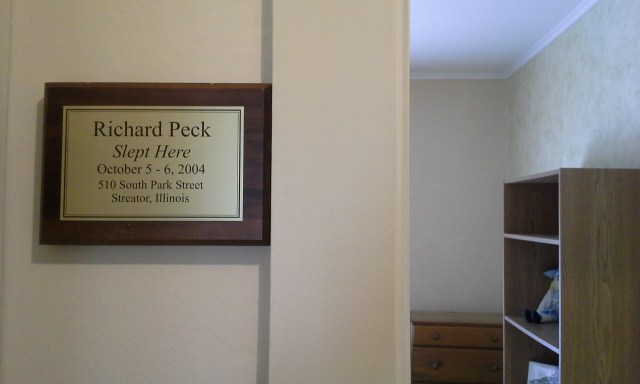
A few days later, this arrived in the mail:

Peck Room

The family already had a plaque commemorating Peck’s stay. When Susan’s mother got word that Peck’s visit was so significant to my reading and writing history, she sent the plaque back to Five-Ten. It now hangs on the wall alongside the Peck Room doorway.

Another literary twist

This discovery of Richard Peck’s stay in my new home isn’t the only accidental literary link I’ve found between myself and Five-Ten. I wrote a column in August about a book that lived at Five-Ten, changed owners’ hands, and then returned home.

Empire Falls Closeup

The address sticker at the bottom right of the cover shows the book formerly belonged to the house my husband and I bought in April.

The abridged version: The former owner of Five-Ten grew up in Maine and purchased a copy of “Empire Falls” by Richard Russo. She made notes in the margin comparing the town in the Pulitzer Prize-winning novel and Streator (where she spent another 50+ years of her life at Five-Ten). Eventually she donated the book to a used book sale, where I found and bought it. There’s an address sticker on the bottom right corner of the cover, which is how I discovered who previously owned the book.

Fast forward a handful of years, and I was packing up our rental home across town when I rediscovered “Empire Falls” — and its address sticker. Even though I would be moving into Five-Ten for the first time, the book was returning home.

It’s now displayed in a place of honor on the bookshelf.

Empire Falls

Five-Ten is a literary home. For five decades it sheltered a book-loving family that built shelves for nearly every room, conducted book clubs, and hosted authors. The vibes in these walls are strong for writing.

I hope I can contribute the next phase of literary history to Five-Ten.

Posted in Children and Family | Tagged , , , , | 2 Comments

Let’s start at the beginning: A writing update

Books start at the beginning. They have a first chapter, a first page, a first word.

It’s the logical place to start.

That’s also the hardest place for me to begin writing a book.

I usually know what happens in the middle and where the story ends, but knowing where to start is a challenge. The opening chapter is the one I rewrite the most, and the first line is the hardest of my entire writing process.

The opening of “The Mountain of Dempsey Molehill” has been one of the primary causes for delay in completing and releasing the book. The book is linear over the course of a year, told in an episodic manner. Many of the stories in the middle of the book already are written.  But I’ve been putting off the first chapter for more than a year.

Which is why I’m relieved to say …

A first draft of the first chapter is finally written!

Phew.

Sometimes a little motivation makes all the difference. I signed up for an opening chapter critique at SCBWI’s Prairie Writer’s and Illustrators Day, which meant a firm deadline loomed for submission. As a newsroom person, deadlines give me a positive boost.

Dempsey’s story is still far from finished, but now I feel like it’s off to a good start.

Posted in Writing | Tagged , , , | 1 Comment

How readers can react to ‘Handbook’ ruckus

On Thursday, YA organizations and social media were buzzing about the New York Times best-seller list.

The short version of what happened: A new teen novel, “Handbook for Mortals,” came out of the blue to bump “The Hate U Give” out of the No. 1 spot on the New York Times young adult best-sellers list. Thanks to some Twitter sleuths, it was discovered the book essentially gamed the system to get on the list, allegedly by having unknown persons call bookstores that report to the NYT and place bulk orders. Meanwhile, print copies of the books were nowhere to be found on major book retailer shelves and were unavailable on Amazon. (You can read more in Entertainment Weekly’s stories about the situation here and here.)

When the New York Times was alerted to the devious path the book took toward the No. 1 spot, the newspaper revised the list and removed “Handbook,” instead pushing “The Hate U Give” back to its 26th week in the top spot.

The drama continued Friday when sharp-eyed write Rick Capone spotted less-than-original cover art and shared it on Twitter.

Handbook Tweet

The dust (mostly) settled by the weekend, and the YA literary universe moved on to other conversations.

But what does this situation mean to the average reader?

The New York Times best-seller serves two great purposes for readers: (1) It measures the top-selling young adult books so we know what others are reading and (2) it’s a list for those looking for fresh reading material. As a reader, I love knowing what others are reading, and I’m fascinated to see what books rise in popularity. Even though I don’t always love the books the majority picks (I’m looking at you, “Twilight” …), it’s fascinating to see the public’s vote for favorite reading material.

Which is why I was rubbed the wrong way when “Handbook” used the system to push its way to the top. It didn’t claim No. 1 by readers buying the book but instead by one or more individuals making deliberate bulk orders. That’s duping the public into believing there’s massive readership for the novel. I’m not naive enough to believe this has never happened in the past on some small scale, and there are likely other ways to influence the NYT list that are beyond my understanding. But I was still disappointed by whoever decided to singlehandedly push “Handbook” into the top slot.

My initial reaction was to resent “Handbook,” I don’t think the proper route is to boycott novel — there’s a good chance the author had nothing to do with the phone calls hunting for NYT-reporting bookstores, and it would pain me to see a writer’s work damaged by scandal that had no direct link to him/her.

Nor do I think the appropriate route is to track it down and read it in light of the publicity it received last week. The cover art still raises questions, and I’m reluctant to give a sale to any publishing firm that would plagiarize another creator’s intellectual property. Not to mention the book hasn’t earned my attention through reviews or a plot synopsis I can’t resist.

So my plan is to put “Handbook” out of my mind for now. My action is to not act in regard to that title.

Instead, if the NYT list debacle irked you as a reader (as it did me), consider reading one of this week’s YA best-sellers. In light of last week’s ruckus, I ordered a copy of “The Hate U Give.” After all, it’s spent 25 weeks so far in the top spot, and the reviews are bursting with praise. It’s a novel that climbed to the top through its merit as a reader favorite and tackling a tough topic in fiction, where young readers can relate and/or empathize.

This week’s top 10 New York Times best-selling YA hardcovers are:

  1. The Hate U Give, by Angie Thomas
  2. One of Us is Lying, by Karen M. McManus
  3. Lord of Shadows, by Cassandra Clare
  4. Once and For All, by Sarah Dessen
  5. Miles Morales: Spider-Man, by Jason Reynolds
  6. This is Where It Ends, by Marieke Nijkamp
  7. Crazy House, by James Patterson
  8. Alex and Eliza, by Melissa de la Cruz
  9. The Last Magician, by Lisa Maxwell
  10. The Sun is Also a Star, by Nicola Yoon
Posted in Writing | 2 Comments