Thoughts on pricing children’s chapter books

When I was a kid, I got an allowance of $5 per week.

That $5 went toward many Beanie Babies, a handful 10-cent Now and Later candies at Mazon Market, and those big 50-cent stickers you can buy from sticker machines at Pizza Hut and Kroger.

But during weeks my Mom and sisters made the trip to Streator to shop, I hoarded that $5 bill.

Streator had On Cue.

On Cue sold books.

Streator shopping trips were agonizing until we got to On Cue. (Mom tended to go there last to make sure I would behave at all the boring stores.) I was dragged through clothing stores like Fashion Bug and Maurices. We had to stop at Kmart for household goods. We went to Save-A-Lot and McGrath’s Seafood and Kroger for groceries. Sometimes we would swing by CVS Pharmacy if there was a good sale.

I dragged my feet. I moaned. I flopped my arms. I  begged to go to On Cue next.

And finally, at the end of the trip, we went to the bookstore.

I would spend an hour in the children’s books, carrying a purse on my shoulder that contained nothing but a wallet, which contained nothing but a $5 bill. I went through each book, evaluating which one I should officially make my own.

The trouble was, most of them were out of my price range. A handful were $4.99, although most of them were below my reading level. A few were $5.99, and I knew I could count on Mom to supplement the purchase by giving me the extra dollar, plus tax. (That’s how I ended up with a shelf full of $5.99 Nancy Drew mysteries.) Sometimes I could even wrangle an extra $2 from Mom to get a $6.99 book.

Then there were the $8.99 books. That was the magic number I recall as a kid. Many of the books in the children and YA fiction section were priced at $8.99. To get one of those, I had to bargain with Mom. She would pay the extra four dollars plus tax, but it would come out of next week’s allowance. No whining allowed the following week if I couldn’t buy Beanie Babies, Now and Laters, or stickers.

(Although if memory serves me right, Mom usually handed over a dollar in quarters for Now and Laters and stickers the next week.)

I grew up knowing books aren’t always easy to buy. I also grew up knowing books are important to developing minds and need to be easily available to children.

For families who live in library districts, easy access is no problem. To families like mine, which lived in rural farm country outside city limits, book access was limited during summer vacation, when the school library was closed.

As a writer, I sit on the fence and see two sides. Publishers and authors need to earn livable wages off their product. But readers also want (and need) access to reading materials.

That’s why, as a self-published writer, I am thankful to cut out the middleman of the publisher. I can set my books at the more affordable end of the pricing scale.

My goal for every children’s chapter book I write is to keep the price below that ever-memorable magic number of $8.99.

Writing isn’t about the money; it’s about making stories available to children. It’s about opening them up to new worlds with new words.

I want every kid with that $5 bill to have a realistic chance of buying a book.

Posted in Writing | Tagged , , , | 7 Comments

Exciting developments

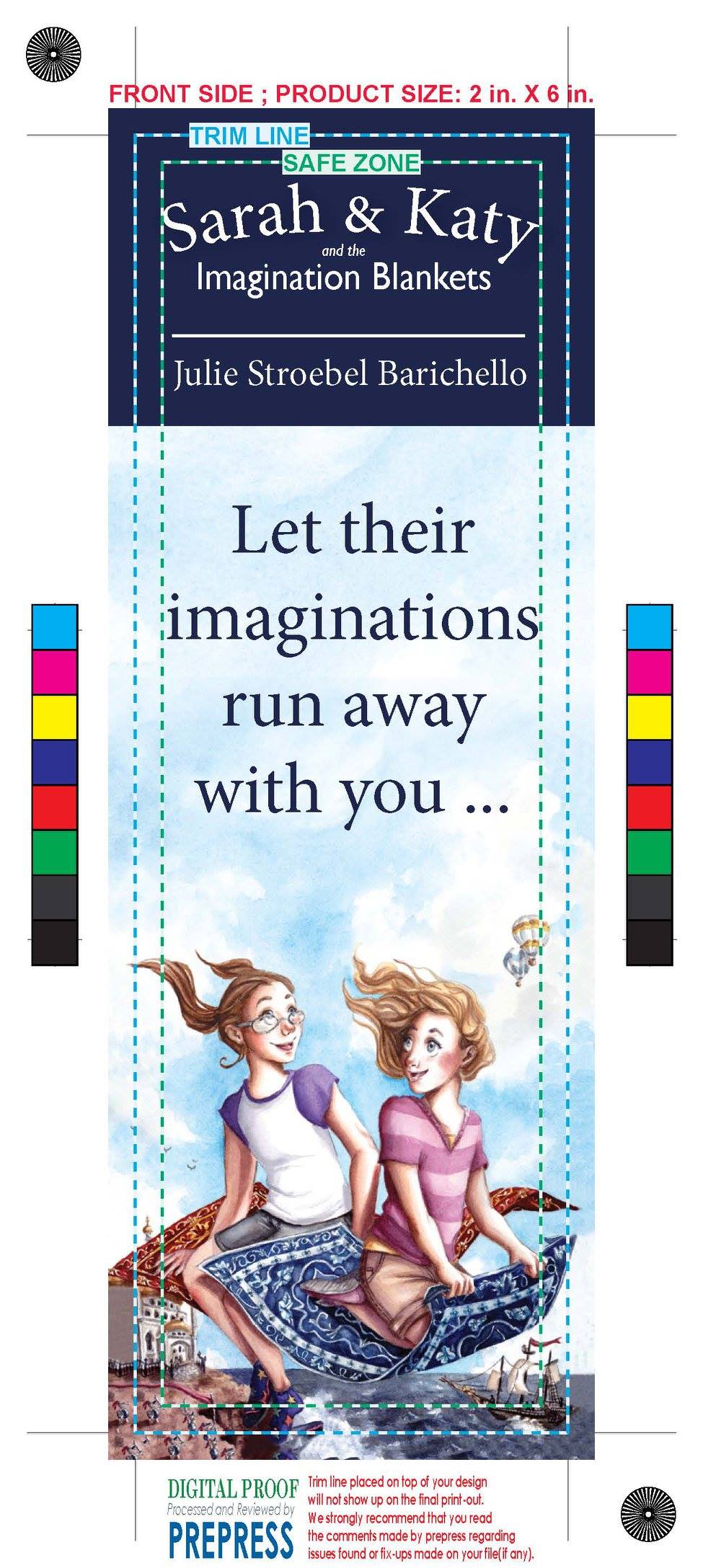
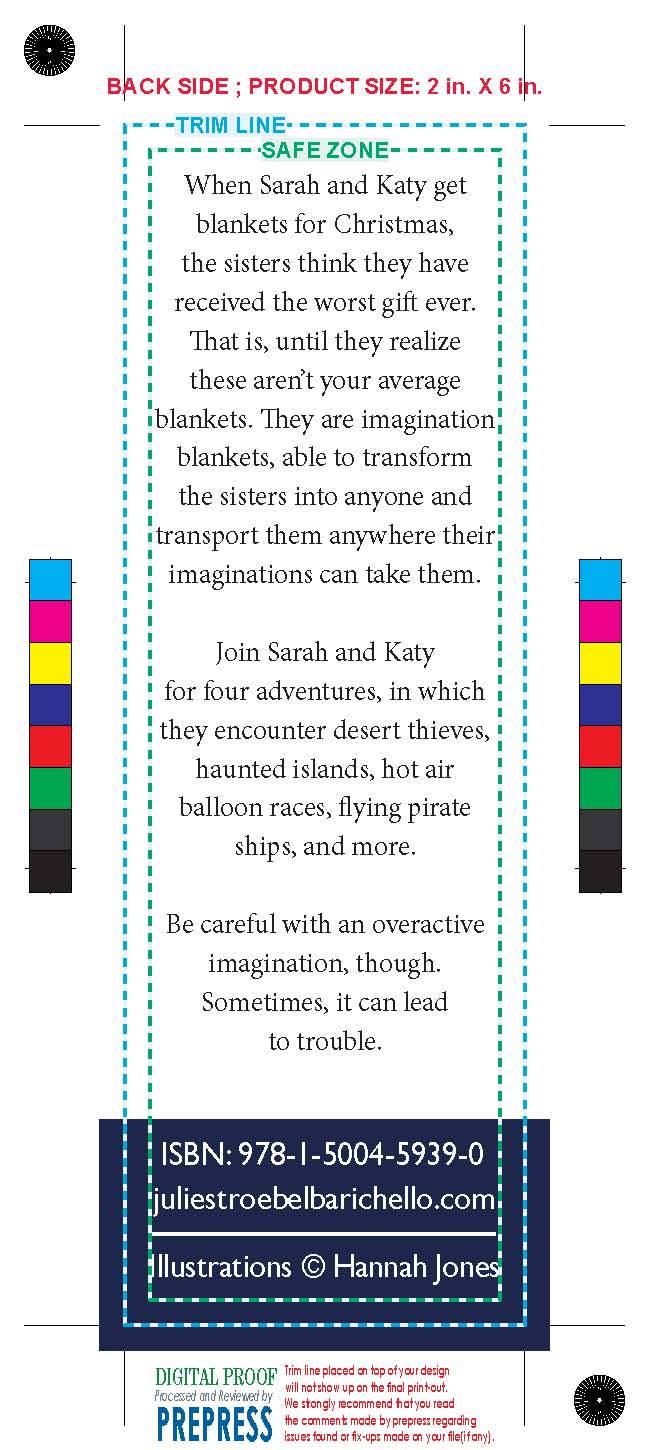
Bookmark FrontBookmarks Back

I haven’t been this excited since the seventh Harry Potter book was released.

I received the proofs for the first bookmarks to accompany SARAH & KATY AND THE IMAGINATION BLANKETS.

(Hopefully I won’t be as disappointed in the final result of the bookmarks as I was in the conclusion of J.K.’s series.)

Shown above are the front (left) and back of the bookmark.

Book design

Design also is underway this week. Above is a sneak peek at pages 20 and 21.

About two months are all that stand between us and the December book release. The to-do list is getting shorter, but there is plenty left to keep us busy on the production side.

Posted in SKIB | Tagged , , , | 3 Comments

Someone wants to prevent you from reading these books

This week is Banned Books Week.

I am perpetually intrigued by the books that land on the banned list. It should come as no surprise when a seemingly innocuous book like “Captain Underpants” tops the list, but I have come to expect unexpected titles.

According to BannedBooksWeek.org, the top 10 “controversial” books of 2013 are:

9.27 Graphic of WeekBanned titles such as “50 Shades of Grey” don’t surprise me as much as books like “Captain Underpants” or “The Hunger Games.”

However, I always remain perplexed at the concept of the few trying to block the flow of ideas and information to the masses.

As a children’s writer, I understand the literary market teems with material unsuitable for all ages. I also understand when I am a parent, it is my responsibility — not society’s job — to filter the content my children consume.

It is never my job to dictate what another person’s child can or cannot read. It is not society’s job to ban a book.

In the spirit of Banned Books Week, swing by your local bookstore or library and pick up one of 2013’s most challenged titles. Or, for good measure, grab one of the top 10 banned books, as cited by ShortList.com:

  1. Brave New World by Aldous Huxley
  2. The Grapes of Wrath by John Steinbeck
  3. Tropic of Cancer by Henry Miller
  4. Slaughterhouse-Five by Kurt Vonnegut
  5. The Satanic Verses by Salman Rushdie
  6. The Perks of Being a Wallflower by Stephen Chobsky
  7. Things Fall Apart by Chinua Achebe
  8. American Psycho by Brett Easton Ellis
  9. The Metamorphosis by Franz Kafka
  10. Lolita by Vladimir Nabokov
Posted in Reading | Tagged , , | Leave a comment

Cover reveal for ‘Sarah & Katy and the Imagination Blankets’

This moment has been a long time in coming.

From the moment an idea for a novel occurs to a writer, the visualization begins. Words aren’t even on paper before we start imagining the weight of the book in our hands and seeing the cover on store and library shelves.

That’s an exciting thought: seeing the cover of our books.

No moment in the book production process quite compares to seeing the cover for the first time. It’s akin to the moment the groom first sees the bride on their wedding day.

You want to laugh and cry and flail and shake the nearest person while shouting, “BEHOLD THIS THING OF BEAUTY BEFORE MY EYES!”

What I’m trying to say is, from the moment I started planning SARAH & KATY AND THE IMAGINATION BLANKETS, I imagined a book cover. I shared that vision with Hannah Jackson, of hannahbird illustration, and eagerly anticipated the moment when she would unveil the cover art to me.

Now, if you take a look at Hannah’s website, you’ll understand why I had high expectations. You’ll understand why I imagined a great cover.

She sent me art far better than I could have imagined. She exploded my expectations and launched them light years beyond what I thought possible. I am ecstatic at the cover art she created.

If people judge SKIB by its cover, there’s no doubt in my mind they’ll think it’s a great book. I hope my writing lives up to her art.

And now, without further ado …

(Since I can’t grab you by the shoulders and shake you, dear reader, I will settle with a caps lock-key shout …)

BEHOLD THIS THING OF BEAUTY BEFORE YOUR EYES!

SKIB cover

Posted in SKIB | Tagged , , , , | Leave a comment

It’s time to let go and stop editing … almost

THE FIRST TIME I found a typo in a novel, I was stunned.

I was in grade school at the time. The typo and novel are long forgotten, but I never will forget the feeling. It was a pie-in-the-face sensation of surprise.

Until that day, I was under the impression that books were infallible. They were the only perfection the world could know. Books could not have mistakes. It was a fact of life.

I tattled on the book, taking it to Mom and indignantly pointing to the misspelled word. Far greater than my surprise at the typo was my surprise at Mom’s reaction:

She wasn’t surprised.

“People who write books misspell words sometimes, the same way you misspell words,” Mom explained.

What? Authors made mistakes? You mean to tell me they didn’t score 100 on every spelling test?

(Suddenly the spelling word I had to rewrite five times because I missed it on the spelling test seemed unfair.)


THE TYPO OPENED my eyes to the industry and process of putting that book in my hands. Authors and editors do their best to polish the product, but every so often a tiny, dull fleck escapes their thorough scrubbing.

In recent weeks, I have been in the polishing process for SARAH & KATY AND THE IMAGINATION BLANKETS. The book was handed off to my copy editor, who returned it to me for revision and correction. It has been shared with beta readers to get feedback. I have run it through spell check, editing software, and multiple readings by me.

Every time, I find at least one small tweak. A double word (“They wanted to show everyone their ‘sky magic,’ as as Jelani called it”), or a typo (“gold threads stitched in diamond pattens”), or an omitted word, or a sentence that could be rearranged to have clearer meaning.

Every time I find another tiny, dull fleck in my text, I have the urge to scrub the entire thing, just one more time …


I KNOW I MUST resign myself at some point to accept the possibility of imperfection. The probability is high that, once the book is printed and in my hands, I will find a typo that slipped through.

(Most likely of the variety spell check wouldn’t catch, such as a their/they’re/there usage problem.)

The stakes are high for self-published authors. Each of us bears responsibility not only for ourselves but for the market as a whole. We depend on each other to release the strongest work of which we are capable. Any low-quality novel that hits the market fuels the fire for traditionalists to insist self-publishing is damaging to the book industry.

The self-publishing industry is teeming with talent and skill. We just have to do ourselves (and others) the favor of polishing the book until it shines.

Even so, chances are an error, be it as minor as a missing Oxford comma or as glaring as a typo, will blemish the text.

I just have to remind myself a corrected version can be released.

And I can always take comfort in the fact that traditional publishing houses make mistakes, too. No book is perfect; some just come closer to achieving “great” than others.


THIS BOOK ISN’T my first rodeo with copy editing nerves and typos.

Working for a daily newspaper means I spend 40 hours per week analyzing words and grammar. Each day is a fresh chance to proofread the next day’s product.

Each day, at least one error makes it to press.

Many times, the error is small.

In Streator, Vermillion Street has two L’s; the Vermilion River has one L. The spellings get mixed up from time to time. The majority of readers don’t notice, although some do. Everyone at the paper notices the next day. We groan and move on.

Sometimes the error is even smaller. So small, in fact, readers won’t notice — but we newspaper folks notice. Readers probably don’t agonize over cell phone (two words) versus cellphone (one word), or e-mail versus email, or Dumpster versus dumpster. The former in each example is incorrect according to Associated Press style; the newsfolk notice when the wrong form slips into print.

We groan and move on.

Other times, the mistake is more obvious. A misspelled name, a headline typo, incorrect information. We issue a correction in the print version, fix it online, apologize to injured parties if needed, groan, and move on.

I expect the process will be much the same for SKIB. Once the book comes out, I will find the error. Hopefully it will be small, like Vermillion/Vermilion or cell phone/cellphone.

Whether it is big or small, chances are when I find it, I will groan.

And, eventually, move on.


THE TIME IS drawing near when I will have to stop polishing. I will have to drop put my hands in the air and back away slowly from the keyboard.

I’m doing one last read-through this week. Then comes time for the book to be designed. After that, off it goes to the Library of Congress to receive a cataloging number.

Then I get my last chance before the big release: I sit down with my proof copy and dab at any last flecks I see. I fix the last-minute design flaws or grammar glitches (and cross my fingers that I don’t edit a mistake into the book as I work to edit another one out).

Then that’s it. Back away. Let go.


BUT I’M NOT quite there yet. I still have a few more days before design time hits.

(It already has been delayed two weeks.)

In the meantime, I’ll just keep polishing this book. I think I missed a spot.

Posted in Writing | Tagged , | 4 Comments