Give the gift of reading this Christmas

I confess I have an ulterior motive in this blog post.

As much as I encourage adults to give the children in their lives any age-appropriate literature for Christmas, I have a specific book recommendation to place under the tree this year.

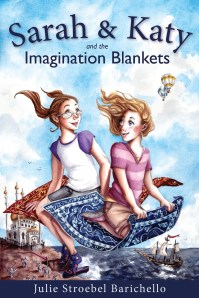
SKIB coverSARAH & KATY AND THE IMAGINATION BLANKETS is now available (hooray!), just in time to order for Christmas. My debut children’s chapter book follows the adventures of two sisters, ages 7 and 8, who imagine grand adventures with an object as simple as a blanket.

You can buy the book here.

Also, you can follow me on Goodreads to stay informed on upcoming book giveaways and promotions!

Posted in Writing | Tagged , , , | 1 Comment

Launch of ‘Sarah & Katy and the Imagination Blankets’ almost here

It has been another exciting week at La Casa Barichello.

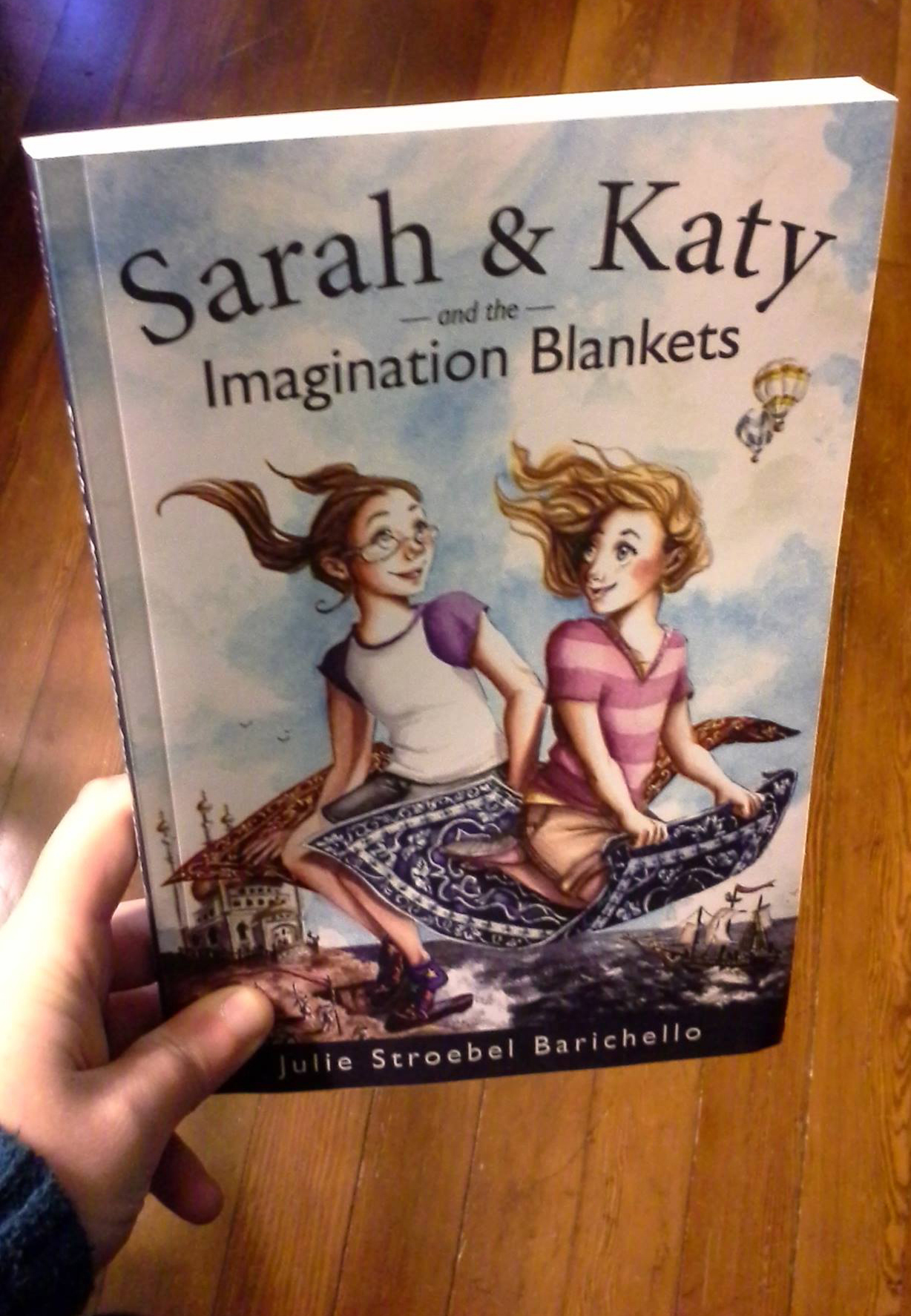
On Tuesday, the proof copy of SARAH & KATY AND THE IMAGINATION BLANKETS arrived in the mail. I may or may not have spotted it sticking out of the mailbox and nudged (shoved?) Derek aside on my dash to snatch it after we got home from work.

It’s one thing to see the layout and proof them on standard 8.5 x 11 copy paper. It’s another thing to hold a bound copy of the book and realize, “This is a reality.”

SKIB proofThe book release previously was set for the first week of December, but our publishing progress has been fortunately ahead of schedule, which may allow me to release it the last week of November. (Only four weeks away!) That offers an extra week of shipping time for anyone who would purchase the book as a Christmas gift for the 7- to 10-year-olds in their lives.

More information will be posted here and on my Facebook page, www.facebook.com/jsbarichello, closer to the release date. An official release date and purchase information will be shared as soon as it is available.


Posted in SKIB | Tagged , , | 1 Comment

In defense of NaNoWriMo and #amwriting

With the approach of NaNoWriMo in T-minus 10 days, I have seen many #NaNoWriMo and #NaNoPrep hashtags among the people I follow on Twitter, as well as the ever-present #amwriting.

And with the approach of NaNoWriMo comes the relatively recent tradition of bloggers espousing their hatred of NaNoWriMo, its participants and the hordes of aspiring “wannabe” writers flooding Twitter. They argue the notion of the masses writing a novel each November trivializes novel writing for “real” writers (or, as one blogger defined it, writers who get paid for their writing). They also take issue with the high volume of Twitter users who identify themselves as writers in their bios.

Group No. 1 (the WriMos and hashtaggers) doesn’t bother me — probably because I am one of them. Each year since 2009, I have participated in NaNoWriMo. In the times I get around to tweeting about something other than the prep football fans’ choice awards my newspaper is running, I slip in a tweet about NaNoWriMo or writing in general.

Group No. 2 (the angry bloggers) leaves me exiting blogs with a sigh. Rather than engage in the comments section, I resign myself to the knowledge that the blogger and I will never see eye-to-eye about NaNoWriMo and #amwriting.

In Defense of NaNoWriMo

I write year-round, but each November I look forward to a monthlong challenge devoted to my craft. It’s a fun challenge with a simple aim: to get people writing.

I was raised under an editor whose mantra is, “Make the world write.” That notion was a rallying point for me. Writing is therapeutic. Storytelling is important. People putting their stories into words matters.

Plenty of bloggers are quick to snub the idea that everyone has a story to tell, but I stand by my editor’s belief that everyone does, indeed, have a story to tell. At our newspaper, he and my husband (a reporter) implemented a feature called Life Story. My husband chooses a person from the obituaries each week and writes exactly what the name suggests: their life story. Each and every person has been fascinating, no matter how plain they seem at face value.

Their lives are incredible stories. Each person’s life is a story, and within each person are interesting stories, both fiction and nonfiction. (Some stories are a blend of both: embellished autobiography.) If only everyone took the time during NaNoWriMo to write those stories down.

Not every written word is publishable, nor is it meant to be. NaNoWriMo is simply an opportunity to encourage people to put pen to paper or fingers to keyboard. It’s like trying to shoot 50 or 75 free-throws in one minute. It’s fun. It’s practice. It’s a challenge. Nothing more.

That is not the least bit trivializing to published authors. Thousands of people writing novels for NaNoWriMo is no more trivializing to professional writers than children at a park shooting hoops is trivializing to NBA athletes.

I have NaNoWriMo projects that turned out to be nothing but writing practice. (That’s important for writers of any level, be they novices or veterans. The unpublished words are just as vital as the unpublished words — they are the hours of practice we put in before the big game. Even LeBron James has to show up for practice.)

The concession I will make to the anti-NaNoWriMo bloggers is when Dec. 1 rolls around and participants push unedited e-books into the market. Saturating the market with unpolished writing does no one a favor. Authors owe it to themselves and to readers to publish their books after revision, editing, and polishing.

In Defense of #amwriting and Other Writing Hashtags

When I see complaints on social media and in blogs about writing tweets and hashtags, I can’t help but wonder, why not just block those hashtags?

Ta-da! Problem solved!

Except the problem isn’t solved in the minds of those who hate the hashtags. It’s not seeing the hashtags that offends them. It is the fact those hashtags even exist.

I am a shameless #amwriting hashtagger. When I first discovered it about two years ago (when I finally started using Twitter regularly), I was excited to find an easy way to connect with other writers.

The majority of people who use #amwriting seem to be novice or intermediate-level writers, which is fine by me. (I consider myself in the intermediate range — I write a weekly column, occasionally freelance articles, and am releasing a self-published book in December.) I like following the tag to browse the content and links fellow writers share, whether it be book design tips from TheBookDesigner.com, comic strips about the writing process, articles from Writer’s Digest, or anecdotes of their own writing experiences.

The #amwriting personal anecdotes seem to be under particular fire from the hashtag’s haters. While nonwriters might find them tedious or dull, I find them communal and entertaining. As a fellow writer, I can relate to the anecdotes. It’s nice to know others  can share my experiences and dilemmas. And it’s nice when others are there to support each other in victories and disappointments.

#amwriting is a community. It’s a way for writers to interact, support each other, and relate. For those who use it, the hashtag functions as a virtual writing group with thousands of members. For those who have no use for it … well, there’s the obvious option of blocking it.

After all, it’s easier for one person to avoid and ignore content (s)he dislikes than to demand thousands of people censor themselves for his/her benefit. Particularly when the content is as harmless as #amwriting. To my experience, the writing community is supportive and embracing — given the rise of cyberbullying and the usual vitriol to be found on social media, a community like #amwriting users seems to be nothing to gripe about.

Posted in Writing | Tagged , , | 6 Comments

Today is National Day on Writing

Today is National Day on Writing, sponsored by the National Council of Teachers of English, the National Writing Project, and The New York Times Learning Network.

This year, according to the National Day on Writing web page, the theme is to write about our communities in any way we see fit.

In honor of National Day on Writing, I have shared below a column I wrote in December 2013 for The Times newspaper (Ottawa/Streator, Ill.) about the communities in which I leave and work:


(Originally published Dec. 2, 2013, in The Times newspaper)

How do I love this area? Let me count the ways

Carole Ledbetter had a great idea.

On April 25, Ledbetter — an Ottawa resident, author and frequent contributor to The Times — published a Write Team column listing her top 10 favorite aspects of Ottawa.

Wonderful idea. It gets all too easy to fall into a rut and talk about a city’s shortcomings or what it isn’t doing right.

After a year of living in Whiteside County, I found my nostalgia growing about La Salle County.

Now that I am back in the area, I am compelled to take a page out of Ledbetter’s book (ahem — I should say, column) and offer another 10 positive aspects.

But I’m adding a twist. As a former Ottawa resident who now lives in Streator, and in the spirit of being a 20-something columnist, I’m going to offer up 20 favorites — 10 for Ottawa and 10 for Streator.

OTTAWA

  • Downtown. My husband and I are walkers. Give us a stretch of sidewalk and we’ll go for a stroll. I especially love walking both sides of La Salle Street to check out the latest window displays in the storefronts and cutting through Washington Square for a stroll through the park.
  • Ottawa East Side Historic District. During downtown walks, we invariably head east down Main Street and then weave through Congress, Pearl and Chapel streets to view the many spectacular houses in the neighborhood and dream of owning one someday.
  • Thai Cafe. The Thai Cafe, 610 Columbus St., not only offers authentic Thai cuisine but also a great view of city life. I especially love a dinner for two on winter nights — who could resist a table near floor-to-ceiling windows looking out on Columbus Street’s bustle during a gentle snowfall?
  • The Cheese Shop. Another restaurant, I know. You’ll see a lot of these in my lists of favorites — I love food. But I also love novelties, which The Cheese Shop sells.
  • The Fox River aqueduct and the Illinois & Michigan Canal towpath. Getting back to the walking theme, treks down the I&M Canal towpath rank among my favorite outdoor activities.
  • Roxy Cinemas. Ottawa’s downtown theater at 827 La Salle St. is full of character. I particularly love the marquee. And the popcorn — even if you don’t have time for a movie, it’s worth stopping by just to sample the concession stand.
  • The Book Mouse. Every town should have a book store. Especially a book store that makes such an effort to carry books by local authors and be a host to community events.
  • Ice Odyssey. I promise I’m not just saying this because it’s winter and fresh on my mind. Ice Odyssey tops my list of must-go-to annual events. It’s free, and it’s like a chilly, outdoor art museum. Scarecrow Fest is a close runnerup.
  • The Times building. I know, I know. I might be a tad bit biased on this one. Back in November 2009 when I started working at The Times (the first time around), the building gave a distinct Daily Planet impression. (The Daily Planet is the newspaper in the Superman comic books.) Just call me Lois Lane. I love this old building.

STREATOR

  • Streator Public Library. Streator’s Carnegie Library is an impressive structure inside and out. From its brick facade to its rotunda, it brims with beauty. Not to mention books — full of books!
  • Mojitos. I warned you: I am a big fan of good food. Mojitos, 116 N. Bloomington St., is my favorite Mexican restaurant, especially for enchiladas. The restaurant serves a blend of Mexican and Italian cuisine.
  • Streator City Park. Covering four city blocks and home to playground equipment, old trees, picnic areas, the Plumb Pavilion and annual carnivals, it’s a great place to either get some exercise or relax on a bench with a book.
  • Streator Polar Pop. I will remain forever convinced Mountain Dew tastes better out of an aluminum can than a plastic bottle. Likewise, I maintain Polar Pops from the Bloomington Street Circle K in Streator are better than those at any other Circle K nationwide.
  • Parks and trails. As soon as temperature warms, my husband rounds up the disc golf gear and off we go to Marilla Park to play its 18-hole course. Other days we visit Spring Lake Nature Park to hike or walk the Hopalong Cassidy Trail, which conveniently is in walking distance from our riverside neighborhood.
  • Decorations. Light Up Streator goes the extra mile to make the downtown festive. Walking down Main Street and through City Park puts me in seasonal and holiday spirits. An added bonus is business owners who decorate their storefronts.
  • Architecture. Streator has four buildings on the National Register of Historic Places: the Majestic; the library; the Ruffin Drew Fletcher House, 609 E. Broadway St.; and the Silas Williams House, 702 E. Broadway St. Those aren’t the only attractive facades in town, though. The city is dotted with architectural gems — my particular favorite is the now-closed St. Anthony Catholic Church.
  • Majestic Theatre. The Majestic has an old-school charm and features the largest indoor screen in La Salle County. Sitting in the balcony and waiting for the curtains to part is my favorite moviegoing experience.
  • Heritage Park. This is perhaps the most underrated spot in Streator — and my favorite. The pocket park at the corner of Monroe and Main streets honors the city’s history and serves to beautify downtown — and offers me a great place to read and write in the heart of Streator.

That’s not the end of the list, though.

Anyone who kept tally will see only nine items on each list. (Be honest; you counted and thought I made an error, didn’t you? Gotcha!)

The 10th — and best — aspect I love about both cities?

They’re home.

Posted in Writing | Tagged , | Leave a comment

E-reading versus “p-reading”: Why e-books and print books each have their place

I used to be a book snob.

People would ask me if I read e-books, and I vehemently would reply, “Absolutely not!” My home was an obstacle course of print books stacked on every surface (floors included), thank you very much.

I swore I never would betray my love of “p-reading,” or reading print books, by reading an e-book.

“Never” met an untimely end last Christmas Eve when my sister gave me a Nook.

The smartest technology I owned before the Nook’s arrival was a 5-year-old Dell laptop and a secondhand Nintendo Wii. The Nook is the first touch-screen technology to take up residence in our home.

I was in the crowd of book-loving traditionalists who insist on experiencing the weight of a hardcover and the dusty smell of pages. But my tech-savvy sister was determined to upgrade me to the 21st century. So I fired up the Barnes & Noble device to give it try.

I scrolled through Facebook. I played videos on YouTube. I browsed Amazon. I (think I) successfully downloaded a free trial of a book before handing it over to my husband to play with.

But I didn’t read a book.

A week later, I came across a New York Times Sunday book review titled “How Do E-Books Change the Reading Experience?” Author Mohsin Hamid and journalist Anna Holmes weighed the pros and cons of e-reading versus p-reading.

“E-reading opens the door to distraction,” Hamid concludes. “It invites connectivity and clicking and purchasing. The closed network of a printed book, on the other hand, seems to offer greater serenity.”

Aha! So my years of insisting on reading print books were justified.

Then again — hadn’t I just read that article on my Nook?

During a Facebook session on the Nook, I stumbled across a debate on friend and fellow writer’s profile. The conversation was a tug-of-war over which was better: e-reading or p-reading.

The p-reading crowd was being particularly vocal (and a tad self-righteous) until my friend squashed it by saying, “Stop being so pretentious. Reading is reading, no matter the format.”

Her words resonated. She was right. Reading is reading — if one form can hook a person into a love of literature better than another form, then both clearly have a place.

I decided to give e-reading a try. I downloaded Jodi Picoult’s “The Storyteller” and read my first e-book.

The experience had its pros and cons. The battery had a tendency to die during marathon reading sessions, requiring an extension cord to run from the wall to the bed. The screen would dim or go black if I took too long reading a page. But it was easier to turn pages when the cat claimed my lap and pinned down my right arm — the swipe of a thumb could turn the page without disturbing His Royal Highness.

All in all, though, the experience could be summarized as: it felt like reading.

One benefit I can’t overlook is the price of e-books. I’d had my eye on “The Storyteller” for several weeks but didn’t want to spend the $10.79 for the paperback. Sales and discounts let me download the e-version for $4.99.

After swallowing the initial price of an e-reader, families could realistically download hundreds of books at a fraction of the cost of print books. The potential for bringing more books to children and families gives e-readers a significant place in my heart.

And let’s face it: By the time I have children, they are going to grow up in a technology age. They will have to have some contact, albeit it limited and monitored, with technology. E-reading is a healthy place to start.

Posted in Reading | Tagged , | 3 Comments