Expanding the imagination’s potential with exposure to other cultures

Brule

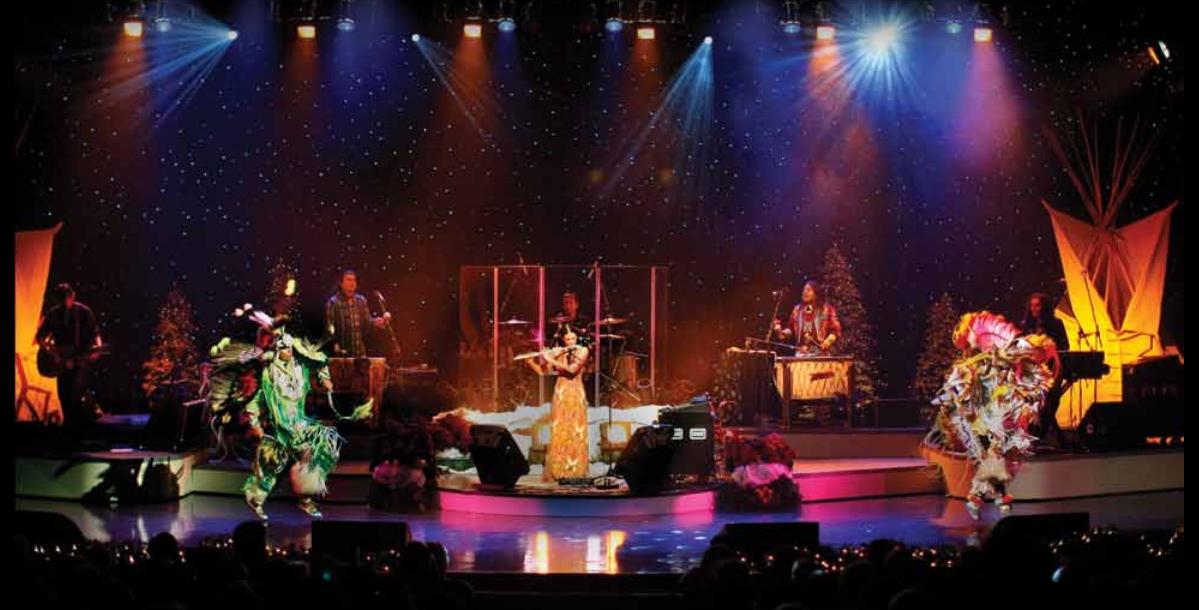
Image courtesy of Brule media kit.

I had the privilege to attend a Brulé concert Saturday night.

The contemporary Native American group describes its music as “a mergence of cultural rock and theatrical instrumentations” that features “the same contagious excitement as Trans Siberian Orchestra, Celtic Thunder, and Riverdance — but with the emotional impact of the American Indian culture.”

The performance includes traditional Native American music blended with modern rock, as well as Native American dancers who perform contemporized versions of traditional dance with elements of traditional garb.

Brulé received rave reviews in my home region of Starved Rock Country after a 2013 concert, so I made sure the husband and I got tickets for the 2014 show performed Dec. 6 at La Salle-Peru High School.

A noticeable portion of the audience was children. Several sat in the rows in front of the husband and I.

I was skeptical when I first saw the makeup of the crowd. Would two hours of Native American music and dance hold a child’s attention?

I needn’t have worried.

One little girl in particular I would estimate her to be 5 to 6 years old captured my attention as much as the dancers onstage.

Whenever one of the Native American women would perform  a dance, the little blond girl in front of me would stand up on her seat and mirror the dancer’s hand gestures. She was completely captivated by the dancers, and at every opportunity, she pretended to be one of them.

Introducing children to other cultures and performances opens the gateway to imagination. I witnessed it happening Saturday night as the little girl watched wide-eyed, absorbing every moment, then reliving it in her imagination.

I watched as the family exited the auditorium, and every few steps the little girl would stomp a few Native American-inspired dance steps, mimicking the arm gestures she followed so faithfully during the performance. My own imagination ran away with her, picturing her the next afternoon tucking a feather in her hair and some Christmas jingle bells in her hands, performing her own version of the jingle dance (a Native American healing dance) over a stuffed animal or doll.

The Brulé performance serves as a bold reminder to introduce children to other cultures as often as possible. Not only does the introduction expand the reach of childhood imagination, but also through imagining, it helps them remember, internalize, and bond with that culture.

Below, for your enjoyment, is a video of a previous Brulé performance:


Posted in Unplugged imagination | Tagged , , | 1 Comment

Book signing @ The Book Mouse, 12-6-14

Thanks to all who were able to attend this morning’s book signing at the Book Mouse in downtown Ottawa, Ill.!

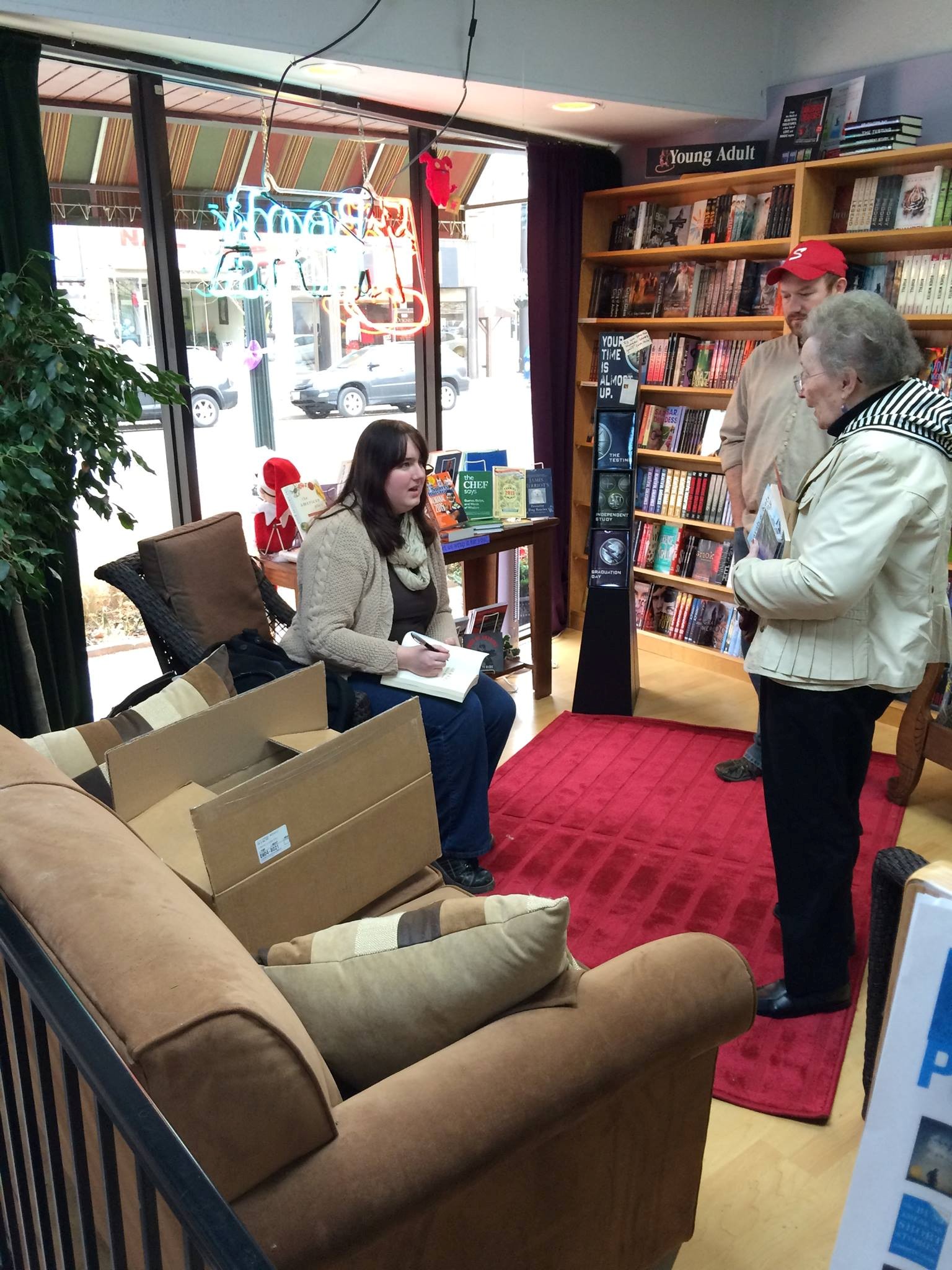
Bev Parsons (right) stops by the Book Mouse to get a copy of SARAH & KATY AND THE IMAGINATION BLANKETS signed by Julie Stroebel Barichello (left). Photo courtesy of Tim Kelleher

Bev Parsons (right) stops by the Book Mouse to get a copy of SARAH & KATY AND THE IMAGINATION BLANKETS signed by Julie Stroebel Barichello (left).
Photo courtesy of Tim Kelleher

It was especially nice to see the many relatives, friends and coworkers who showed their support, as well as the many new faces who are kind enough to give this book a chance. The highlight of the day, beyond all others, was meeting 8-year-old Marissa, from north-central Illinois. Her smile over meeting an author was humbling.

Meeting the readers is a vital reminder that the readers are one of the most important components of the writing process.

Thank you for the privilege of allowing me to tell you a story.

Posted in Writing | Tagged , , , | 1 Comment

Kids + cats + books = brilliant

I love cats. (One look at my cat-toy-covered floors and cat-fur-covered furniture is enough to show that.)

I also love books. (Just take a look at my permanently deformed shelves sagging under the weight of books.)

So when I heard about the Book Buddies program at the Animal Rescue League of Berks County, Pa., I was in love with the program.

If you’ve been on the Internet for more than 10 minutes in the past year, chances are you’ve seen this photo circulating:

2014-05-06-ColbyProcyk1-thumbShown is seven-year-old Colby Procyzk. In March, Colby’s mother, Katie, told the Huffington Post whenever she asked Colby to read, he would respond with tears and tantrums. That’s why his grandmother pointed them toward the Book Buddies program.

In a nutshell: The program seeks to achieve two goals of (1) socializing timid shelter cats and (2) improving child literacy by having children read aloud to the cats. Because the shelter cats tend to be calm and quiet, they offer a non-distracting audience for children. And being around people who are engaging in a calm activity allows the cats time to acquaint themselves with humans and overcome timid tendencies.

In her interview with the Huffington Post, Katie said her son looked forward to reading to the cats — so much so that he convinced his mother to adopt cats from the shelter so he can read to them at home. He no longer resists reading because he wants to spend time with the animals.

The program has signs of success. Katie said her son’s report card rose by two letter grades after he started reading to the cats.

The shelter has noted success, too. As parents and children visit the cats to read to them, the adoption rates are rising. Beth Ireland, the shelter’s communication director, told the Huff Post that “kids and parents have fallen head over heels and adopted [the cats] along the way.”

One of my nieces is a strong reader, although she would rather do something active than settle down with a book. She also happens to adore my skittish cat, Webster. Perhaps it’s time to take a page out of the Animal Rescue League’s book. Encouraging her to read to Webster might make her want to hold still for a while, and my chicken … ahem, I mean, my cat … may become a little more social in the process.


Posted in Reading | Tagged , , , | 2 Comments

Goodreads Giveaway!

Want another Christmas gift to put under the tree for a 7- to 10-year-old without having to buy it? Then enter for a chance to win 1 of 10 free copies of SARAH & KATY AND THE IMAGINATION BLANKETS on Goodreads!

Goodreads Book Giveaway

Sarah & Katy and the Imagination Blankets by Julie Stroebel Barichello

Sarah & Katy and the Imagination Blankets

by Julie Stroebel Barichello

Giveaway ends December 12, 2014.

See the giveaway details
at Goodreads.

Enter to win

The giveaway runs through Friday, Dec. 12, and is open to residents of the United States and Canada.

Posted in Writing | Tagged , , , | 2 Comments

Self-publishing by any other name

A trend has developed when I talk about SARAH & KATY AND THE IMAGINATION BLANKETS with friends, acquaintances, and complete strangers.

The conversation usually starts something like this:

PERSON: Wow! You wrote a book? Is it for sale anywhere?

ME: Yeah, it’s for sale online right now through the CreateSpace store and on Amazon. I’m working to get it on local bookstore shelves, too.

PERSON: So who published it?

ME: I did.

PERSON: Oh, it’s self-published? That’s cool.

Once they hit the word “self-published,” their smile becomes a bit forced, and “That’s cool” is code for, “That’s not a real book if you’ve self-published.”

It’s true that self-publishing can be a hairy industry. There are no quality control measures to prevent independent authors from pushing unedited, poorly constructed material into the marketplace.

Self-publishing is the writing industry’s version of the digital camera. These days, everybody and their grandmother can say they’re a photographer because there is a low barrier to get professional equipment. Access to a camera doesn’t make a person a great photographer; likewise, the accessibility of self-publishing doesn’t make some a quality writer.

But I also happen to know a great many talented, artistic people who self-taught themselves to handle a camera pretty darn well. They don’t identify themselves as photographers, but the accessibility to the equipment created opportunity. They dabbled, and it led to great things.

The accessibility to self-publishing means we may have to shake the pan a little harder to separate the dirt and pebbles from the gold, but it also leaves the opportunity for more gold to be found in the literary market.

Still, it’s hard to shake the self-published author stigma. People hear the words “self-published” and equate it with “poor quality.” That is a hard mountain to scale, particularly for independent authors who hire professional artists and editors.

As I noticed the conversation trend, I started steering future conversations a different direction. Exhibit A:

PERSON: Wow. You wrote a book? Is it for sale anywhere?

ME: Yeah. I decided to publish independently, so it’s not available in bookstores yet, although it should be on local shelves soon. The easiest place to get it right now is through Amazon, or I have a link on my website you can follow to purchase it.

PERSON: Awesome. What’s the title? I’ll have to search for it on Amazon.

I’ve stopped namedropping CreateSpace, and I’ve adopted the word “independent.” For some reason, being an indie author is more acceptable than being a self-published author. Perhaps the rising popularity of the Indie Film Festival has lent legitimacy to the idea of being an independent artist of any sort.

Guy Kawasaki and Shawn Welch, authors of APE: AUTHOR, PUBLISHER, ENTREPRENEUR, are trying to get the phrase “artisanal publishing” to take off in the industry. I have to confess, the phrase has a certain glamour and prestige to it. It feels almost superior.

Traditional publishing? Through a major publishing house? Pshaw. I insist on artisanal publishing.”

On their website, apethebook.com, Kawasaki and Welch write:  “Artisanal publishing features writers who love their craft, and who control every aspect of the process from beginning to end.”

In other words, it is self-publishing.

But it’s all about the perception. Never mind that self-publishing, indie publishing, and artisanal publishing are triplets — carbon copy DNA with different names; people treat the phrases differently.

I tested the phrase artisanal publishing on an acquaintance. When asked what it meant, I replied it meant taking artistic control over all areas of book production. Because I am a magazine/newspaper designer by day, I said I wanted to infuse my own creativity into the book design as well as the writing.

That was the first time I was praised for my decision to self-publish.

It seems self-publishing, by any other name, would sound sweeter to the masses.

Posted in Writing | Tagged , | 3 Comments