The best feedback I’ve ever received as a writer

Over the weekend, my family gathered at my parents’ house to celebrate my 28th birthday.

The family definitely knows me well and had the gifts to prove it: four boxes of banana-flavored Little Debbie Marshmallow Pies, newspaper-print Converse shoes, a birthday card from the husband featuring a stack of books that says, “Every love story is beautiful but ours is my favorite.”

(Never mind that it’s a Sweetest Day card, and he scratched out Happy Sweetest Day to say Happy Birthday — that just makes it more perfect.)

The best items handed to me, though, were two sheets of notebook paper bearing letters handwritten in pencil.

Sarah and Katy (my nieces, for whom I wrote SARAH & KATY AND THE IMAGINATION BLANKETS) wanted to give me thank-you notes for their Christmas gifts, which included a copy of the book and a blanket for each girl.

Their letters read:

Thank you for the imagination blankets! You were right about them being magic! And so me and Katy decided that we should go and go somewhere. And they worked! So then we went to the dessert and saw Bast! Oh, and by the way Ruddy came to! So did Dragon and Piggy. Well, when we went to Katarah anyway. We also went to the North Pole! Brrrrrr! At least we brought blankets, right? And best of all we saw Santa Claus! Oh, and by the way we will open your presents last next Christmas Eve because we know there will be something special inside it. Bye!

From Sarah

EPSON MFP image

and:

Thank you for the Imagination Blankets. Gusse what, we went in space, and we also saw Bast again. We also went to the dessert. Oh, we also brought Piggy and Dragon with us oh, we we also went to Katarah. And we went to the North Pole! Brrrrrrrrrrr! At least we brought blankets. Right? But at least we had each other! Bye

From Katy

EPSON MFP image

No fan mail or review can beat that. The story is in their hands now — I can’t wait to hear where there imagination blankets take them next.

Posted in Writing | Tagged , , , , , | 1 Comment

Take a deep breath, read a word at a time: A writer on reading reviews

The first few weeks SARAH & KATY AND THE IMAGINATION BLANKETS was listed on Goodreads, I checked the website obsessively multiple times per day.

I was both eager and anxious for that most important of components to a recently published book:

A book review.

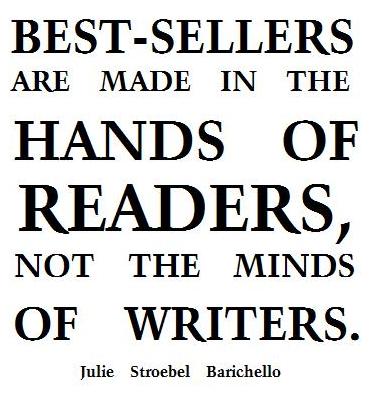
BestsellersQuoteA book can be either brilliantly crafted or horribly written, but its success doesn’t lie in its quality. It lies in how readers receive it. Best-sellers are made in the hands of readers, not the minds of writers.

So each day I held my breath, logged into Goodreads, and silently prayed, “Please don’t let the readers hate my book.”

Every writer goes through this at one point or another. The question, “Is it good enough?” leaves us paralyzed as we await the first judgment.

The first reader feedback was a star rating — Goodreads allows users to rate books from 1 to 5 stars. The first I received was a 5-star rating, which left me overjoyed (especially because the rating came from a stranger, not family or friends).

The second rating was 3 stars.

My heart plummeted into my stomach. Three means average. It means someone liked the book but didn’t love it. It means I’m a failure as a writer and might as well hang up my writing cap.

Then I kicked myself out of the melodrama, took a deep breath, and approached the rating rationally. The majority of books I read in 2014 were books I enjoyed, and I gave them 3-star ratings. They were good books. None of them made my favorite list, though.

OK, I told myself. I can deal with 3-star reviews. I can handle being a good book, even if I’m not a favorite.

The following days were gentler on my delicate writer’s ego, with a couple of 4-star ratings as well as two more 5-star ratings.

Then came the moment of truth: The first Goodreads reader review.

I considered calling the husband at work and making him read it first, then tell me whether I should eagerly read it or spend the next few days bracing myself for harsh criticism. But I took a deep breath (then another), and opened the review.

Goodreads user Brandi shelved my book under “unique-and-original,” and she wrote:

Julie Stroebel Barichello’s “Sarah & Katy and the Imagination Blankets” is a charming tale of two sisters who receive a couple of magical blankets for Christmas. The story is delightful and fun and the illustrations by Hannah Jones complement the story well and add to its charm. It’s easy to read and the banter between the two sisters, and the cast of characters they meet on their adventures, is relatable for young ones. I like the author’s choice for a quote at the beginning of the book as well. The concept of this book adds to its appeal, since many schools have eliminated music and art classes and young people’s playtime is usually spent on technological devices, there just doesn’t seem to be much in the way of encouraging them to use their imaginations any more. This book can do just that.
I won this book from Goodreads.com in exchange for a review. I highly recommend this book as it is charming and has language appropriate for its intended audience (no complicated words, profanity, etc.).

I exhaled. (Only noticing after I was done reading that I had held my breath.)

The constellation of other star ratings pale in comparison to that review. That is my shining star, my north star, the feedback I will forever remember as the first. It is my armor against negative reviews to come (because, inevitably, they will come). This is the review I will return to after reading the bad reviews, giving me the strength to go back and reread the bad reviews to sift for the nuggets of criticism and feedback that will strengthen future books.

Even knowing I have Brandi’s review to strengthen me, though, I bet I still hold my breath through reading the next one.

Posted in Writing | Tagged , , , , | 3 Comments

Borrowing a lesson from Disney to sell books

ONE DAY in college (I forget which class — maybe marketing, or a business course), the professor asked, “What does Disney sell?”

He wanted a one-word answer. There is one product, he told the class, that Disney sells. So what is it?

No one wanted to venture an answer. We knew it was a trick question. No one wanted to be the person to get it wrong.

The classroom fell completely silent (the way it does only when everyone goes stock-still, willing themselves into invisibility with the mantra, “Don’t call on me, don’t call on me”).  Our professor scanned the crowd, settling on me.

“Julie. What is the one product Disney sells?” he asked.

I tried to think on the spot. Disney made movies, but it also had toys, TV shows, clothing, two theme parks …

“Movies?” I guessed.

“Wrong,” he said.


I RECENTLY finished reading Scott Westerfeld’s AFTERWORLDS.

The book is dedicated to writers, particularly NaNoWriMo participants, and tells the tale of Darcy Patel. She is a NaNoWriMo writer who succeeds in signing a book deal and moves to New York at age 18 to enter the dazzling world of YA publishing.

Basically, a book written for writers as much as for readers.

The novel features a particular passage I found engaging, in which Darcy joins a book tour with peers Stanley Anderson and Imogen Gray. The trio are conducting a Q&A at a high school when a student asks which is most important to a novel: plot, setting, character, conflict, or theme?

Stanley says plot is most important. Imogen argues that characters are the most important. Darcy says they’re both wrong: conflict is the most vital part of storytelling.

In the four pages devoted to each character answering the question, examples are given for each argument. Darcy wins the competition for giving the best answer in the book.

But her answer may not be entirely correct.


“DOES EVERYONE give up?” my professor asked.

Yes, of course we did. And now we were hooked. We needed to know the one product Disney sells.

“Characters,” my professor said. “Disney sells characters. Everything else is secondary.”

The selling point of this mug isn't so much that it's a coffee mug; it's the character on the mug.

The selling point of this mug isn’t so much that it’s a coffee mug; it’s the character on the mug.

He explained Disney releases a movie featuring new characters. Those characters then are made into toys. They are placed on T-shirts, hats, backpacks, gloves, dresses, socks. The characters stroll the theme parks, where children can meet them and get autographs. The characters become Halloween costumes. They are put on miscellaneous merchandise, like coffee mugs and phone cases. (I’ll confess: I have a Belle coffee mug that says “It’s hard to be a beauty when mornings are a beast.”)

The characters are the driving force of Disney and are sold across all of the company’s platforms.

Of everything Disney fans adore, it all comes down to the characters.


ALL FIVE ELEMENTS of a novel are important, but as I read the debate scene AFTERWORLDS, I kept thinking about Disney and its characters.

The release of SARAH & KATY AND THE IMAGINATION BLANKETS has generated fun feedback, but there has been a trend in that feedback. As people tell me their favorite parts of the book, they never mention a setting, a plot point or the conflict.

They mention their favorite characters. (So far, Destrian Wain and Dragon seem to be in the lead for favorites, although the opossums got one vote from a relative.)

As I outline my next novel, I also realize how much of the other elements stem from the characters. Portions of the setting (such as the type of house and what is inside) depends on the personality of the character. Much of the conflict depends on characters, because their decisions and actions drive conflict. The same goes for plot.

When I write a book, I am — above all else — writing characters. When readers fall in love with characters, they care about what happens to those characters in the plot. They care about the conflict in which the characters find themselves.

Writing books means writing characters. Selling books means selling characters.

One of the most important writing lessons I learned in college wasn’t even taught in a writing course:

Disney sells characters.

And books do, too.

Posted in Writing | Tagged , , , , | Leave a comment

Why are readers scaling back on how much they read in 2015?

I am a devoted follower of Book Riot.

Bookriot.com is an online hub for readers to purchase book-related merchandise and talk about reading and writing. The articles posted on the site are composed by people who love adore worship (ah … there’s the right word!) the written word.

So why are so many Book Rioters committing to read less in 2015? Shouldn’t lovers of literature want to read more?

I already heralded blogger Jeremy Anderberg in my last post about my reading and writing resolutions for 2015, but I want to show him some more love by once again quoting his reasoning behind read fewer books this year:

It mostly comes down to me wanting to accomplish more with my free time than just reading. I want to write more, I want to craft more, I want to do more woodworking. […] I even want to just socialize more and spend more time catching up with friends on the phone or over coffee. I don’t want my default activity for free time to be to grab a book and go lay down on the couch in my basement.

I firmly believe that reading should compel us to growth. And at some point, a point which will be different for each person, it no longer does that. It reaches oversaturation. I believe I’ve hit that point. It’s really just a feeling I’ve had recently while reading that “this isn’t contributing to me — to who I am.” If we just read read read forever, what’s the point? Shouldn’t our reading compel us to action in some way?

Today, I also stumbled upon Jessica Pryde’s Book Riot blog post, Why I’m Not Participating in the Goodreads Reading Challenge in 2015.

Before I delve too much into Pryde’s experience with Goodreads challenge, I want to preface this by saying I clicked her link in wholehearted agreement. For 2014, I committed to read 30 books. As of today, my count stands at 25 1/2 books. (I’m halfway through Scott Westerfeld’s AFTERWORLDS, and I don’t predict I’ll finish it before 11:59 p.m. tonight.)

When I began to fall behind in the Goodreads challenge, I started reading for the sake of reaching a quota. Picking up a book became an obligation, not a pleasure. (Although once reading commenced, the pleasure returned.)

Pryde says it a bit more eloquently:

I was reading every chance I got. Not because I wanted to, but because I had to catch up. Have you ever gone onto Goodreads and seen that you were three books behind on your challenge? It’s nerve wracking! I felt like I ALWAYS had to be reading, no matter what else might be going on. The challenge was exacerbated by the guilt that I had so many books in the house, both paper and electronic, and felt that I needed to push through them.

So in 2015, I’m going to give myself a year-long thirtieth birthday present.

I’m going to give myself a break.

I should note that Pryde’s book tally was far higher than mine — in 2013, she read 189 books. Her reading goal for 2014 was 175 books.

That’s about six times as many books as I planned (and failed) to read.  Clearly her life was a bit more consumed by reading than mine was.

But that’s what brings us back to Anderberg’s point about reading compelling us to action. Reading is an important part of life, but it shouldn’t become life. Just as a healthy work-life balance is needed, so is a healthy reading-life balance.

Like Pryde, I am skipping this year’s Goodreads Reading Challenge. Although I still hope to read as many good books as life allows, I want to keep it fun and stress-free all year.

I’m still participating in a reading challenge of sorts for 2015, but I don’t plan to try to tackle all the different types of books on the list below. Instead, I plan to use it as a long-term scavenger hunt.

Goodwill Librarian


This challenge may take me one year, five years or a decade. Someday I’ll have all the boxes checked off. But the point is to keep it fun and non-demanding.

Readers are committing to read less to reduce quantity but improve quality. In my reading resolutions, I list more purposeful book selection as a goal:

I want to be more purposeful in what I read. Certainly, there will be books I grab off the shelf for sheer entertainment. But I need to stop reading for quantity (goodbye, Goodreads challenge) and read for quality. Likewise, I want to take time to savor and absorb what I read, not rush through one text so I can tally it off and then grab the next one to read as fast as I can.

Pryde concludes her blog with an excellent point:

There are all kinds of reading challenges people set for themselves, and they’re not always based on numbers. Some decide they’re going only read fiction, or read more books by women or authors of color.

For 2015, let’s make reading challenges more about content and less about numbers.

Posted in Reading | Tagged , , , , | Leave a comment

6 reading and writing resolutions for 2015

The year is winding down, which means everyone is gearing up to share their New Year’s resolutions.

I’ve already made a list of goals I want to accomplish (see my 29 Things to Do Before Age 29 on The Times website), but I also have a few reading- and writing-related goals I want to accomplish in 2015.

So here they are — six literary goals for 2015.

  1. Join two reading- or writing-related organizations. I have had my eye on a few organizations, both local and national, and want to join at least two of them. One is the Starved Rock Reading Council, a chapter of the Illinois Reading Council, which promotes literacy among all education levels. Then there is the Society of Children’s Book Writers and Illustrators, a national network of children’s book authors and artists. Another is the Friends of the Library, a group that raises money and donates time to the Streator Public Library. A fellow writer in Streator also has mentioned creating a writer’s group. Readers and writers should seize the opportunity to network with peers who share their literary interests and professional aspirations.
  2. Offer creative writing lessons to elementary school children. As solitary as writers and readers can be, most of us can’t resist “talking shop.” Leading a few creative writing lessons and activities — especially among young, wildly imaginative minds — is appealing. My goal is to pack up my writing experiences and visit a few local classrooms.
  3. Read less. When I first read the headline to Jeremy Anderberg’s Book Riot blog (“In 2015, I hereby resolve to read … less?“), I was a bit scandalized … and also knew there had to be a catch. So I clicked the link to read the blog. It turns out Anderberg has good reason to read a bit less. “It mostly comes down to me wanting to accomplish more with my free time than just reading,” Anderberg writes. “… I firmly believe that reading should compel us to growth. And at some point, a point which will be different for each person, it no longer does that. It reaches oversaturation. … If we just read read read forever, what’s the point? Shouldn’t our reading compel us to action in some way?”
  4. Be more purposeful in book selection. Hand-in-hand with reading less, I want to be more purposeful in what I read. Certainly, there will be books I grab off the shelf for sheer entertainment. But I need to stop reading for quantity (goodbye, Goodreads challenge) and read for quality. Likewise, I want to take time to savor and absorb what I read, not rush through one text so I can tally it off and then grab the next one to read as fast as I can.
  5. Write longhand and be more committed to journaling. A lot of great fiction pours forth at the keyboard, but writing longhand in journals always has been my way of letting my brain reset and find inspiration. In the past decade, my journaling has trickled down to a drip. This year will be the year I open the floodgates on journaling.
  6. Start my day with writing. On Jan. 2, I change from a day shift at our local newspaper to a night shift to work as the night editor. (This is a positive thing — I’ve never been much of a morning person.) This means my mornings are wide open now. Even though the plan is to sleep in a bit, I plan to start my day with writing when my mind is fresh and stress levels are low. (Rather than the alternative of ending my day with writing after hours spent at the office.)
  • What are your literary aspirations for 2015? Strike up a conversation in the comments below!
Posted in Reading, Writing | Tagged , , , , , , | 5 Comments