Christian Boer: The man who makes the world read

Imagine you’re reading on an e-reader. As you read, letters like a lowercase b flip upside down, mirroring to become a p. Or the horizontal line in a lowercase e disappears, leaving behind a c.

Soon, none of the letters look like they’re supposed to. The words become gobbledygook.

Welcome to the daily challenge faced by dyslexic readers.

The Dyslexia Center of Utah reports 1 in 5 people deal with dyslexia. The center’s research says dyslexic individuals are highly creative and intelligent. However, the learning disability makes it difficult to use and process linguistic and symbolic codes, particularly alphabetic letters representing speech sounds or number and quantities.

The inability to make sense of letters and numbers on a page is a setback for dyslexic learners. They miss out on learning opportunities as well as the simple pleasure of reading a novel for enjoyment.

Christian Boer is looking to change all that.

Christian Boer, Dutch designer of the font Dyslexie

Christian Boer, Dutch designer of the font Dyslexie

Boer is a Dutch graphic designer who created a new font, Dyslexie, as a thesis project at the Utrecht Art Academy in the Netherlands.

Boer knows firsthand the pains of being dyslexic — he, too, struggles to make sense of linguistics and letters. To counteract the challenges he faced, he created the typeface to make letters more distinguishable from each other, thus making it less likely for dyslexic readers to mix up similarly styled letters.

On his website, Boer says:

Traditional fonts are designed solely from an aesthetic point of view, which means they often have characteristics that make characters difficult to recognize for people with dyslexia. Oftentimes, the letters of a word are confused, turned around or jumbled up because they look too similar.

Dyslexie Font from Dyslexie Font on Vimeo.

Now that he created a font to make reading easier for dyslexic people, he’s taking it one step further.

He’s giving it away for free.

Boer’s website, dyslexiefont.com, details the mechanics of how the font was conceived and designed and how it helps dyslexic readers make more sense of symbols on a page. Moreover, he gives text layout tips for dyslexic readers, such as:

  • avoiding large blocks of texts by breaking them into more paragraphs and keeping line length short (six to nine words)
  • dividing texts into several columns with ample white space between
  • avoiding “justified” alignment, instead opting for a “ragged right” alignment

The font was developed in 2008 and released in English in 2011, according to a USA Today report. It has been used to publish several Dutch books, including translations of John Grisham novels and the Steve Jobs biography.

A concept as simple as changing the font — something we do in word processing programs with the click of a mouse — is bringing reading and learning to a staggeringly large portion of the population that previously was excluded from the joys of reading. A few newly shaped letters and numbers could revolutionize the learning process for people who previously struggled to make sense of pages set before them.

Boer will forever rank as an extraordinary man in my book. Reading is a vital part of learning and living. He is making a difference in the lives of thousands, one letter at a time.

Bravo, sir.

Posted in Reading | Tagged , , , , , | 1 Comment

Fun (and free!) children’s activity resources for parents, teachers

The F-word comes to mind when I brainstorm activities for kids that relate to SARAH & KATY AND THE IMAGINATION BLANKETS.

If you’re thinking of a four-letter F-word that is inappropriate at school, you’re on the wrong blog. The one I’m thinking of is “fun.”

But … there’s another F-word (incidentally, it is four letters) I love as well.

Free.

When I find activities that are both fun and free, I consider it a successful day.

In other news: Today was a successful day.

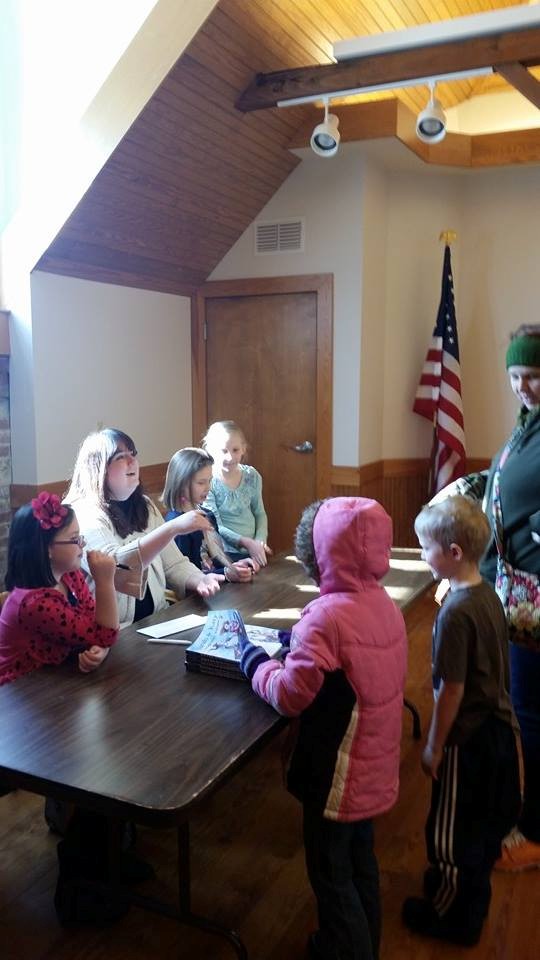
While planning for an upcoming book signing at Prairie Creek Public Library in Dwight, Ill., I decided I should bring some activity pages to hand out to kids. As much as I like to think my sparkling personality and elementary-level dialogue are fun and attention-grabbing, it helps to come bearing activities at a children’s book signing.

I decided to make word searches and a crossword puzzles to hand out with each signed copy of the book. The only cost would be the ink and paper to make a few copies.

The only dilemma was finding a way to easily and effectively create the puzzles.

Lo … behold the power of Google!

A simple Google search of “word search generator” and “crossword generator” produced two reliable (and free) sites to produce customized puzzles for the classroom or home. Word searches and crossword puzzles can be created to tie into recent studies, holiday festivities, and more.

Creating a word search. The top hit for custom word searches is Discovery Education’s puzzlemaker (check it out here). You can set the number of rows and columns, how frequently or minimally letters are shared among words, format (either text or HTML), and the clues.

An important thing to note when creating clues: If you have a two-word clue, don’t include a space or hyphen. (For example: The clue for Aunt Julie would be AuntJulie, with no space.) Otherwise, the puzzle generator will interpret the clue as two words, which will put Aunt on one end of the puzzle and Julie on the other end.

The formatting options are helpful, for the most part. Text allows users to copy/paste, and HTML allows users to print directly from the browser.

I like to have .jpgs and .pdfs when I share puzzles online, so I take the extra step of taking a screen shot (just hit the Print Scrn key on a PC, or Shift + Command + 4 to capture a portion of the screen on a Mac — just click and drag the crosshairs until you’ve highlighted the portion of the screen you want to crop). I then upload the screenshot to my website.

Be sure to download the answer key before you exit the word search generator.

  • Download a copy of the SARAH & KATY Word Search here.

Creating a crossword puzzle. These crossword puzzles won’t look like the modular squares you find in your Sunday Tribune, but they are user-friendly for kids and easy to generate.

I use The Teacher’s Corner for this puzzle (check it out here). Under the entry fields for adding clues and answers, there are two notable check boxes: Make a Line for Name, and Show the Word Bank. The first puts a blank line with “Name:” at the top of the page, and the second adds a word bank to accompany the clues. For my audience of 7- to 10-year-olds, I added the word bank. (Particularly to assist with spelling of the more obscure answers, like Katarah or Kamaria.)

Unlike the word search, the crossword puzzle generator allows you to include spaces with clues; however, if a space is in a clue, it adds an extra box on the crossword puzzle. I recommend omitting spaces and telling children that the clue is two words, but there’s no space between them in the puzzle. That tends to avoid confusion.

This software has an additional cool factor for my design nerd side: After clicking Make Crossword Puzzle, users can manipulate the puzzles design in basic ways. Fonts can be changed, an image can be added (although I don’t recommend this; it’s difficult to move or manipulate the image), and the cell background color can be changed under Advanced Options. Also dear to my heart is the Create PDF option.

As with the word search generator, remember to download the answer key before exiting the website.

  • Download the SARAH & KATY Crossword Puzzle here.

If you know of any other fun and free activities teachers and/or parents can create, please share your tips in the comments!

 

Posted in Unplugged imagination | Tagged , , , , , , | Leave a comment

The best feedback I’ve ever received as a writer

Over the weekend, my family gathered at my parents’ house to celebrate my 28th birthday.

The family definitely knows me well and had the gifts to prove it: four boxes of banana-flavored Little Debbie Marshmallow Pies, newspaper-print Converse shoes, a birthday card from the husband featuring a stack of books that says, “Every love story is beautiful but ours is my favorite.”

(Never mind that it’s a Sweetest Day card, and he scratched out Happy Sweetest Day to say Happy Birthday — that just makes it more perfect.)

The best items handed to me, though, were two sheets of notebook paper bearing letters handwritten in pencil.

Sarah and Katy (my nieces, for whom I wrote SARAH & KATY AND THE IMAGINATION BLANKETS) wanted to give me thank-you notes for their Christmas gifts, which included a copy of the book and a blanket for each girl.

Their letters read:

Thank you for the imagination blankets! You were right about them being magic! And so me and Katy decided that we should go and go somewhere. And they worked! So then we went to the dessert and saw Bast! Oh, and by the way Ruddy came to! So did Dragon and Piggy. Well, when we went to Katarah anyway. We also went to the North Pole! Brrrrrr! At least we brought blankets, right? And best of all we saw Santa Claus! Oh, and by the way we will open your presents last next Christmas Eve because we know there will be something special inside it. Bye!

From Sarah

EPSON MFP image

and:

Thank you for the Imagination Blankets. Gusse what, we went in space, and we also saw Bast again. We also went to the dessert. Oh, we also brought Piggy and Dragon with us oh, we we also went to Katarah. And we went to the North Pole! Brrrrrrrrrrr! At least we brought blankets. Right? But at least we had each other! Bye

From Katy

EPSON MFP image

No fan mail or review can beat that. The story is in their hands now — I can’t wait to hear where there imagination blankets take them next.

Posted in Writing | Tagged , , , , , | 1 Comment

Take a deep breath, read a word at a time: A writer on reading reviews

The first few weeks SARAH & KATY AND THE IMAGINATION BLANKETS was listed on Goodreads, I checked the website obsessively multiple times per day.

I was both eager and anxious for that most important of components to a recently published book:

A book review.

BestsellersQuoteA book can be either brilliantly crafted or horribly written, but its success doesn’t lie in its quality. It lies in how readers receive it. Best-sellers are made in the hands of readers, not the minds of writers.

So each day I held my breath, logged into Goodreads, and silently prayed, “Please don’t let the readers hate my book.”

Every writer goes through this at one point or another. The question, “Is it good enough?” leaves us paralyzed as we await the first judgment.

The first reader feedback was a star rating — Goodreads allows users to rate books from 1 to 5 stars. The first I received was a 5-star rating, which left me overjoyed (especially because the rating came from a stranger, not family or friends).

The second rating was 3 stars.

My heart plummeted into my stomach. Three means average. It means someone liked the book but didn’t love it. It means I’m a failure as a writer and might as well hang up my writing cap.

Then I kicked myself out of the melodrama, took a deep breath, and approached the rating rationally. The majority of books I read in 2014 were books I enjoyed, and I gave them 3-star ratings. They were good books. None of them made my favorite list, though.

OK, I told myself. I can deal with 3-star reviews. I can handle being a good book, even if I’m not a favorite.

The following days were gentler on my delicate writer’s ego, with a couple of 4-star ratings as well as two more 5-star ratings.

Then came the moment of truth: The first Goodreads reader review.

I considered calling the husband at work and making him read it first, then tell me whether I should eagerly read it or spend the next few days bracing myself for harsh criticism. But I took a deep breath (then another), and opened the review.

Goodreads user Brandi shelved my book under “unique-and-original,” and she wrote:

Julie Stroebel Barichello’s “Sarah & Katy and the Imagination Blankets” is a charming tale of two sisters who receive a couple of magical blankets for Christmas. The story is delightful and fun and the illustrations by Hannah Jones complement the story well and add to its charm. It’s easy to read and the banter between the two sisters, and the cast of characters they meet on their adventures, is relatable for young ones. I like the author’s choice for a quote at the beginning of the book as well. The concept of this book adds to its appeal, since many schools have eliminated music and art classes and young people’s playtime is usually spent on technological devices, there just doesn’t seem to be much in the way of encouraging them to use their imaginations any more. This book can do just that.
I won this book from Goodreads.com in exchange for a review. I highly recommend this book as it is charming and has language appropriate for its intended audience (no complicated words, profanity, etc.).

I exhaled. (Only noticing after I was done reading that I had held my breath.)

The constellation of other star ratings pale in comparison to that review. That is my shining star, my north star, the feedback I will forever remember as the first. It is my armor against negative reviews to come (because, inevitably, they will come). This is the review I will return to after reading the bad reviews, giving me the strength to go back and reread the bad reviews to sift for the nuggets of criticism and feedback that will strengthen future books.

Even knowing I have Brandi’s review to strengthen me, though, I bet I still hold my breath through reading the next one.

Posted in Writing | Tagged , , , , | 3 Comments

Borrowing a lesson from Disney to sell books

ONE DAY in college (I forget which class — maybe marketing, or a business course), the professor asked, “What does Disney sell?”

He wanted a one-word answer. There is one product, he told the class, that Disney sells. So what is it?

No one wanted to venture an answer. We knew it was a trick question. No one wanted to be the person to get it wrong.

The classroom fell completely silent (the way it does only when everyone goes stock-still, willing themselves into invisibility with the mantra, “Don’t call on me, don’t call on me”).  Our professor scanned the crowd, settling on me.

“Julie. What is the one product Disney sells?” he asked.

I tried to think on the spot. Disney made movies, but it also had toys, TV shows, clothing, two theme parks …

“Movies?” I guessed.

“Wrong,” he said.


I RECENTLY finished reading Scott Westerfeld’s AFTERWORLDS.

The book is dedicated to writers, particularly NaNoWriMo participants, and tells the tale of Darcy Patel. She is a NaNoWriMo writer who succeeds in signing a book deal and moves to New York at age 18 to enter the dazzling world of YA publishing.

Basically, a book written for writers as much as for readers.

The novel features a particular passage I found engaging, in which Darcy joins a book tour with peers Stanley Anderson and Imogen Gray. The trio are conducting a Q&A at a high school when a student asks which is most important to a novel: plot, setting, character, conflict, or theme?

Stanley says plot is most important. Imogen argues that characters are the most important. Darcy says they’re both wrong: conflict is the most vital part of storytelling.

In the four pages devoted to each character answering the question, examples are given for each argument. Darcy wins the competition for giving the best answer in the book.

But her answer may not be entirely correct.


“DOES EVERYONE give up?” my professor asked.

Yes, of course we did. And now we were hooked. We needed to know the one product Disney sells.

“Characters,” my professor said. “Disney sells characters. Everything else is secondary.”

The selling point of this mug isn't so much that it's a coffee mug; it's the character on the mug.

The selling point of this mug isn’t so much that it’s a coffee mug; it’s the character on the mug.

He explained Disney releases a movie featuring new characters. Those characters then are made into toys. They are placed on T-shirts, hats, backpacks, gloves, dresses, socks. The characters stroll the theme parks, where children can meet them and get autographs. The characters become Halloween costumes. They are put on miscellaneous merchandise, like coffee mugs and phone cases. (I’ll confess: I have a Belle coffee mug that says “It’s hard to be a beauty when mornings are a beast.”)

The characters are the driving force of Disney and are sold across all of the company’s platforms.

Of everything Disney fans adore, it all comes down to the characters.


ALL FIVE ELEMENTS of a novel are important, but as I read the debate scene AFTERWORLDS, I kept thinking about Disney and its characters.

The release of SARAH & KATY AND THE IMAGINATION BLANKETS has generated fun feedback, but there has been a trend in that feedback. As people tell me their favorite parts of the book, they never mention a setting, a plot point or the conflict.

They mention their favorite characters. (So far, Destrian Wain and Dragon seem to be in the lead for favorites, although the opossums got one vote from a relative.)

As I outline my next novel, I also realize how much of the other elements stem from the characters. Portions of the setting (such as the type of house and what is inside) depends on the personality of the character. Much of the conflict depends on characters, because their decisions and actions drive conflict. The same goes for plot.

When I write a book, I am — above all else — writing characters. When readers fall in love with characters, they care about what happens to those characters in the plot. They care about the conflict in which the characters find themselves.

Writing books means writing characters. Selling books means selling characters.

One of the most important writing lessons I learned in college wasn’t even taught in a writing course:

Disney sells characters.

And books do, too.

Posted in Writing | Tagged , , , , | Leave a comment