Pokemon, Harry Potter, Stranger Things … oh my

When Pokemon Go was released in early July, my Facebook feed of twenty- and thirty-somethings was filled with cellphone shots of Rattata, Squirtle, Pidgie, Bulbasaur, and Charmander sitting on their kitchen tables, in their yards, on their work desks.

At the end of the month, my Facebook feed again was filled with a common theme, this time the release of “Harry Potter and the Cursed Child.”

Many adults I know were more than happy to indulge in these “childish” pleasures. I was among the Harry Potter fans tweeting photos from the bookstore on release night and sharing my thoughts on the play a couple days later.

One reason twenty- and thirty-somethings love juvenile pop culture with roots in the ’80s, ’90s, and ’00s is because it takes us back to our childhood. But for every five lovers of Pokemon and Harry Potter, there’s bound to be a hater in the ranks.

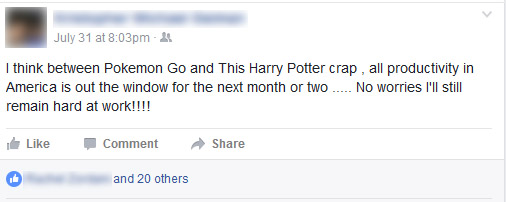
One Facebook friend had this to say:

FacebookPost

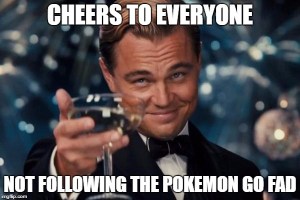
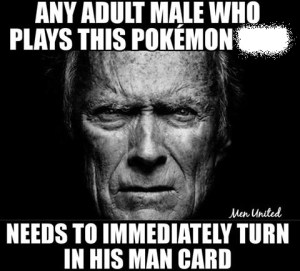
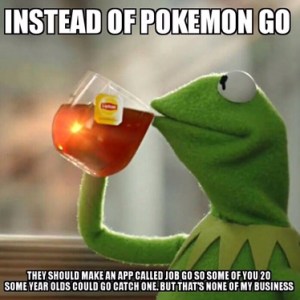
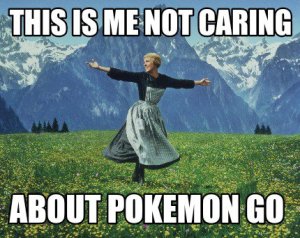
And then there were memes like these:

Meme4

Meme3

Meme2

Meme1

An article on Discover Magazine’s website, The Psychology of Pokemon Go Haters, explains one reason why some people were quick to share their dislike of the mobile augmented reality game and the latest Harry Potter installment:

Facebook and Twitter are quick and easy ways to push against the grain and shed the Average Joe status, and dissing a wickedly popular game may be a way to recover a desired status. Adam Arvidsson and Alessandro Caliandro analyzed nearly 9,000 tweets about Louis Vuitton using a qualitative research method called netnography. Based on their analysis, the experience for many users was simply about exposure, building a reputation and getting the satisfaction of a “like” from an anonymous person.

Despite memes’ accusations of Pokemon Go and Harry Potter fans being lazy, jobless, overgrown children, the fans among my Facebook friends are hardworking adults. Moreover, they’re balanced people who manage the responsibilities of adulthood while finding joy in both adult and childhood pleasures. They can enjoy their appletinis and late bedtimes as much as they love the nostalgia of revisiting much-loved characters.

A different sort of nostalgia

There are plenty of adults who want to put childlike things behind them. They associate Pokemon Go and Harry Potter with immaturity. (Wrongly so, in my opinion.)

But I think that’s why those same adults love “Stranger Things.”

Stranger

The Netflix original series is a blend of genres — horror, mystery, sci-fi, thriller. The show feels like a merger of Steven Spielberg’s “E.T.” and a Stephen King novel adaptation.  Its target audience is adults, but the main characters are a band of junior high-aged kids. Set in the 1980s, the show is as much about the plot and characters as is it about paying homage to the decade of its setting.

Like Pokemon Go and Harry Potter, the reason many adults adore the Netflix program is because it lets us relive parts of childhood. There’s a difference, though.

I think the reason some adults aren’t ashamed of joining the “Stranger Things” pop culture bandwagon while simultaneously spreading vitriol about Harry Potter and Pokemon boils down to target audiences. “Stranger Things” is clearly marketed to an older audience, while the others are marketed to a spectrum of ages, including children. Accessibility to children makes it “immature,” which chafes the pride of certain adults. (I speak from speculation and not from any expertise in psychology.)

Not everyone has to love every pop culture phenomenon. I’m not a Pokemon Go player, and I was only a passive Pokemon television watcher as a kid, but I’m not offended that other adults are passionate about it. Falling back on a cliche, “To each their own.”

Meanwhile, I’ll be over here reading Harry Potter and “Stranger Things” fan theories …

Posted in Writing | Tagged , , | Leave a comment

BRB; I have to finish sniffling over this Harry Potter thread

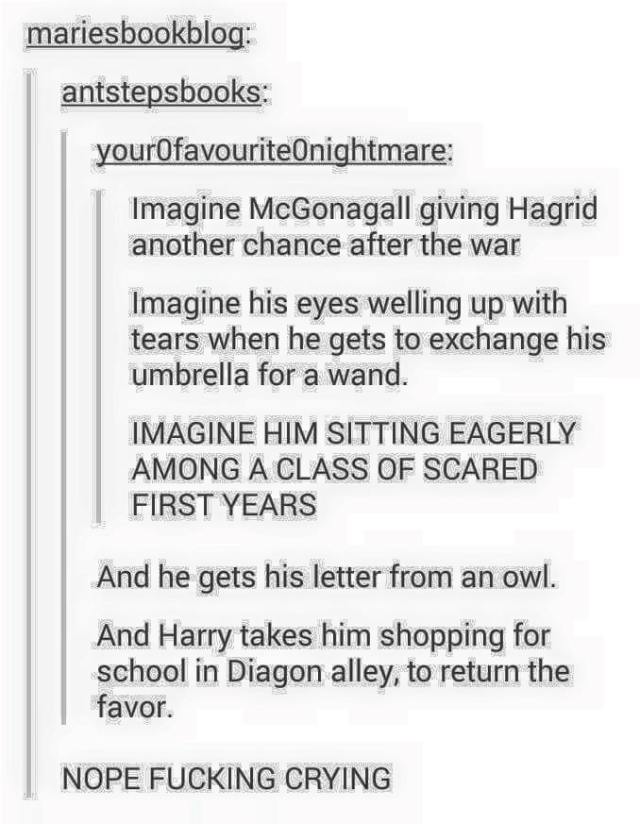
I came across this exchange this afternoon while wasting time online (be warned that the image below contains a curse word):

13658973_1093052234082800_522038362026413615_n

My first reaction to this thread was to tear up a little. Like most Harry Potter fans, Rubeus Hagrid has a special place in my heart. Hagrid and his pink umbrella were the first exposure to Hogwarts that Harry and his readers ever received. (When news that a character would die in the upcoming “Harry Potter and the Goblet of Fire,” I swore if it was Hagrid I would be done with the series.)

My second reaction to the thread was a deep appreciation for what J.K. Rowling has accomplished as a writer. She didn’t simply create a story; she created a rich, thriving, ongoing universe.

I don’t mean “ongoing” in the sense that the “Harry Potter and the Cursed Child” script will be released at midnight Sunday, July 31 (which is Harry’s birthday, incidentally), or that the movie “Fantastic Beasts and Where to Find Them” is coming to theaters (which is set in the Harry Potter universe but doesn’t feature Harry himself).

I mean “ongoing” in the sense that the universe is so vast, so well-created, that fans can continue the story in a myriad of beautiful, believable ways. Such as the thread speculating that Hagrid, who was denied his magical education due to false charges of a crime, could finally become a full-fledged wizard.

Good ol’ J.K. truly did create magic with her books. She planted that seed of imagination in all of her readers, and that seed has grown and flourished in every mind. An entire Enchanted Forest of new ideas lives in her universe. One of the trees in that forest (that goes by the username your0favorite0nightmare)  dropped a new seed to plant in the forest: a seed in which Hagrid gets his magical education.

As a reader, I love her books. As both a reader and writer, I admire her ability to write universes.

Posted in Writing | Tagged , , , , , | 3 Comments

What the #$@& to do about profanity in middle grade fiction

One year my Battle of the Books reading list contained “The Runner,” by Cynthia Voigt.

Battle of the Books was an annual in-school competition that allowed students to sign up as teams of four, read a list of books issued by the librarian, and compete against other teams in a Jeopardy-style competition against other teams. Each book had a three-tier system of points: six points for answering the question correctly, four points for naming the author, and two points for naming the title.

The several weeks devoted to Battle of the Books were among my favorite of the school year. The competition was almost as fun as trying to read the entire list on my own.

But that year, there was one book I didn’t finish: “The Runner.”

The problem wasn’t that I ran out of time, nor that I couldn’t get my hands on copy (which was a frequent problem when half the student body was trying to lay hands on the library’s one or copies of each title). The problem was when I opened to the first page and reached the fourth paragraph. It said:

He was PO’ed, pissed off, he was royally pissed off, and he didn’t care what they thought. He didn’t give a royal fart for the two of them sitting at that table back in the kitchen.

Reading it as an adult, those two sentences don’t raise a red flag. I’d read right over them without a second thought. But as a grade schooler, I was stunned by the words. It wasn’t the kind of language I was used to in books.

Several pages further, a snippet of dialogue observed, “War is hell.” After that, I shut the book without bothering to place a bookmark. The next day I handed it back to Mrs. Spradling, our librarian, with the comment, “I can’t read this book. It has bad words.”

No one told me I wasn’t allowed to read the book. But I wasn’t allowed to talk that way at home, and I was rarely allowed to watch movies or TV programs with “foul language.” My mom was less than enthusiastic during my phase of using the word “crap” and was even less impressed by me labeling things “craptastic.” I never went so far as to use the word “piss” in childhood (there were some boundaries I wasn’t willing to test), and I certainly never used “hell” (or “bitch,” or “damn,” or “shit,” or the dreaded F word).

I assumed if I wouldn’t say it, I shouldn’t read it.

Profanity in literature and society

Brigham Young University researcher Sarah Coyne analyzed the use of swear words in 40 YA novels on the New York Times best-seller list for children in 2008. Her study, published in the May 18, 2012, edition of the journal Mass Communication and Society, reports 35 of the 40 books contained at least one instance of profane language.
Coyne found YA fiction contained an average of 38 profanities, with Sara Shepard’s “Pretty Little Liars” tallying as many as 80 uses.

This wasn’t the norm a few decades ago. Imogen Russell-Williams made this observation in a September 2010 installment of The Guardian’s book blog:

Swearing in children’s books, and even in books for teenagers, used to be pure anathema.  SE Hinton’s 1967 young adult novel “The Outsiders,” for instance, an emotionally-charged account of youthful gangs clashing in Tulsa, features no language more colourful than “Glory!”, “Shoot!” or a very occasional “Hell!”  On this side of the pond, Robert Westall’s 1975 Carnegie-winner “The Machine-Gunners” generated a sustained fuss over the inclusion of “bloody.”… Despite being set in second world war-torn England at a time of great fear and freedom for its child protagonists, and featuring a story saturated with exhilaration, danger and distress, the use of even a mild swearword was a step too far into realism for many parents and teachers at the time of its publication.

Even though literary cursing wasn’t the norm in many middle grade and YA classics, Tristin Hopper, of the National Post, reported a trend of swear words rising in art and pop culture since the 1960s.

“Expletives, once absolutely banned in public discourse, are now increasingly turning up in literature, television, the news media and even political speech,” Hopper writes.

He adds:

[T]he expletives “f—,” “s—” and “c—” are almost non-existent in printed books from 1820 all the way up to the mid-20th century. Then, around 1960, swear words of all kinds undergo a radical surge in popularity. By 2008, the word “f—” alone constituted 0.0006% of all printed words. S— scored even higher. Popular music, once a no-go zone for the slightest whiff of profanity — particularly on the radio — has become so open to colourful language that four-letter words now grace band names.

Curse words are becoming mainstream. So much so that they don’t blip on my radar when I read, listen to music, or watch television. It’s not uncommon to hear teenagers or younger children use profanities in public. So it’s no shock that teen literature (and in some instances, children’s literature) reflects that language. Using lingo in writing that is used regularly by readers gives writing a sense of authenticity.

But for writers, it begs the question: For what age of readers is it appropriate to include profanity? How much is too much? And in what circumstances should we use it?

Swearing among children
By the time I started school, I had a decent arsenal of swear words locked away in my head. Even if I didn’t use them, I knew them.

The fact is, profanity is everywhere. Even if parents aren’t using the words at home, little ears are like radars. They’ll pick the words up in public. From TV. And from other kids. Those words will end up in a child’s vocabulary no matter how hard a parent tries to avoid it.

Even so, many parents want to filter their child’s exposure to profanities. Some go so far as to campaign for banning books from the library so other people’s children won’t be exposed. (That’s a rant blog post for a different day.)

It’s understandable that parents want to filter what young children consume to make sure it’s age-appropriate.

Which leads to the question: When do curse words become age-appropriate?

My former English professor, Dr. Val Perry Rendel, has a thought on that: They’re always age-appropriate, she says. The trick isn’t learning at what age the words should be used, but in what context.

“Learning to wield the power of language effectively means not stripping it of any of its dimensions,” she writes in an essay published July 15.

Rendel has a young daughter of her own, and she isn’t holding back from letting her learn and wield swear words. She writes:

I don’t want her to “politely” ask the weird guy on the subway to please leave her alone – I want her to come out swinging, to not be afraid to bring out the heavy artillery when needed. I want her to be honest and loyal and upfront, confident and funny and strong, fearless and kind, to learn how to use language to shatter prejudices and chisel away at the patriarchy, one “goddammit” at a time. I also want her to learn to figure out when swearing will suit the context or accomplish a goal, and when it probably won’t. I can instruct her about this all day long, but the only way she’s going to develop this critical capacity is to practice it herself … and doubtless make a few mistakes along the way.

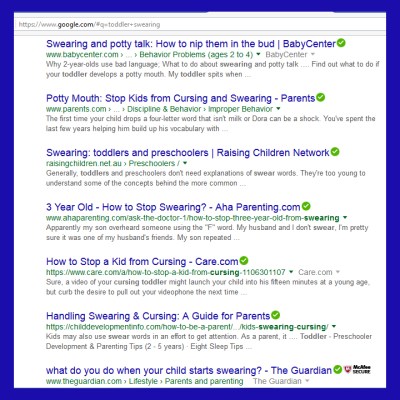
Not all parents have this approach, as Rendel points out early in the essay. “Apparently I’m supposed to feel some kind of shame or guilt for ‘teaching her’ to talk like this,” she writes. “The Google school of parenting seems to agree, because 100% of my searches on ‘toddler swearing’ yield results that focus solely on why it’s bad and how to make it stop.”

I conducted a quick Google search of “toddler swearing” to see what would come up. Four of the top seven hits shown below address how to stop swearing; another addresses “handling” it, while another asks what to do. None of the top hits encouraged letting children experiment with the words.
Swearing

How old to swear?

I tested another Google search, this time on what age it is appropriate for children to swear. Mostly, this pulled up Yahoo forums, and several parents responded with, “Never.” Another parent said it varies from household to household. No one offered a general age range.

I had better luck on a Circle of Moms forum, in which a parent said a 13-year-old asked if she could swear at home. These answers gave a bit more insight into when parents thought exposure to and use of foul language was allowable:

  • I’m 13 and i have the mouth of a trucker. You’re welcome.
  • I openly let my kids (daughters, ages 12 and 9) swear as much as they like at home as long as they don’t use racist terms or use them against family members in a hurtful way. They can use them in a conversational manner as much as they like. They have been taught, however, not to use them in certain situations where someone may object to them. I think kids should be allowed to use such words –they are just words, and it’s time we take away the taboo.
  • My husband says that children at age 13 should be able to use moderate swearings, but nothing directed to someone in an offensive manor.
  • It’s not okay to throw foul language around at our house no matter who you are. I think the odd curse word can be let go if something really awful happened and a strong word slips out … but I would not give my child permission to use crass language freely.
  • I think that 13 would be a good age, actually. My 10-year-old daughter asked me if she could swear. I said only the “c” word, “s” word, and the “a” word. Nothing else and that she may not use them frequently. I also told her she can only say [crap] in front of me.

The consensus seemed to fall into two groups: (1) it’s never allowable and (2) when children become teens.

So what about ‘bad words’ in kid lit?

One of my favorite moments in the Harry Potter series is when Molly Weasley steps into a duel against Bellatrix Lestrange and bellows, “NOT MY DAUGHTER, YOU BITCH!”

By the time “Harry Potter and the Deathly Hallows” hit the shelves, I was in college and had heard far worse than words like “bitch.” But the curse caught me by (pleasant) surprise. The reason being that Molly was always a mild, fretful, motherly type. She wasn’t the sort of character you’d catch bellowing “BITCH” in all of its caps lock glory.

That’s what gave it so much impact, though. The insertion of the swear word was used carefully and deliberately. Molly dived into the duel to protect her daughter from torture or death, and only an extreme circumstance could pull “extreme” language from her.

The rest of the series is incredibly mild in its cursing. Ron mutters “bloody hell” a few times, which is pretty mild for readers here in the U.S. In most other cases, J.K. Rowling simply writes, “Ron swore,” or “Harry swore.” She lets readers know the characters swore without using the words.

As a writer, I can appreciate this solution. It’s a middle ground of sorts. Readers know the character cursed without using the curse words.

Middle grade fiction is the gray area of deciding whether to use profanity. Rosanne Parry writes at The Mixed-Up Files of Middle Grade Authors:

The expectations for the use profanity in children’s fiction are pretty clear. It’s commonplace in YA novels and completely absent in picture books and easy readers. But middle grade fiction takes the middle ground. Is swearing okay in a middle grade book? Well, it’s complicated. The issue is balancing authenticity with respect for your audience. Everybody encounters profanity; it is a language intensifier and can be useful in conveying the weight and reality of your characters situation. And yet it is the nature of profanity to offend, so any use will have consequences in how the book as a whole is received.

In my own writing, I haven’t found cause to use swear words … yet. I’m sure I’ll encounter a character sooner rather than later who, if I met her/him in real life, would sprinkle in a curse now and then. I’m not opposed to using a “bad word” in a book (like when Molly shouts “bitch”), but it has to be used with intention. If it doesn’t serve a purpose other than shock value, it doesn’t have a role in the book.

No author should use words unnecessarily, but as a children’s author I’m especially aware of language and word selection. If there’s a way to write around profanity in kid lit without damaging the authenticity of a character, I do it. One method is to borrow Rowling’s “so-and-so swore” technique, but I believe Elizabeth Sims has the better strategy.

Sims offered advice on this topic in a Writer’s Digest post titled How to Use Profanity and Other Raw Talk in Your Fiction. Among her advice is this nugget:

[…] a writer can invent insults way more entertaining than those found in the standard lexicon. You can do it by brainstorming aspects of your characters and their circumstances:

  • He was as appealing as a baboon’s butt.
  • You are the worst thing to happen to the world since
    call waiting.
  • May you be condemned to an eternity of weak coffee, warm gin and a driveway paved with roofing nails.

Creating brand new insults, or even brand new curses (such as wizards exclaiming, “Merlin’s beard!” in Harry Potter) can get the same point across without alienating readers or their parents.

Banning books with ‘bad words’

I know I said earlier that banning books was another topic for another time, but I want to touch on it lightly here. I have two thoughts on banning children’s books over language.

  1. There is no such thing as a bad word. Words are arbitrary combinations of letters and sounds. We can assign a negative meaning, but negativity is not the same as “bad.”
  2. A book should never, ever be banned. Period.

I’m not opposed to books being flagged for age-appropriateness. I’m not going to crusade for “Lady Chatterly’s Lover” or “Lolita” to be stocked on the shelves of second-grade classrooms. But I don’t think books should be withheld just because they contain a bad word or two.

“Bridge to Terabithia,” which is one of the books I most highly recommend, contains a few swear words, including “damn” in the opening chapters. “To Kill a Mockingbird,” another favorite from my junior high days, says “goddamn whore.” The word “bitch” is used in “Where the Red Fern Grows” (although it’s used in the context of referring to a female dog).

All of those books were childhood favorites of mine. The themes and lessons well outweighed the instances of foul language. (In fact, I had to do Google searches to verify the presence of profanity in all three — the curse words are the least memorable part of the book and have no lasting impact.)

If I had a second chance at my grade school Battle of the Books experience, I would finish reading “The Runner” instead of banning myself from reading it.

I never did learn how the story ends.

Posted in children's literature | Tagged , , , , , | 7 Comments

The importance of boredom

boredomWhen I was a kid, it was usually around this time of year — at the height of summer vacation — that I started to get bored.

The novelty of being out of school would wear off as June melted into July. The newness of spending full days outside and staying up past my bedtime to read got varnished. Everything I couldn’t wait to do when I stepped off the bus on the last day of school had already been done.

Yup. I would get out of bed and wonder, “What am I going to do with myself today?” I’d slump down the stairs, swinging my arms gorilla-style, and look around for an activity.

Whenever boredom set in, a miraculous thing eventually would happen: I would get un-bored.

Boredom instigated creativity and independence. If I moaned to Mom about being bored, she would say, “If you’re bored, I can give you housework.” Inevitably I’d skedaddle and stop pestering her with complaints of having nothing to do. I’d go to my room or outside to find something to occupy my time.

Once I made a three-dimensional colt from construction paper and paper towel tubes rescued from the trash can. That was in the height of my horse obsession, after I’d already read and reread all of my Pony Pals and Thoroughbred and Saddle Club brooks. I spent an afternoon in my room pretending I ran a stable.

Another time I had a dog show with all of my Beanie Baby dogs. I repeated that game the next day, and again the next.

One summer I escaped Mom’s threat of chores by spending an afternoon at the backyard basketball hoop. I imagined I was the star player on a junior high team headed to a national championship. That evening I created a team roster for my team … then for all the opposing teams. I spent the evening pretending we were on a road trip and I was in a hotel. Over the next two weeks, I spent every non-rainy day at the basketball hoop, eliminating rival teams on a tournament bracket I created.

I loved that multiweek game of make-believe so much that I started writing it down. It eventually became the second novel I wrote in childhood, a 200+ page middle grade book titled “The Coach.” I started it that summer and finished writing in the midst of my seventh-grade year.

On rainy days, boredom usually was cured by books. If there wasn’t new reading material lying around, I’d comfort myself in an old favorite.

Parents, kids, and passing time

Last month, digital news outlet Quartz published the article advising parents not to fill every minute of their children’s day with fun and activities.

Instead, child psychologist Lyn Fry told Quartz that parents should fill their leisure time with activities that make them happy, and children should be left to discover their own happiness and interests during leisure time.

Except our society doesn’t like people to be bored or leisurely. Busy is the new normal. Ana Veciana-Suarez, of the Miami Herald, observes:

Our culture abhors boredom. It looks askance at unstructured time. Idle hands are the devil’s workshop and all that. If an adult is bored, it must be because she isn’t working enough or cultivating the people and the causes she should. And if a child confesses to this dullest of dull states, we sign them up for soccer or order them to pick up their bedrooms.

As a (hopefully) future parent, the pressure is intense. I don’t even have kids yet, and already I feel the need to be a “perfect” mom. My social media feed is full of women my age who share daily highlights of their mommyhood, from their homeschooling stories to sensory play strategies to elaborate photo collages showing the themed birthday parties they’ve arranged. They have blogs about day trips they take their kids on and hands-on activities they plan and cloth diapers they sew and lessons they teach (be it introductions to Spanish/French/sign language, cooking, crafting, etc.) …

For a long time, I aspired to be one of these mothers. The kind who devotes every minute of my life outside of work to my kids. The kind who makes sure every waking minute for the tiny humans in my house is fulfilling and magical and perfect.

Except that’s not the kind of person I am. And my desire to fit that role weighed me down. That method works for some moms, but I worried about how I wouldn’t fit that role. Because I value alone time. I need family and togetherness, but I also need independence and “reset” time.

My mom was attentive but left us to amuse ourselves much of the time. She went about her housework and errands while we played. She read books and watched TV programs that she enjoyed while we did the same in another room. She maintained her own identity as an individual person with independent interests and let us develop our own identities and interests.

There were times she would work with us on a craft or plan an activity. But there were plenty of summer days when she’d leave the job of entertaining ourselves up to us.

And on those days, I managed to find things to do.

Boredom isn’t bad

Even though I don’t have kids yet, the Quartz article let me breathe a sigh of relief. I won’t be a “bad mom” if I tell kids to amuse themselves instead of expecting me to cultivate entertainment 24/7.

Even better, the article says I’ll  be a good mom for telling kids to amuse themselves.

Fry, the child psychologist, told Quartz, “There’s no problem with being bored. … I think children need to learn how to be bored in order to motivate themselves to get things done. Being bored is a way to make children self-reliant.”

The article also states:

In 1993, psychoanalyst Adam Phillips wrote that the “capacity to be bored can be a developmental achievement for the child.” Boredom is a chance to contemplate life, rather than rushing through it, he said in his book On Kissing, Tickling, and Being Bored: Psychoanalytic Essays on the Unexamined Life. “It is one of the most oppressive demands of adults that the child should be interested, rather than take time to find what interests him. Boredom is integral to the process of taking one’s time,” added Phillips.

We should let ourselves (and our children) be bored sometimes so we can find new, pleasant ways to fill time. Veciana-Suarez, from the Miami Herald, proposes a good goal:

Think of boredom in another light: as the catalyst to creativity, as the pathway to invention, as proof that slowing time and delaying duty is a luxury in a hyper-connected world. Seems there’s a growing movement to bring back boredom, the kind that forces us to wonder about ourselves and about the world around us, the kind that shuns outside stimulation but produces private entertainment.

So this summer, slather on the sunscreen, make sure to stay hydrated and refuse a child’s panic call. Get bored. Discover the vastness of your mind and your imagination: the last unexplored frontier.

Posted in Children and Family | Tagged , , , , | 4 Comments

BOOK REVIEW: ‘Out of My Mind’ by Sharon Draper

I wanted to love this book.

I was introduced to “Out of My Mind” by fourth-graders at McKinley Elementary School in Ottawa, Ill. During a round of questions and answers, they asked me to name my favorite books, then shared their own favorites. Several students recommended Sharon Draper’s novel because their teacher was reading it aloud in class and they were enjoying it.

I promised the class I would add the title to my to-read list. So when I saw the book on display during a weekend visit to Barnes & Noble, I grabbed a copy. I got around to reading it this past week. My thoughts are below.

Plot

Out_of_My_Mind_novel_by_Sharon_Draper_book_coverMelody Brooks is a fifth-grader who longs to be able to talk to her classmates. It’s not that she’s too shy — the eleven-year-old has cerebral palsy and is unable to speak her thoughts. She lives her life strapped in her wheelchair to avoid falling out when her legs or arms spasm, and sometimes she can’t control the drool that dribbles from her mouth.

Despite her inability to control her body, Melody’s mind is perfect. She has a photographic memory and can memorize any fact shared with her. She has synesthesia, or the ability to see colors when hearing music. She longs to have a voice and speak her thoughts, but no one ever knows what she’s thinking.

That is, until her classroom aide does some research and discovers the Medi-Talker, a machine that will allow Melody to communicate with her family and classmates. Once she’s able to express herself, she tries out for the school quiz team to put her knowledge to good use.

Unfortunately, being able to speak her mind is only the first step of an uphill battle to be accepted by her peers.

My Thoughts (contains spoilers)

This book is a classic example of the importance of showing and not telling. I nearly gave up on the book in the first 90 pages. The first ten chapters largely consist of Melody narrating her family’s backstory and explaining multiple times why she’s frustrated at not being like everyone else.

The two-page first chapter is beautifully written. It’s poetic in its prose, musing about the power of words. It ends with a grabbing line that hooks the reader: “I have never spoken one single word. I am almost eleven years old.” We’re left asking, “Why has she never spoken?” And so we turn the page.

Then begins the exposition, in which very little action occurs during the next nine chapters. There are dozens upon dozens of anecdotes featuring bits of dialogue and actions, but they’re framed by Melody overexplaining them and analyzing them and telling the reader why they’re important.

The first ten chapters essentially function to paint the picture of Melody’s life with cerebral palsy. She tells about her infancy, and early childhood, and a visit to a doctor. She tells about every teacher from kindergarten to fourth grade and then describes every student in her special education class. Another chapter is devoted to describing her next-door neighbor, Mrs. V.

Seventy pages into the book, her baby sister is born when Melody is eight years old. This came as a surprise to me — first, because by chapter nine, she was only eight years old. At the end of chapter one, she mentioned being almost eleven, which seemed to set the stage for the story to tell us about her fifth-grade year, but I was still slogging through backstory trying to catch up to Melody’s current age. Second, it seemed odd to be introduced to everyone else in her life — her classmates, her string of lousy teachers, the neighbor — and then suddenly find out the story’s family dynamic was completely different because there was a baby sister in the picture. Sure, the story is chronological up to this point, but I was starting to feel like it was losing focus.

There is an explanation for this, if you read between the lines. The closing chapter explains that the book was written as Melody’s autobiography project for English class. It makes sense that a student would ramble with backstory. But to read between those lines, first you have to make it to the last page. Those early chapters risk losing readers.

But I stuck it out for the next twenty pages, and I’m glad I did. Because once you make it to chapter eleven, the story really begins.

“Fifth grade started a few weeks ago, and a couple of cool things happened,” the chapter begins. Aha! So we’ve finally caught up to Melody’s age. This is the chapter in which Melody gets to attend “inclusion classes,” which are certain class periods that allow her to leave the special education room and join “normal” classmates.

Over the course of the next few chapters, Melody joins the regular history class. Mr. Dimming is the history teacher and coach of the Whiz Kid quiz team. When he gives a practice test in class, Melody gets a perfect score. He chalks it up as a fluke and insults her in front of the other students, saying, “If Melody Brooks can win the first round, then my questions must not be difficult enough!” Her classmates accuse her classroom aide, Catherine, of giving her the correct answers.

Melody is heartbroken and bitter that people assume her mind is dysfunctional just because her body is different than theirs. She sulks over the day, but her family, Catherine, and her neighbor Mrs. V encourage her to try out for the quiz team. So she studies daily with Mrs. V and Catherine, and when the tryouts come around, Melody shows up, much to her classmates’ surprise and, in some cases, dismay.

She makes the team, but she doesn’t feel included. When they go to their regional tournament, they win. That means the group gets the chance to head to Washington, D.C., to play for the national title. Despite Melody’s contributions to the team, the other students are still uncomfortable around her and don’t fully include her.

BlogQuote

At this point, I expected the story to go something like this: The kids go to D.C., Melody comes through for them, they accept her as one of them, and Melody finally has friends and everything turns out swell.

Except that’s not even close to what happens. And it makes me appreciate Sharon Draper as a storyteller.

The national competition was scheduled for 7 p.m. on a Saturday evening in March. All of the teammates went out for breakfast together without Melody, then arrived early for their flight. They were scheduled for a noon departure, but it turned out the noon flight was being canceled due to bad weather in D.C. The airline bumped the team up to an earlier flight and got them to D.C.

No one told Melody’s family about the cancellation. When they arrive at the airport for the noon flight, they’re turned away. There’s no way to get to the competition in time. The whole family is outraged and heartbroken, and they return home. The team loses without Melody.

This is the climax of the book, and I was outraged and hurt right there with Melody. I was really caught up in the story through this point, but there’s a scene in which Melody’s little sister gets bumped by the car while her mom is backing out of the driveway, and that steals the show from Melody’s dilemma. It seemed like an attempt at a second high-emotion climax, and it actually killed the momentum of the story for me.

I was more interested in finding out what happened when Melody returned to school and faced her classmates, and instead the readers are yanked back into a scene of Melody reflecting on how frustrating it is that she can’t talk. She saw her sister run out of the house and behind the car, but she couldn’t warn her mother because she was strapped into the car and didn’t have her Medi-Talker to type out what was happening.

Yes, yes, we know. The entire first half of the book explained that Melody can’t communicate easily. The scene of the sister getting hit by the car robs the emotional impact of Melody’s situation with her team excluding her from the team breakfast and then abandoning her by not telling her the flight was canceled.

Despite the lack of action early in the book and the crippled climax, I still give “Out of My Mind” a solid three out of five stars on Goodreads. My three-star reviews mean I like the book and think it’s solid, although it’s not a favorite and probably not one I’ll read again.

The merit of this book is that it’s important for young readers (and in many cases, older readers, too) to get the perspective of those who are different than them. It’s good for readers to empathize when Melody’s sense of exclusion and to relate to the person beyond the disability. It’s a book that might make a student re-evaluate treatment toward a fellow student.

As I read the book, I was reminded of a student at my high school. Like Melody, she had cerebral palsy. I didn’t know her well and didn’t cross paths with her often, but my sharpest memory of her was from Halloween my senior year.

It was before school, and most of the student body was gathered in the commons waiting for the bell to ring. She was walking into the building with crutches when she slipped and fell. Many of us saw, but not a single student got up to help her. Myself included, much to my shame. A fellow senior sitting near me said loudly, “What did Gloria dress up as for Halloween? Oh, a retard!”

By this point, a teacher was helping her up. Students all around were laughing. I picked up my books and went to my favorite teacher’s classroom to avoid the scene. I was angry at my classmate for mocking her, but also ashamed at myself for not helping her up and not defending her.

I wish this book had been around when I was in elementary school and junior high. I wish it had been read aloud to my classmates. I wish I had more empathy and understanding toward students with disabilities.

That’s the kind of world this book will help build — one of inclusion and understanding, one reader at a time.

  • Out of My Mind, by Sharon Draper, 2010, Atheneum Books for Young Readers. 295 pages, readers age 10 and older (recommended for fifth through eighth grade). $8.99 paperback
Posted in Reading | Tagged , , , , , | 5 Comments