
One year my Battle of the Books reading list contained “The Runner,” by Cynthia Voigt.
Battle of the Books was an annual in-school competition that allowed students to sign up as teams of four, read a list of books issued by the librarian, and compete against other teams in a Jeopardy-style competition against other teams. Each book had a three-tier system of points: six points for answering the question correctly, four points for naming the author, and two points for naming the title.
The several weeks devoted to Battle of the Books were among my favorite of the school year. The competition was almost as fun as trying to read the entire list on my own.
But that year, there was one book I didn’t finish: “The Runner.”
The problem wasn’t that I ran out of time, nor that I couldn’t get my hands on copy (which was a frequent problem when half the student body was trying to lay hands on the library’s one or copies of each title). The problem was when I opened to the first page and reached the fourth paragraph. It said:
He was PO’ed, pissed off, he was royally pissed off, and he didn’t care what they thought. He didn’t give a royal fart for the two of them sitting at that table back in the kitchen.
Reading it as an adult, those two sentences don’t raise a red flag. I’d read right over them without a second thought. But as a grade schooler, I was stunned by the words. It wasn’t the kind of language I was used to in books.
Several pages further, a snippet of dialogue observed, “War is hell.” After that, I shut the book without bothering to place a bookmark. The next day I handed it back to Mrs. Spradling, our librarian, with the comment, “I can’t read this book. It has bad words.”
No one told me I wasn’t allowed to read the book. But I wasn’t allowed to talk that way at home, and I was rarely allowed to watch movies or TV programs with “foul language.” My mom was less than enthusiastic during my phase of using the word “crap” and was even less impressed by me labeling things “craptastic.” I never went so far as to use the word “piss” in childhood (there were some boundaries I wasn’t willing to test), and I certainly never used “hell” (or “bitch,” or “damn,” or “shit,” or the dreaded F word).
I assumed if I wouldn’t say it, I shouldn’t read it.
Profanity in literature and society
Brigham Young University researcher Sarah Coyne analyzed the use of swear words in 40 YA novels on the New York Times best-seller list for children in 2008. Her study, published in the May 18, 2012, edition of the journal Mass Communication and Society, reports 35 of the 40 books contained at least one instance of profane language.
Coyne found YA fiction contained an average of 38 profanities, with Sara Shepard’s “Pretty Little Liars” tallying as many as 80 uses.
This wasn’t the norm a few decades ago. Imogen Russell-Williams made this observation in a September 2010 installment of The Guardian’s book blog:
Swearing in children’s books, and even in books for teenagers, used to be pure anathema. SE Hinton’s 1967 young adult novel “The Outsiders,” for instance, an emotionally-charged account of youthful gangs clashing in Tulsa, features no language more colourful than “Glory!”, “Shoot!” or a very occasional “Hell!” On this side of the pond, Robert Westall’s 1975 Carnegie-winner “The Machine-Gunners” generated a sustained fuss over the inclusion of “bloody.”… Despite being set in second world war-torn England at a time of great fear and freedom for its child protagonists, and featuring a story saturated with exhilaration, danger and distress, the use of even a mild swearword was a step too far into realism for many parents and teachers at the time of its publication.
Even though literary cursing wasn’t the norm in many middle grade and YA classics, Tristin Hopper, of the National Post, reported a trend of swear words rising in art and pop culture since the 1960s.
“Expletives, once absolutely banned in public discourse, are now increasingly turning up in literature, television, the news media and even political speech,” Hopper writes.
He adds:
[T]he expletives “f—,” “s—” and “c—” are almost non-existent in printed books from 1820 all the way up to the mid-20th century. Then, around 1960, swear words of all kinds undergo a radical surge in popularity. By 2008, the word “f—” alone constituted 0.0006% of all printed words. S— scored even higher. Popular music, once a no-go zone for the slightest whiff of profanity — particularly on the radio — has become so open to colourful language that four-letter words now grace band names.
Curse words are becoming mainstream. So much so that they don’t blip on my radar when I read, listen to music, or watch television. It’s not uncommon to hear teenagers or younger children use profanities in public. So it’s no shock that teen literature (and in some instances, children’s literature) reflects that language. Using lingo in writing that is used regularly by readers gives writing a sense of authenticity.
But for writers, it begs the question: For what age of readers is it appropriate to include profanity? How much is too much? And in what circumstances should we use it?
Swearing among children
 By the time I started school, I had a decent arsenal of swear words locked away in my head. Even if I didn’t use them, I knew them.
The fact is, profanity is everywhere. Even if parents aren’t using the words at home, little ears are like radars. They’ll pick the words up in public. From TV. And from other kids. Those words will end up in a child’s vocabulary no matter how hard a parent tries to avoid it.
Even so, many parents want to filter their child’s exposure to profanities. Some go so far as to campaign for banning books from the library so other people’s children won’t be exposed. (That’s a rant blog post for a different day.)
It’s understandable that parents want to filter what young children consume to make sure it’s age-appropriate.
Which leads to the question: When do curse words become age-appropriate?
My former English professor, Dr. Val Perry Rendel, has a thought on that: They’re always age-appropriate, she says. The trick isn’t learning at what age the words should be used, but in what context.
“Learning to wield the power of language effectively means not stripping it of any of its dimensions,” she writes in an essay published July 15.
Rendel has a young daughter of her own, and she isn’t holding back from letting her learn and wield swear words. She writes:
I don’t want her to “politely” ask the weird guy on the subway to please leave her alone – I want her to come out swinging, to not be afraid to bring out the heavy artillery when needed. I want her to be honest and loyal and upfront, confident and funny and strong, fearless and kind, to learn how to use language to shatter prejudices and chisel away at the patriarchy, one “goddammit” at a time. I also want her to learn to figure out when swearing will suit the context or accomplish a goal, and when it probably won’t. I can instruct her about this all day long, but the only way she’s going to develop this critical capacity is to practice it herself … and doubtless make a few mistakes along the way.
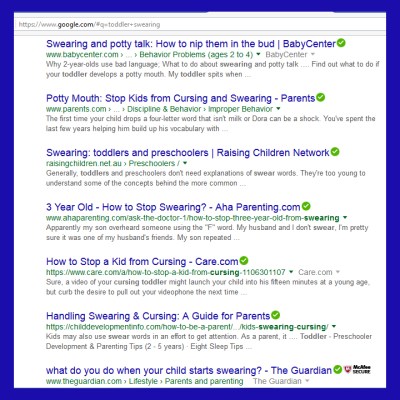
Not all parents have this approach, as Rendel points out early in the essay. “Apparently I’m supposed to feel some kind of shame or guilt for ‘teaching her’ to talk like this,” she writes. “The Google school of parenting seems to agree, because 100% of my searches on ‘toddler swearing’ yield results that focus solely on why it’s bad and how to make it stop.”
I conducted a quick Google search of “toddler swearing” to see what would come up. Four of the top seven hits shown below address how to stop swearing; another addresses “handling” it, while another asks what to do. None of the top hits encouraged letting children experiment with the words.
How old to swear?
I tested another Google search, this time on what age it is appropriate for children to swear. Mostly, this pulled up Yahoo forums, and several parents responded with, “Never.” Another parent said it varies from household to household. No one offered a general age range.
I had better luck on a Circle of Moms forum, in which a parent said a 13-year-old asked if she could swear at home. These answers gave a bit more insight into when parents thought exposure to and use of foul language was allowable:
- I’m 13 and i have the mouth of a trucker. You’re welcome.
- I openly let my kids (daughters, ages 12 and 9) swear as much as they like at home as long as they don’t use racist terms or use them against family members in a hurtful way. They can use them in a conversational manner as much as they like. They have been taught, however, not to use them in certain situations where someone may object to them. I think kids should be allowed to use such words –they are just words, and it’s time we take away the taboo.
- My husband says that children at age 13 should be able to use moderate swearings, but nothing directed to someone in an offensive manor.
- It’s not okay to throw foul language around at our house no matter who you are. I think the odd curse word can be let go if something really awful happened and a strong word slips out … but I would not give my child permission to use crass language freely.
- I think that 13 would be a good age, actually. My 10-year-old daughter asked me if she could swear. I said only the “c” word, “s” word, and the “a” word. Nothing else and that she may not use them frequently. I also told her she can only say [crap] in front of me.
The consensus seemed to fall into two groups: (1) it’s never allowable and (2) when children become teens.
So what about ‘bad words’ in kid lit?

One of my favorite moments in the Harry Potter series is when Molly Weasley steps into a duel against Bellatrix Lestrange and bellows, “NOT MY DAUGHTER, YOU BITCH!”
By the time “Harry Potter and the Deathly Hallows” hit the shelves, I was in college and had heard far worse than words like “bitch.” But the curse caught me by (pleasant) surprise. The reason being that Molly was always a mild, fretful, motherly type. She wasn’t the sort of character you’d catch bellowing “BITCH” in all of its caps lock glory.
That’s what gave it so much impact, though. The insertion of the swear word was used carefully and deliberately. Molly dived into the duel to protect her daughter from torture or death, and only an extreme circumstance could pull “extreme” language from her.
The rest of the series is incredibly mild in its cursing. Ron mutters “bloody hell” a few times, which is pretty mild for readers here in the U.S. In most other cases, J.K. Rowling simply writes, “Ron swore,” or “Harry swore.” She lets readers know the characters swore without using the words.
As a writer, I can appreciate this solution. It’s a middle ground of sorts. Readers know the character cursed without using the curse words.
Middle grade fiction is the gray area of deciding whether to use profanity. Rosanne Parry writes at The Mixed-Up Files of Middle Grade Authors:
The expectations for the use profanity in children’s fiction are pretty clear. It’s commonplace in YA novels and completely absent in picture books and easy readers. But middle grade fiction takes the middle ground. Is swearing okay in a middle grade book? Well, it’s complicated. The issue is balancing authenticity with respect for your audience. Everybody encounters profanity; it is a language intensifier and can be useful in conveying the weight and reality of your characters situation. And yet it is the nature of profanity to offend, so any use will have consequences in how the book as a whole is received.
In my own writing, I haven’t found cause to use swear words … yet. I’m sure I’ll encounter a character sooner rather than later who, if I met her/him in real life, would sprinkle in a curse now and then. I’m not opposed to using a “bad word” in a book (like when Molly shouts “bitch”), but it has to be used with intention. If it doesn’t serve a purpose other than shock value, it doesn’t have a role in the book.
No author should use words unnecessarily, but as a children’s author I’m especially aware of language and word selection. If there’s a way to write around profanity in kid lit without damaging the authenticity of a character, I do it. One method is to borrow Rowling’s “so-and-so swore” technique, but I believe Elizabeth Sims has the better strategy.
Sims offered advice on this topic in a Writer’s Digest post titled How to Use Profanity and Other Raw Talk in Your Fiction. Among her advice is this nugget:
[…] a writer can invent insults way more entertaining than those found in the standard lexicon. You can do it by brainstorming aspects of your characters and their circumstances:
- He was as appealing as a baboon’s butt.
- You are the worst thing to happen to the world since
call waiting.
- May you be condemned to an eternity of weak coffee, warm gin and a driveway paved with roofing nails.
Creating brand new insults, or even brand new curses (such as wizards exclaiming, “Merlin’s beard!” in Harry Potter) can get the same point across without alienating readers or their parents.
Banning books with ‘bad words’
I know I said earlier that banning books was another topic for another time, but I want to touch on it lightly here. I have two thoughts on banning children’s books over language.
- There is no such thing as a bad word. Words are arbitrary combinations of letters and sounds. We can assign a negative meaning, but negativity is not the same as “bad.”
- A book should never, ever be banned. Period.
I’m not opposed to books being flagged for age-appropriateness. I’m not going to crusade for “Lady Chatterly’s Lover” or “Lolita” to be stocked on the shelves of second-grade classrooms. But I don’t think books should be withheld just because they contain a bad word or two.
“Bridge to Terabithia,” which is one of the books I most highly recommend, contains a few swear words, including “damn” in the opening chapters. “To Kill a Mockingbird,” another favorite from my junior high days, says “goddamn whore.” The word “bitch” is used in “Where the Red Fern Grows” (although it’s used in the context of referring to a female dog).
All of those books were childhood favorites of mine. The themes and lessons well outweighed the instances of foul language. (In fact, I had to do Google searches to verify the presence of profanity in all three — the curse words are the least memorable part of the book and have no lasting impact.)
If I had a second chance at my grade school Battle of the Books experience, I would finish reading “The Runner” instead of banning myself from reading it.
I never did learn how the story ends.

 When I was a kid, it was usually around this time of year — at the height of summer vacation — that I started to get bored.
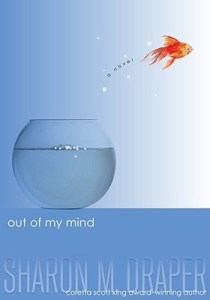 Melody Brooks is a fifth-grader who longs to be able to talk to her classmates. It’s not that she’s too shy — the eleven-year-old has cerebral palsy and is unable to speak her thoughts. She lives her life strapped in her wheelchair to avoid falling out when her legs or arms spasm, and sometimes she can’t control the drool that dribbles from her mouth.


