This is a great cover design concept

During a recent visit to Book World, I was browsing the classics section when I came across this:

Book design

Two different book covers that, when arranged side by side, create a single piece of art.

This isn’t a brand new concept (I see it on the spines of boxed sets all the time), but this example stood out to me. It’s a clever setup — one I’d like to try in the future. Perhaps there will be an opportunity to release special edition Sarah & Katy books that merge the covers someday.

This is a cover design concept I’ll definitely keep filed away for future series or books with sequels.

Posted in Writing | Tagged , , , , , , , | Leave a comment

Playing the role of writer needs to stop being a game

My life is role playing.

Yours, too.

Think about the roles you play. For me, the title roles are wife, journalist, aunt/sister/daughter, housekeeper, pet owner, writer. Each comes with its own responsibilities and duties.

Notice how writer fell at the end of the list. That’s how my writing role has felt lately – pushed to the background.

Notice how I also said each role comes with responsibilities and duties. Yes, to be a writer means you are duty-bound to produce something. That is as much a responsibility as spending time with family, taking out the trash, feeding the cat, and going to work.

Unfortunately, that’s not how writing gets treated by many writers. It’s considered a hobby, nothing more than a bonus if there are 15 minutes free to pound out a couple paragraphs on the keyboard.

This month marks the turning over of a new page for me, though. Writing will be a priority. I have put my foot down on that.

And boy oh boy, did I stub my toe when I put my foot down. Because let me tell you, it’s hard to make that commitment.

Serious writers know this already. Obstacles galore want to stand between you and the laptop. (Quite literally, in the case of Webster, the 18-pound purring machine who likes to wedge himself between me and the keyboard because heaven forbid I pay attention to something other than him for five minutes.)

Aside from oversized house cats, serious writers know the many other distractions and excuses that arise. I am, of course, the Queen of Excuses.

Let it be noted, if you are a loyal subject in my Kingdom of Excuses, I hereby banish you.

“But how do I proceed without excuses?” you might ask.

Here are some tips on the top excuses I’ve encountered and ways to combat them:

  1. I just don’t have time. Really? You don’t? Neither do I. Nor does any writer with full-time jobs and family commitments. You’ve heard it before, so I’ll say it again. Make time. Buy a voice recorder and talk out your ideas in the car. Save your novel on a flash drive or online so you can access it wherever there is a computer to write. Lock yourself in a room and nail a sign to the door saying, “Abandon all hope ye who enter here” and warn your family to stay out or else [insert horrific form of torture here]. Your day is busy. If you’re serious about writing, it’s about to get a whole lot busier. Even if it means giving up the hour you devote to your favorite TV show – catch it online later and get crackin’ on the keyboard for now.
  2. I’m out of ideas. Here is Part 1 of my two-part philosophy on inspiration: Write when you’re inspired. If you’re not near your novel, kick down doors, leap tall buildings and outrun speeding commuter trains to jot down your ideas. If you’re at work, take a bathroom break with a pen and notebook and quickly jot down your brilliant idea before you forget, then type it up as soon as you get home. Here is Part 2 of my philosophy: Write when you’re not inspired. It’s hard, and it’s agonizing, and it’s downright infuriating sometimes. You may end up writing 1,000 words you’ll throw out and never use again. Or you may end up finding inspiration along the way. The point is to write daily. Be consistent, even if you’re not in the mood to write. Take it from Brian A. Klems, online editor for Writer’s Digest magazine: “If you can’t carve out at least a short portion of your day to dedicate to writing, then you aren’t serious about finishing a manuscript.”
  3. I seriously cannot concentrate on this project today. That’s OK. Sometimes it’s good to take a break from your book or writing project. But don’t let the day get away without writing. Try your hand at a poem, or a short story, or just write little snippets of observations. Crank out a few writing exercises. Or go back and touch up sections you already have flagged as weak – make the dialogue more believable, slash out the overabundance of adjectives, cut a scene or two. Even if you’re not writing a fresh, brand new scene for your book, give your writing muscles a workout. Don’t let them atrophy from neglect.
  4. They gave me a guilt trip. If you’ve ever tried to turn down an invitation by saying, “Sorry, I need to get some writing done today,” you’re bound to get this reply at some point: “Fine. It’s nice to know your book is more important than I am.” The variations of guilt trips are endless. “You work on your book every day, but the last time we hung out was two weeks ago. Can’t you skip it for just one day?” It takes some juggling to give everyone – and everything – equal attention as a writer. Try explaining the book isn’t more important; however, it is very important to you, and you hope everyone will understand and support you as you work on undertaking the task. (That said, don’t hermit away and become a crazed, antisocial cat lady glued to the computer screen day and night.) It’s all about a healthy balance.Don’t let anyone talk you out of writing by making you feel guilty for it. One way around that is to set a specific hour as your writing time and let everyone know it. Then if they try to drag you away, say, “Don’t forget, 5 to 6 p.m. is my writing time. I’m free any time after 6, but not a minute before.”
  5. I just don’t feel like it. I don’t always feel like going to work, doing laundry, or emptying the litter box. I still do those things because I need a paycheck, clean underwear, and a carpet without cat urine stains. Not feeling like writing is not an excuse. You still have to do it for the sake of having a completed manuscript. Like I said, don’t let anyone – not even yourself – talk you out of writing.

Want to be a serious writer? When you play that role, don’t let it be a game anymore. Make it a necessary part of your life. And enjoy watching the words flow.

Posted in Writing | Tagged , , , , | 3 Comments

A house fit for an author

Exterior

For about five years, I’ve loved this house from afar.

I first encountered it when I met my husband. During our early dates, we would take long walks around his hometown of Streator, and I developed the habit of pointing out which houses I liked.

Each time we passed this one, I would pause for a second longer than I did for others and think, “Now that’s a house for a writer.”
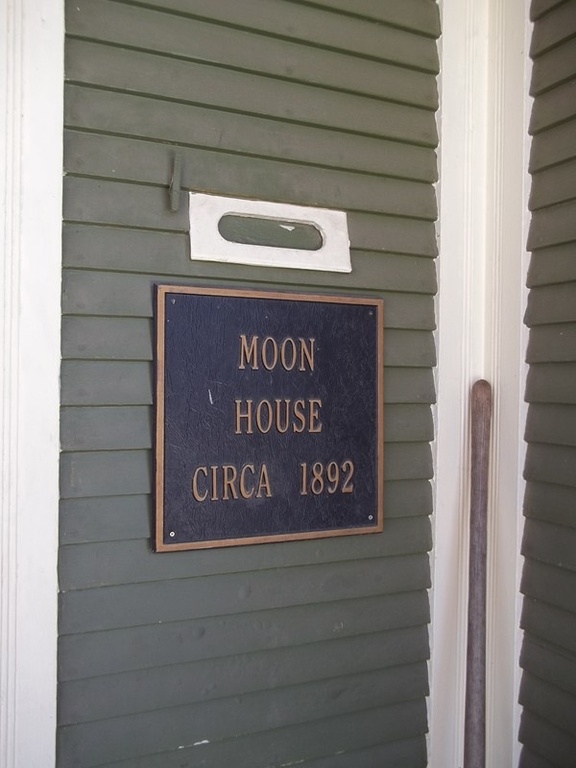
PlaqueKnown as the Moon House, the Queen Anne-style home was built in 1892 by Ammon B. Moon. (If that isn’t a great name for a literary character, I don’t know what is.) The Moon family is rooted in Streator’s history, and the house maintains much of its old-time feel.

It’s the kind of house that inspires a person’s imagination to run away. It’s the kind of house that encourages fantasies and daydreams.

It’s the kind of house that is now for sale.

The husband and I have (slowly) begun the process of searching for a home to buy and call our own. Last night I was browsing Zillow.com for Streator listings, I came across my beloved Moon House. Even though I’ve known for a few months that it’s been on the market, I deliberately avoided the listing. I didn’t want to know the price. I didn’t want my heart to break at not being able to afford it on a writer’s wages.

But Zillow sprang it upon me by surprise: $99,000.

Not outside the realm of possibility, but still a bit higher than the budget we set for ourselves.

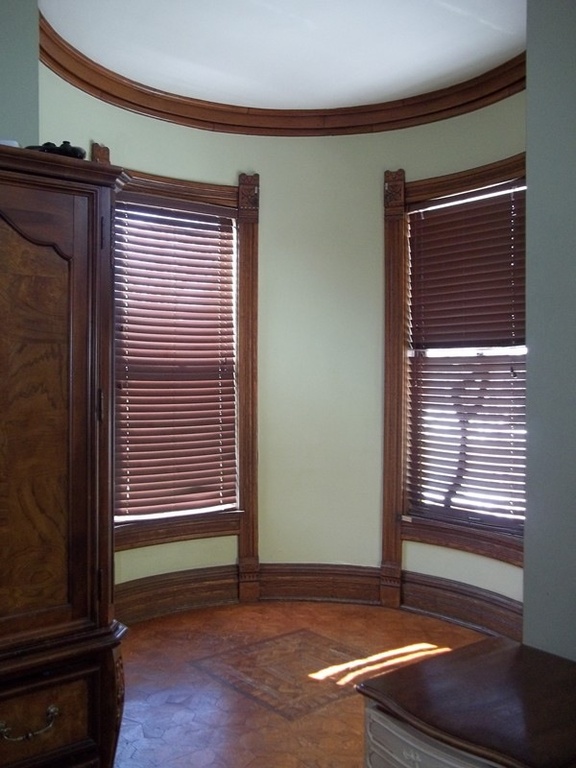
Round roomI went to bed with my mind firmly rooted in fantasy. With six bedrooms, the Moon House offers plenty of space for a master bedroom, rooms for two to three children, a library, and an office. The turret room would be the perfect place for a writing desk. (Plenty of sunlight, plenty of inspiration. I write best during the daylight hours.)

And I asked myself, $99,000 isn’t so bad, right? Maybe the owner is open to Rumplestiltskin-like negotiations. Here’s $85,000 and a promise of my firstborn.

(Just kidding, future firstborn.)

As I drifted off to sleep, I fell back on hoping for a fairy godparent to slip a lottery ticket into our hands that could give us a $15,000 boost to get the house of a writer’s dreams. If Cinderella could get a dress, coach, coachmen, glass slippers, and the works, surely it couldn’t be too hard for a fairy godparent to rustle up a scrap of paper with a few numbers.

Alas, I don’t live in a fairy tale.

Exterior 2In the daylight, I’m a bit more realistic. Think of the utility bills to heat the home in harsh Illinois winters. Imagine the extra time it would take to clean a house that size. We’re only two people right now; we can always start small with a three-bedroom starter home and upgrade when we need the space and don’t just want the space. There’s a family out there that needs this house, right?

Logic and reason don’t do much to mute the imagination, though. I can’t help daydreaming of a life spent writing behind those walls. It’s a home that sings its siren tune to creative people, saying, “Come to me. Create with me.”

Double doors(It just occurred to me how fantastic it would be to host a monthly book club in this house. Doesn’t that look like the perfect book club atmosphere?)

In the reality of daylight, I’ve accepted that the Moon House is outside of our price range. Dropping $15,000 from the price is an unreasonable offer to owners who have invested so much in restoring and maintaining this home, which may soon qualify to be added to the National Register of Historic Places.

But I have one dream for this house. I hope whoever buys it has a creative spirit. I believe there’s an author or artist out there who deserves a house like this. And I believe the house deserves a creative spirit or two who will draw inspiration from its character and setting.

I’ll be envious of the owner, but I’m willing to set that envy aside … as long as the buyer invites me over for book club.

  • A few more glimpses inside the Moon House (all photos in this post are from the Zillow listing):
Posted in Writing | Tagged , , , , , , , | 1 Comment

Overcoming the fear of writing children’s books

At first, I didn’t want to release Sarah & Katy and the Imagination Blankets to the public.

For five years, I had toiled and troubled over a novel with the working title Watchdog. The target audience was adults, and I worried that releasing a children’s book would compromise my future in adult fiction.

I had always visualized myself as a literary writer who would one day pen a Pulitzer prize-winner. Tagging the words “children’s author” to my identity seemed to overshadow dreams of a Pulitzer. So I planned to quietly (and privately) print a few dozen copies of the Sarah & Katy adventures via Lulu.com, distribute them amongst the family, and call it a day.

The plan changed as feedback came in from beta readers, family, and friends. I was encouraged to distribute the book more widely. Heartened (and a bit nervous), I began planning a full-fledged book release.

But in the back of my mind, the worry persisted: Am I boxing myself into a writing identity?

The worry dissipated from the moment my nieces received their copies of the book on Christmas Eve. And it continued to dissipate as I visited classrooms and met young readers and writers who were eager to talk about the story. Young readers made me proud to have “children’s author” attached to my name.

So I put Watchdog into my Incomplete Projects folder, dusted my hands, and walked away (mostly) content.

Until last night.

I’ve been reading Nancy Lamb’s book, The Writer’s Guide to Crafting Stories for Children, and in Chapter Nine she discusses Mario Puzo’s middle-grade novel The Runaway Summer of Davie Shaw. Most readers are familiar with Mario Puzo’s work … but not his middle-grade book about Davie Shaw.

They know him better for writing The Godfather.

This was a revelation for me. Authors could dip toes not only into the kiddie pool, but also the deep end?

I abandoned reading to visit Google. I wanted to hunt for other names that grace book covers in both the children’s and adult sections of the bookstore.

  • Antoine de Saint-Exupery, author of The Little Prince, won awards as a writer for older audiences before penning his famed classic.
  • Jerry Spinelli originally identified as an adult author and wrote four unpublished adult novels. However, he has published exclusively as a children’s author. (One of my husband’s favorite childhood writers, in fact.)
  • Goosebumps writer R.L. Stine released a horror novel for adults.
  • Judy Blume, best known for her works targeted toward middle schoolers, also has adult fiction.
  • Roald Dahl — my first thought was, “What?!” Dahl’s whimsical, wacky, and sometimes downright weird creations seemed exclusively suited to children, but Google led to two adult novels: Sometime Never: A Fable for Superman, and My Uncle Oswald.
  • A.A. Milne, creator of Winnie-the-Pooh, began with plays and a murder mystery. He continued to write adult fiction after he wrote Winnie-the-Pooh tales as well.

The list goes on — many familiar names swam double dipped in children and adult fiction. Some, like Daniel Handler (a.k.a. Lemony Snicket) published under different names for their children and adult works. (An idea I’ve considered for adult novels — I’ve toyed with the pen name J.S. Baric for Watchdog and other adult works).

Whatever name I publish under in the future, one thing is for certain: There is plenty of room to add “children’s author” and Pulitzer-prize winner after my name.

Posted in Writing | Tagged , , , , , | 5 Comments

Book Riot offers good deal for those who love reading

Note: I wrote this review for The Times newspaper (Ottawa/Streator, IL). It was originally published June 26, 2015, in Better Times (the newspaper’s special Friday edition). The link to the original story can be found here: http://bit.ly/1HkHIlv)

Book Riot boxEach birthday and Christmas, my wish list is short. It can be summed up in one word:

Books.

Even though I could get books any day at the Book Mouse or Streator’s library, it’s the element of surprise I like. (I’m also a sucker for “blind date with a book” campaigns.)

That’s also why I sign up for Book Riot’s quarterly subscription box.

Four times a year, the book-loving website BookRiot.com chooses a theme centered around the reading life and curates products to ship out to subscribers.

This quarter’s box, which shipped in mid-June, was themed “technology, the Internet and the future of reading.”

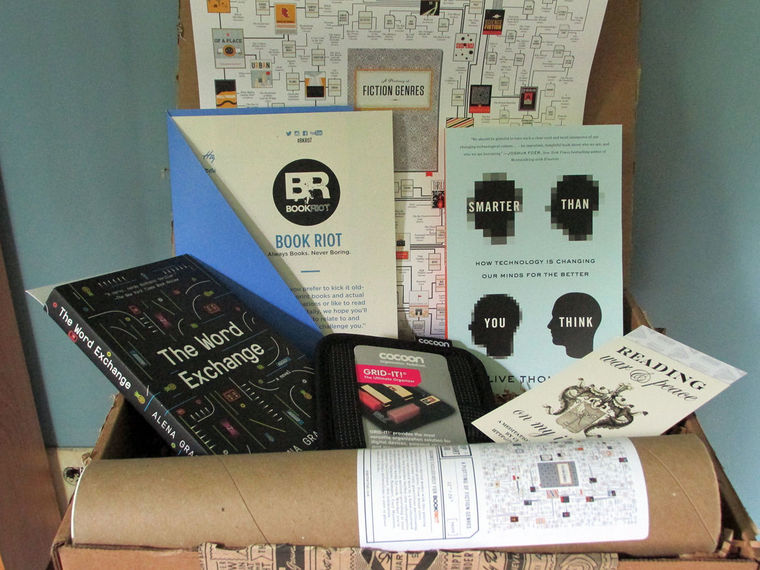
In each box, subscribers are guaranteed to get a new book or two to add to their collection with titles selected to fit the theme. The latest installment included one fiction and one non-fiction selection: Alena Graedon’s 2014 novel “The Word Exchange” and Clive Thompson’s 2013 book “Smarter Than You Think.”

At first glance, I dismissed “The Word Exchange” as a bandwagon book — just another tale of dystopian future society. But when I read the back cover synopsis, I couldn’t deny being intrigued. Books, libraries and newspapers are extinct, wordsmiths still cling to crafting dictionaries and a “word flu” is spreading.

Well-played, Book Riot. Way to tap into a word lover’s interests.

“Smarter Than You Think” is the real prize, though. The book addresses how every technological innovation, from the written word to the printing press to the Internet, has created worry that society will never be the same and that culture is eroding. However, Thompson argues each innovation has improved society and we continue to retain what is good of the old while moving forward with the new.

As a reluctant converter to e-books and hoarder of print books, I’m eager to dive into Thompson’s analysis.

The Grid-It organizer was the weakest link for the theme (and a bit too non-bookish to appreciate). The Grid-It isn’t useless — it can snugly carry cellphones, charger cables, earphones, a wireless computer mouse and other tech accessories, or it can be repurposed to hold makeup, notebooks or any other travel items you don’t want floating loose in your luggage.

Larger models listed on Cocoon’s website include cases to carry tablets and e-readers, which would have made more sense with the subscription box, but their price is twice the cost of the small version issued by Book Riot.

A strength of Book Riot’s subscription boxes is the inclusion of exclusive items, such as this quarter’s “A Plotting of Fiction Genres” poster, created by Pop Chart Lab. Items like this are why book nerds subscribe to the box: for fun reading-related products.

(Also, Pop Chart Lab is one of my favorite go-to sites for creating wall decor wish lists.)

The $50 spent on the box is a bargain. One book’s list price is $17, and the other book is $15.95, while the organizer is priced at $11.99. The poster is tougher to price since it was made specifically for Book Riot boxes, but similar 12-by-16-inch posters at popchartlab.com go for $20.

That would put the retail value of this box at $64.94 — a $10 savings, after you account for the $4.99 paid for shipping.

Also, 5 percent of Book Rioters get lottery items in addition to the standard fare. Alas, I missed out on receiving this quarter’s lottery items, both books: M.T. Anderson’s “Symphony for the City of the Dead” and Brittany Gibbons’ “Fat Girl Walking.”

  • WHAT’S IN THE BOX is a monthly feature in Better Times reviewing subscription boxes available online.
Posted in Reading | Tagged , , , | Leave a comment