Looking at kid lit through adult eyes

About a year ago, I was lounging around the periodicals section of Sterling Public Library, awaiting a mechanic down the road to finish replacing at oil gasket on my car.

I plucked magazines from the rack like apples, examining them quickly and then setting them aside, as though they were full of worms. I couldn’t find many articles of interest.

Then an item in The Atlantic’s table of contents caught my eye. “Why Are All the Cartoon Mothers Dead?” it asked.

I flipped to the article and read with interest. (You can click the link above to read it as well — it’s long, but interesting.) One of the nuggets I absorbed from it is that in children’s storytelling, moms are essentially spoilsports.

Yup. We women are the enemies of adventure. We want to tuck our children safely into bed at night, not let them go on wild, hair-raising, dangerous adventures. Mothers are boring.

Fathers, on the other hand, get a pass because they apparently aren’t as careful or attentive with children (specifically in Disney and Pixar films), and sometimes dads join the fun and adventure.

In the recent New York Times essay “Whose Side Are You On?” middle grade author Maile Meloy observes:

I understand now why so many fictional kids are orphans. The existence of parents throws a monkey wrench into an efficient plot. By protecting their kids from danger, they stave off adventure. It would be simpler to dispense with them altogether, and maybe that’s easier to do if you aren’t a parent yourself.

The Sarah & Katy books buck the absent mother trend, but only slightly. Their mother is alive and well throughout the books, but it’s also true that she’s absent during their adventures. Katy and Sarah imagine themselves to fantastic places where they can have adventures away from the watchful eyes of their mom — in fact, in Sarah & Katy and the Imagination Blankets, Katy specifically imagines a land without grown-ups after she gets angry that their mom grounded them.

(Although in the land without grown-ups, Katy realizes there are no parents to protect her and starts to miss her mother. So there is awareness of the need for parents woven into the story.)

The only way Sarah and Katy are able to explore without chaperones is through escaping into their imaginations. The thing is, they’re never in real danger because they never leave their home. (Although the books leave this ambiguous so the reader can decide if the imagination blankets really do have some magic in them.)

As a child, reading about other kids having grand adventures without parents stifling the fun was … well, fun. It was the perfect form of escapism — I disappeared into a book where there was no mother to say, “No, that’s not safe.” I broke all the Hogwarts rules with Harry Potter. I visited other dimensions and planets with Meg Murry (whose mother was alive, but not in the adventure for Meg and Charles Wallace to rescue their father). I followed Dorothy to Oz.

Screen Shot 2015-09-04 at 6.49.08 PM

In the New York Times essay, Meloy makes an interesting observation about how we read kid lit once we’re adults:

There’s a Rubicon you cross when you become a parent. Your emotional viewpoint shifts, and you start identifying with the parents in stories, rather than with the children. That’s a good thing — it’s hard to make rational decisions as a parent if you identify too completely with childhood hurts and desires. But if you don’t have kids, or until you do, you tend to identify with the children in any story.

I put this to the test recently. For the first time in eight years, I decided to reread the Harry Potter series. The final book came out between my sophomore and junior years of college, when I was still a pseudo-adult. Although I was 20 years old, I was still living at home with my parents and read the series through the eyes of a child more than an adult.

I’m about halfway through the third book, Harry Potter and the Prisoner of Azkaban. While I still immensely enjoy the books, there is a noticeable shift in my attitude. Rather than associating best with adventurous and rule-breaking Harry, I now associate best with Hermione, who is the voice of reason and a bit of a nag when Harry is trying to break rules. There was a catch in my throat at the end of Chamber of Secrets, when Molly Weasley sobbed with joy at discovering her daughter, Ginny, had been rescued and not killed. And I’m starting to get tired of the repetitiveness of Harry’s rule-breaking. Internally I find myself groaning, Seriously, Harry? Just go to Dumbledore and avoid all the danger and drama.

But that’s not the point of the series. It would make for boring reading to have Harry go to Dumbledore and the resolution of every book to be, “And Dumbledore fixed the problem and the rest of the school year was uneventful.” I recognize that, which is why the books are still entertaining and enjoyable as an adult, even if I connect with them differently than I did in the past.

An additional side effect of reading them as an adult is, every so often, the writing itself causes me to stumble to a halt. I encountered this sentence in Chamber of Secrets:

The basilisk was moving toward Harry; he could hear its heavy body slithering heavily across the dusty floor.

A couple paragraphs later:

There was a loud, explosive spitting sound right above him, and then something heavy hit Harry so hard that he was smashed into the wall.

And on the next page:

Something very hard and heavy thudded onto the top of Harry’s head, almost knocking him out.

Apparently everything inside the Chamber of Secrets was heavy. As a young reader, I was so caught up in the action I never noticed the writing. Now, awkward phrases or repetitive writing hit the brakes on the flow of the story. Although perhaps I notice it now not because I’m an adult but because I’m a writer.

The bright side about kid lit is that anyone of any age can read and enjoy it. There was an uproar when Ruth Graham wrote an essay in Slate titled “Against YA,” saying adults should be embarrassed to read children’s books. Earlier this year, The Guardian explored the idea of adults loving YA fiction in “Why are so many adults reading YA and teen fiction?” Personally, I think the answer is simple: Those books tell good stories. They may not be literary masterpieces, but they offer the same escape to adults as they do to children, and they tell resonating stories in the process. (Even if the writing itself is a bit more basic and everything is heavy … haha.)

I was pleased when a reader in an online book club reviewed Sarah & Katy as a book both children and adults would enjoy. A mother gave the story a gold star for being entertaining for adults while still being written at a children’s level.

I wasn’t surprised, though. I grew up in a family that appreciates kid lit — whenever my sister and I brought home Hank the Cowdog books from the school library, Dad would read them before we returned them. He appreciated them from a different angle, though — we had two Labs growing up that were just as bumbling as Hank and Drover. While we were reading them to see life through Hank’s point of view, Dad was reading them as near-satire from the view of being a dog owner.

One more benefit to reading kid lit as an adult: The nostalgia is priceless. Each time I open The Last of the Really Great Whangdoodles and read a few passages, time rewinds. I get a strong sensation of late afternoons, warm breezes, and reading while swaying on my childhood rope-and-plank swing, which hung from a branch of the blue spruce in my parents’ backyard. I can almost hear the huffa huffa panting of my childhood dog lying on the grass beside me. And I get that quiet longing in my chest once more, that silent wish, If only I could imagine strongly enough to transport myself to Whangedoodleland.

When I put the book down, nostalgia hasn’t entirely faded. I almost expect to see my parents’ backyard stretched out ahead of me, where I will set the book aside and run off to imagine myself traversing Whangdoodleland, or perhaps Oz, or Hogwarts. But I’m only standing at my bookshelf, and the nostalgia passes, and I go about adulthood once more.

But the day is just a bit more magical, and childhood doesn’t feel so many years away anymore. All because I dipped my toe in a bit of kid lit.

Posted in Reading | Tagged , , , , , | 4 Comments

Do you know who illustrated your favorite kid books? If not, read this

Can we talk about art for a minute?

Let’s talk about art for a minute.

As a child, I remember knowing the authors of my favorite books. I savored the knowledge of knowing their names. I looked at book covers like flash cards, memorizing who wrote them. One of my favorite card games as a child was Authors — it was like Go Fish, except each card featured a different author with four titles. I had three decks: Authors, American Authors, and Children’s Authors. I memorized those cards proudly.

But I never memorized illustrators’ names.

I’m ashamed of this now. Illustrations are equally important to children’s storytelling. And sometimes (dare I say it?) the art is more important.

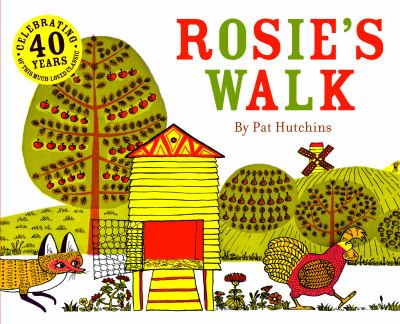
Book Cover Rosies WalkOne of my favorite examples of the power of art in children’s literature comes from the free lectures series Genres in Children’s Literature (available on iTunes). David Beagley, a lecturer in children’s literature and literacy at La Trobe University’s Bendigo campus in Victoria, Australia, discusses the book “Rosie’s Walk” in his introductory lecture.

The text of the book tells a simple story:

Rosie the hen went for a walk across the yard, around the pond, over the haycock, past the mill, through the fence, under the beehives, and got back in time for dinner.

That’s it. One sentence. Hearing the story aloud doesn’t sound like much. In fact, it’s rather drab. There is no conflict and nothing at stake.

In this book, the complex story is told not by the text; it’s told by the art.

In Beagley’s lecture, he discusses the peritext, which is all the images and textual elements that aren’t actually part of the written story. Peritext includes such items as the cover (front and back) and the illustrations. Readers make judgments about a book with every element they encounter. They interpret the story through peritext as much as they do through the written content.

The artwork in Rosie the Hen provides the tension in the story. Throughout the book, the text tells nothing of a threat, but the art shows a fox stalking Rosie on each page. Even though there’s no fox mentioned in the text, the predator becomes an integral part of the story.

Rosie the Hen“The words are only talking about Rosie. The pictures are doing something else,” Beagley says. “… What is happening in the pictures is not contradicting what’s happening in the words, only certainly is distinct and separate. … This use of largely textless pages by Pat Hutchins enables the reader. It’s as if the reader is being led into a secret. You are being asked to contribute yourself. ‘Oh look, I’ve noticed something the writer didn’t tell me. I’m starting to contribute to this whole experience of the story. I’m building it myself.”

The fox keeps failing in attempts to catch Rosie, which offers simple slapstick comedy.

Beagley says two stories happen simultaneously: the textual narrative and the visual narrative. He adds they don’t operate against each other. They don’t contradict each other. In fact, they require each other. The text characterizes Rosie as oblivious to everything. The art provides the tension.

That’s important to note. Art and text are integrated. They work together to tell stories in children’s literature. In “Rosie’s Walk,” the art tells the stronger story. If I were to listen to the story without seeing the pictures versus look at the pictures without seeing the text, I would get a stronger sense of the story from the art alone.

I feel a bit guilty for not having memorized illustrators as much as I did authors. (Although I also feel better knowing some of my favorite stories, such as Jan Brett’s “The Mitten” or Eric Carle’s “The Very Hungry Caterpillar,” were both written and illustrated by the author.)

Show some love to the artists of the favored children’s book in your household. They deserve the recognition.

  • And while you’re at it:
    Show some love to Sarah  & Katy and the Imagination Blankets artist Hannah Jones! Visit her website at hannah-bird.com and browse her extensive portfolio of original artwork.
Posted in Reading | Tagged , , , | 3 Comments

Writers, we can’t put a price on the press (or maybe we can)

There are plenty of costs for the independent author.

Like cover art.

And editing.

There’s inventory.

And did I mention marketing and advertising expenses?

The price can range from the hundreds to the thousands, depending on who we hire and how much we’re willing to invest. But there’s one priceless tool money can’t buy.

Being featured in the press.

I’m not talking about $425 Kirkus reviews (because those certainly aren’t priceless). I’m talking about articles in the newspaper, interviews on the radio, Podcast chats, etc.

The job that pays my bills is working as the evening news editor at a rural Illinois newspaper. I’ve always loved and valued newspapers, but even I didn’t recognize their full impact until I became an independent author.

I’ve paid small amounts to advertise here and there. (Pro tip: The Goodwill Librarian page on Facebook accepts advertisements for as low as $10, and it reaches an audience of 313,000+ followers. Check out goodwilllibrarian.webs.com for details.)

But every time I have a surge in a book sales, it’s been after my book or I was featured in the local paper. My newspaper ran a Q&A with me when Sarah & Katy and the Imagination Blankets was first released. That resulted in the first surge of sales. Then the paper published a press release about my first book signing. The event was a huge success.

When I attended a more recent book signing this summer that had no prior press coverage, I sold only one book.

If you’re an independent author, it’s worth asking visitors to book signings and events, “How did you learn about my book? Where did you hear about this event?” More often than not, news media will be a leading answer.

There’s no guarantee the press will cover a book release or event, but when it does, the value is immense. We can’t put a price on that kind of book promotion.

Then again, maybe we can … the value is measured in book sales.

Posted in Writing | Tagged , , , , | Leave a comment

A pillow every reader should have

Last weekend, the hubs and I took a day trip to nearby Princeton, Ill., to wander its two downtowns.

(You read that right … Princeton has not one, but two downtown areas.)

The little community has fewer than 7,500 residents, but it is well known for its connection to antiques and arts. You can’t walk a full block downtown without coming across one antique shop or a haven for crafts and art.

Book LampOne shop we visited was The Makery, where hundreds of handmade goods from a dozen or more creative folks are for sale. That’s where I spotted a book lamp and adopted it.

That’s also where I found the most ingenious pillows ever made.

They were labeled “tote pillows.” Each one had a pocket stitched on the front, and many had book-related quotes on the pocket, such as “It’s a long story” or simply “READ” in typewriter key-styled letters. The card placed in the pocket of each pillow explained they were made to hold books or e-readers. The pillows have a handle on top, so they easily can be carried on vacation with reading material tucked in the pocket. My plan was to take one home and keep it on the bed or couch, with a go-to place for my book. The, as I’m reading, it gives me something soft to prop an elbow on or hug my arms around.

I picked up four and agonized over which to buy. One had owl fabric behind the pocket, which I didn’t like. Another had red rose fabric, which doesn’t match any room in my house, but I loved the “It’s a long story” pocket. Another had a bright pattern that didn’t match much in my house, but I liked it well enough.

I ended up not buying any and only took home the book lamp. But I couldn’t get them off my mind, so I visited the maker (Desmond Brown Design) on Facebook.

And there it was. THE PERFECT PILLOW.

Book Pillow

I commented on the photo, asking if it was available for sale. Within minutes, Desmond Brown Design owner Kelly had replied, sent me an invoice via PayPal, and promised to ship it out the next day.

My “Can’t, I’m Booked” pillow is the perfect addition to my home’s newspaper- and book-themed decor. It’s also the perfect storage place for current reading material and a nice reading buddy (except when the cat pushes it off my lap to make room for himself).

Desmond Brown Design has dozens of other pillow designs (not just pocketed pillows, either … there are regular pillows, plus several other home decor items). Check out her Facebook page. Show her some love. Order her amazing decor.

(You’ll just have to beat me to ordering it first.)

Posted in Reading | Tagged , , | Leave a comment

It’s OK to be a member of the Childless Children’s Authors Club

Middle-grade author Maile Meloy made an important point in the New York Times Sunday Book Review last week.

In an essay titled “Whose Side Are You On?” Meloy explores the idea of being a childless children’s author.  Meloy muses:

But most of my friends who write for kids don’t have them, and neither did some of the best children’s book writers ever. Theo­dor Geisel — Dr. Seuss — didn’t even like kids. “You have ’em, I’ll amuse ’em,” he’s supposed to have said. Maurice Sendak had none. Neither did Tove Jansson, Tomie dePaola, Ezra Jack Keats or Margaret Wise Brown. The great children’s books editor Ursula Nordstrom said, “I am a former child, and I haven’t forgotten a thing.” It’s not a requirement to have children in order to write for them. You just need to have been one, and to remember what it’s like.

That closing sentiment — you just have to have been a kid and remember what it’s like — resonates deeply in my writing life.

I am a member of the Childless Children’s Author Club. I don’t plan on having a lifelong membership (I plan to be a lifelong writer, but the husband and I are hoping to be parents – the sooner the better), but as a childess children’s author, I’ve often worried if parents would find my writing inferior or less authentic. I’ve always feared I would encounter the question, “If you don’t have children, how can you be pretentious enough to write for them?”

(For the record, no one has ever asked that question.)

Although I’m a CCA (childless children’s author), I spend a fair amount of time with my nieces. Katy just entered second grade and Sarah is now fourth grade. Having them in my life has rekindled many of the joys I experienced as a child — each time I see them, they inevitably ask, “Aunt Julie, want to play imagination?” At 28 years old, I still frequently say, “Yes.” (Although perhaps not as often as I ought to.)

In some ways, being a CCA has been a benefit in these early days of my writing career. Katy and Sarah inspire stories and stir vivid memories of life when I was their age, but as an aunt I have free time I wouldn’t immediately have as a mother. I have time to experiment and explore the self-publishing industry. I have time to lock myself in a room and selfishly horde hours on end to write. I have time to establish a routine and work out the kinks of independent book production.

By the time I become ineligible for the CCA Club, at least I’ll be confident in the process. Then it will just be a matter of finding the time to write.

quote

Having Katy and Sarah as a test audience helps boost my confidence as a children’s author, but much of my children’s writing follows a simple concept: I use the same philosophy I use for buying Christmas gifts.

When holiday shopping for Sarah and Katy, I ask myself: Would I have loved this gift as a little girl? I shop through my inner child’s eyes. When I spot an item I would have loved, I take a chance on buying it for the girls. So far, it’s been successful.

The same concept applies to my writing. If I would have enjoyed reading it at their age, I write it. (Probably why so much of my writing is so heavily influenced by Lloyd Alexander’s “Time Cat” and Julie Andrews Edwards’ “The Last of the Really Great Whangdoodles” — both were my favorite books growing up.)

When writing the first Sarah & Katy book, Ruddy is the character who made me laugh and who I loved most to write; he’s been the most popular among young readers. For this book, the Glomtom and the swamplings were my favorite to write; I’m willing to bet they’ll be the next crowd favorite. My inner child giggled throughout those chapters.

That’s why Meloy’s point rings so true for me. Having children in our lives is beneficial for children’s authors, but not entirely necessary. I feel more authentic as a CCA in knowing many other (including well-known and much-loved) authors were members of the CCA Club. Being a parent is not a prerequisite to writing for children.

We just have to be sure not to suppress our inner child. At the keyboard, we suppress our inner adult instead.

Posted in Writing | Tagged , , , , , | 1 Comment