Kid lit is worth writing — and reading

Not long ago, I attended a small, informal gathering of fellow writers. We “talked shop” in the usual way: asked how each other’s projects were coming along, shared our hopes for our own projects, and discussed the woes of writing.

These get-togethers tend to be group therapy. Venting is part of the agenda. We complain about writer’s block, rejection letters, failed projects, or the writing process in general. Releasing the frustrations of the job typically leave us refreshed and ready to return to the keyboard.

It was at one such gathering I was taken by surprise when a friend and writer whom I respect turned to me and asked, “So how is your book doing?”

“Really well,” I replied. “I sold 25 copies during a school visit, and the class was really excited to talk about it.”

“It must be nice to have a built-in audience,” she replied. “It’s so much easier writing for kids.”

The conversation turned to how much more complex writing for adults is. As the only kid lit writer at the table, I was caught by surprise and didn’t know how to respond. Their talk had touched a nerve, a silent fear: Was I a lesser writer for setting aside my adult fiction and pursuing children’s books instead? Was I a sellout, taking the easy road?

For days after, I mulled over the conversation. I was restless until I found solace in my book shelf.

Looking through my book collection, I was reminded many of my most lasting favorites (not to mention many of the classics) on my shelves are in the realm of kid lit.

Alice in Wonderland, The Wizard of Oz, Peter Pan. No one would think to snub these or discount them for their kid lit status. References to these stories are prevalent in culture and society. They are told and retold, revised and reimagined.

And the wonderful thing about kid lit is readers of all ages can enjoy it.

The mistake readers can make about kid lit is that it is unsophisticated. But David Beagley, a university lecturer in children’s literature, says kid lit can be as complex as adult literature. The difference is not the quality of the literature.

The difference is simply the age of the audience.

In a 2012 lecture series at La Trobe University’s Bendigo campus in Victoria, Australia, Beagley tells his students of children’s literature, “Children are not simple-minded.”

Nor is their literary taste.

“Children are readers as much as adults are readers,” Beagley said. “The fact they read something different doesn’t make them any less a reader or appreciater of their literature.”

Writing kid lit has its advantages over writing adult literature. The turnaround time for finishing a draft typically is shorter because the word count is lower. The fans are always excited to meet an author. The language is simpler in some ways, although there’s a case to be made for writing with the goal of elevating a child’s vocabulary. (And it’s amazing what kids can learn simply by context.)

Despite some of the advantages, the stories are not lesser products. The Wizard of Oz has political interpretations, but it also addresses good versus evil and the importance of family. These are themes that are relevant to both children and adults. In Matilda, we experience both the thrill and fear of childhood. The book, while lighthearted in many ways, also addresses abuse.

Kid lit tackles serious issues. Fewer pages and simpler vocabulary does not equal lesser literature.

“It has value as a creation in itself, an artistic creation,” Beagley said. “It should be judged by that inherent literary value.”

Posted in Writing | Tagged , , , | 6 Comments

Where has all the magic gone for Halloween?

The spirit of Halloween is alive and well in the Stroebel family.

I’m not the one carrying the torch, though. This year, that honor belongs to Sarah and Katy.

They’re determined to light a fire under the whole family. Now that October is upon us, they’re in full-fledged Halloween mode. After all, as far as they’re concerned, Oct. 1 marks the first day of 31 Days of Halloween.

There’s no dodging their persistent question: “Aunt Julie, what are you going to be for Halloween?”

It’s a question I used to take seriously. And they’ve known me to dress up in the past. The husband and I joined them for trick-or-treating one year dressed as Alice and the Mad Hatter. A year before, I was darting around my retail job dressed as Batgirl.

My answer this year is, “I don’t know. Maybe I won’t dress up.”

Where has all the magic gone? This year especially, I’m struggling to find enthusiasm for fall and its holidays. I haven’t found the energy yet to haul the autumn decorations up from the basement. Not a single bag of Halloween candy has come home in a grocery bag. I even talked myself out of buying pumpkins and mums — why invest the money when squirrels and frost will bring about their early demise?

Bah humbug.

I haven’t always been a Halloween curmudgeon. Even last year, I bought Halloween-themed stickers, candy, pencils, and erasers to make 70 treat bags. Eight trick-or-treaters later, the other 62 bags are still in my basement.

(Minus the candy … I plundered that to console my disappointment over the lack of costumed kids coming to my door.)

Rewinding way back, I was as far opposite a curmudgeon as you could get. By Aug. 1 each year, I was pulling “Hocus Pocus” off the movie shelf and watching it daily. I was plotting my Halloween costume, changing my mind almost daily. I would open my Halloween drawer (yes, I had a drawer devoted exclusively to Halloween) to pull out decorations, carefully preserved trick-or-treating bags, and craft supplies.

Halloween was my favorite holiday in childhood. For one night each year, I didn’t have to imagine I was a princess or a witch or a pirate or a superhero. I became a princess or a witch or a pirate or a superhero. I looked the part.

And boy, did I ever play the part. Halloween was a daylong imagination extravaganza!

The magic of the season stayed alive through high school. Our drama club hosted an annual Halloween costume contest, and I reveled in the opportunity to escape into another identity for a day. As a junior, I spent a glamorous day whisking around the halls as Cinderella. As a senior, I tapped into my superpowers to be Rogue from X-Men.

The holiday fun fizzled a little in college, though. As a freshman, I rolled out of bed on Oct. 31 and dressed in a devil costume in honor of being a Eureka College Red Devil. I donned a bright red dress (complete with a pointy tail), a sparkling red wig, a devil-horned headband, bright red lipstick, and topped off the look with a pitchfork. My love for Halloween merged with my pride of being a college student.

By the end of my first class of the morning, my face was as red as my wig. On a campus of 500+ students, I was the only person in costume. And there wasn’t time to return to my dorm and change into jeans and a hoodie. I spent the entire day sticking out like …

Well, like the only girl on campus in a bright red devil costume.

I’ve only dressed up twice since then (as Batgirl and Alice), and both were Halloweens I spent with Sarah and Katy.

I’ll try to muster up some magic this year and reignite my love of a holiday tailor-made for imagination and play.

And worst case scenario, if I can’t put my heart into a costume, I’ll tell Sarah and Katy I’m dressed as a character from literature …

I’ll wear my usual clothes and just say I’m Aunt Julie from “Sarah & Katy and the Imagination Blankets.”

Posted in Children and Family | Tagged | Leave a comment

Kids can win cash for reading a book and writing to the author

banner_lal 2014

If you live in Illinois and have a child between fourth grade and high school senior, there’s an opportunity to win cash in exchange for reading — and then writing about it.

The 2016 Letters About Literature contest is a national reading and writing competition sponsored by the Illinois Center for the Book.

This gist is this: Students read a book, poem, or play; then they write a letter to the author about how the work changed their lives or view of the world. Students can enter on their own or through schools, libraries, or youth organizations.

There are three levels of participation:

  • Level I for grades four through six.
  • Level II for grades seven through eight.
  • Level III for grades nine through 12.

One Illinois winner is selected for each level and receives a $200 cash award.

Winning not only benefits the student, but also the school: Teachers of winning students receive a $100 cash award to purchase materials for the school library. Winners and teachers also are invited to an awards ceremony in Springfield. The state winners’ letters will be forwarded for national judging.

The deadline to enter is Friday, Dec. 4, for Level III and Monday, Jan. 11, for Levels I and II. State winners will be announced in April.

To download an entry form, click here. If you’re a teacher and are interested in downloading the teachers’ guides, click here for the first guide and here for the second. For additional information or general contest information, click here, or contact Bonnie Matheis at 217-558-2065 orbmatheis@ilsos.net.

Posted in Writing | Tagged , , , , , , | Leave a comment

BOOK REVIEW: A Girl with a Cape, by Amy Logan

Amy Logan

Author Amy Logan signing a copy of “A Girl With a Cape and Her Jar of Pennies” at Prairie Creek Public Library.

On Saturday, I had the pleasure of joining my nieces for a reading and book signing by Amy Logan, author the the “A Girl With a Cape” books.

The visit was my first encounter with these tales, which tell the story of a girl who ties a scarf around her shoulders like a cape and sets off to make a difference. Even though she has no super powers, she makes people’s day better with kind words and deeds.

After all, the subhead of the first book (titled simply “A Girl With a Cape”) is “The true story about the superhero in all of us.”

The story aims to teach children that saving the day and making a difference doesn’t require super powers. With the booming popularity of all things Marvel and DC Universe lately, kids are inundated with the idea that heroes wear costumes and can fly, fight, outrun speeding bullets, etc. But the Girl With a Cape books debunk this for young readers, letting them know that they, too, can make someone’s life better through kindness.

The effect of the girl’s kind deeds creates a chain reaction in the first book. Whenever she extends a compliment, the recipient then passes another compliment to someone else, and that person compliments someone else, and so on.

The second book, “A Girl With a Cape and Her Jar of Pennies,” features the girl spreading good luck by dropping pennies all over town and letting other children excitedly find them.

Written in rhyme, it’s easy to fall into the rhythm of the stories. My favorite detail, however, is the activity element: After parents and children finish reading, they can talk about what kinds of simple steps they can take to make the world a better place.

Amy Logan also promotes the CAPE campaign: Create a Positive Environment. On her website, she includes a list of deeds to help young readers “Rock the CAPE.” (gotyourcape.com/rockthecape) The list is worth reviewing with kids and setting a goal to tackle one or two per day.

Amy Logan’s third book, A Girl With a Pink Cape, will be available in October.

  • A GIRL WITH A CAPE, by Amy Logan, illustrated by Tracy Wendt, 2013, Full Heart Press. 30 pages, K-4th grades. $22.95
  • A GIRL WITH A CAPE AND HER JAR OF PENNIES, by Amy Logan, illustrated by Rich Green, 2014, Full Heart Press. 24 pages, K-4th grades. $22.95
Posted in Reading | Tagged , , , , , , | 1 Comment

SNEAK PEEK: Excerpt from upcoming Sarah & Katy sequel

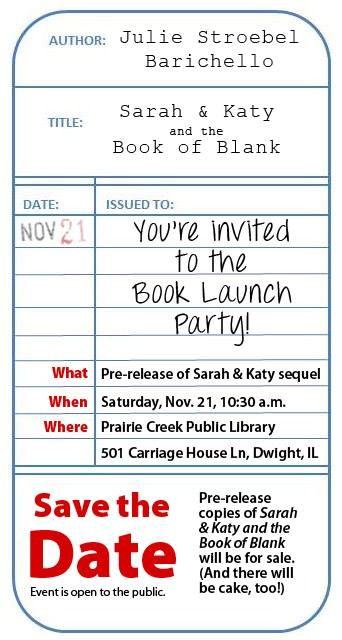
Want a glimpse of what’s coming in the sequel to SARAH & KATY AND THE IMAGINATION BLANKETS? Check out the full first chapter of SARAH & KATY AND THE BOOK OF BLANK below!


Chapter 1: No Ideas

Sarah’s mind was blank.

That was unusual, and not entirely pleasant. Usually she had all sorts of ideas to keep her and her younger sister Katy occupied. But not today.

She lay on her bed with her head hanging over the side. Everything in the room was upside down. From that angle, the floor became the ceiling and the ceiling became the floor. Across the bedroom, her younger sister Katy sat cross-legged on her own bed, but it looked like she was dangling from the ceiling.

Katy flopped onto her back. From Sarah’s vantage point, it looked like she was falling up.

“I don’t know why you lay like that,” Katy said.

“It helps me think,” Sarah replied.

She could feel the blood rushing to her head and hear her heartbeat pounding in her ears. She swished her hair back and forth over the carpet like a broom. The sisters were waiting for their friends to come over. Mom was babysitting Miss Teresa’s three children that afternoon — Milana, Indi, and Walter. Milana was Sarah’s best friend, Indi was in Katy’s class at school, and Walter was their little brother. When Mom told them earlier that morning that Miss Teresa would bring the trio, Katy insisted on inviting over her best friends, too. Unfortunately, Sophie was at home with a cold and Ryan was visiting relatives.

Sarah sighed. She knew she would have plenty of ideas once their friends arrived. After all, having visitors was fun. Waiting for them to get there was not fun.

Katy hung her head over the side of her bed, imitating her sister. “What are you thinking about?”

“What we can do until the others get here,” Sarah said.

“We can play one of the games we got for Christmas,” Katy suggested.

Sarah shrugged. Even though the holiday was only a few days ago, the newness already had worn away from all of their presents. All of the toys had been played with. All of the movies had been watched. All of the board games and video games had been played.

This was the worst time of year, Sarah decided. All of the glitter of Christmas was gone. Only the dreary gray days of winter were left.

Katy snatched a yellow blanket from her bed and waved it like a flag. “Let’s imagine a magic carpet ride to the Arabian desert.”

Sarah shook her head, causing her hair to swish the floor again. “Been there, done that. I want to do something we’ve never done before.”

“I know one thing we shouldn’t do,” Katy said, sitting upright again. “Hang around with our heads upside down. I’m dizzy.”

Sarah ignored her sister. She looked around the room. What hadn’t they done yet? What was new?

Her eyes swept over the pile of dolls on the dresser, the hammock full of stuffed animals, a doll house, a stack of board games, a book shelf, a plastic bin overflowing with Legos …

She sat up. Her attention returned to the book shelf. There was one gift left they hadn’t used. Their aunt and uncle had given them books for Christmas. They meant to start reading them during the family Christmas party — they had curled up with blankets and hot chocolate in Grandma’s living room, but just when they opened the books to start reading, Uncle Kevin had challenged them to a Mario Kart tournament. When he first asked if they wanted to play, they said no because they were going to read. But then he said he understood if they didn’t want to play just because they were afraid of losing. How could they say no to a challenge like that? They couldn’t resist setting aside the books to beat their uncle in a video game.

When they brought all of their presents home, they put the books on the shelf … and forgot.

Sarah slid off the bed and crossed the room. She grabbed both books and carried them to the middle of the floor, where she plopped on the carpet. Katy jumped off her bed and sat next to her sister.

“Are you going to read until they get here?” Katy asked.

“It’s worth a try,” Sarah said. “Maybe the books we got from Aunt Julie and Uncle Derek will be interesting.”

Sarah handed Katy the other book. The covers were identical. They were deep blue with gold foil decoration. In the center was a circular sun surrounded by squiggly rays. Vines swirled around the outside edges of the cover. Light glinted on the foil, giving the images a spark of life. If Sarah tilted the book at the right angle, the sun’s rays looked like they waved, and the vines seemed to twist and grow. It was just a trick of the light, though. It had to be.

The only thing the cover was missing was a title.

“What are these books even about?” Katy asked. When she turned hers over to read the description, she found no writing. The back cover was identical to the front.

“I’m not sure.” Sarah looked at the spine. There was no title there, either — just more gold trim. Even the edges of the pages were gold.

She opened the book. The first page was nothing but gold foil — it had no writing. She turned to the second page, which was normal paper. In bold letters it said:

THE BOOK OF ______________

“Weird,” Sarah said, holding up the page for Katy to see. “The title isn’t complete.”

Katy opened her copy to the title page. “Mine is the same.” She flipped through the book, fanning the pages quickly. Each page featured nothing but blank white space. The book was empty. She snapped it shut and tossed it aside. “I wonder if Aunt Julie and Uncle Derek know the words are missing.”

Sarah turned to the next page in her book. “Mine has some writing. Look.”

Katy scooted closer to her sister so they could read the page together.

WARNING

Do not proceed with this book unless you plan to complete it from beginning to end.
Do not turn the page unless you have time to finish in one sitting.
The story does not end until you reach the last page.

Katy scrunched her eyebrows. “What is that supposed to mean? Isn’t the last page where every story ends?”

Sarah turned the page. “There’s more.”

FINAL WARNING
If you turn this page, there’s no turning back.

“What do you think?” Sarah asked. “Should we turn the page?”

“It’s just a book,” Katy shrugged. “What’s the worst that could happen?”

Sarah turned the page. It was blank.

“What did I tell you? It’s just an empty book.” Katy stood up and put her hands on her hips.

Sarah couldn’t deny being disappointed. Even though Katy’s book was blank, she had hoped hers would have a story to distract them until Miss Teresa dropped off Milana, Indi, and Walter.

“Maybe this book isn’t made for reading,” Sarah suggested. “Maybe it’s made for writing.”

She stood and rummaged through the mess on top of their dresser — dolls, headbands, a wristwatch, a pair of Happy Meal toys, an empty DVD case — until she found what she was looking for. Under a lonely sock was a pink pen with a rose bloom at the end.

She returned to the book, tickling her chin with the rose petals on the pen while she thought about what to write. Finally she shrugged and bent over the blank page.

“Once upon a time …”

Before Sarah could finish writing the sentence, she uttered a surprised, “Oh!” The book grew warm in her hands. The blank page glowed gold, just like the planets and sun on the cover. Startled, she dropped it and scrambled away to stand beside Katy. They exchanged wide-eyed glances.

The light brightened. It spread off the page and filled the entire room until it became blinding. They squinted and shielded their eyes with their hands. A force like a wind pushed them toward the place where the book had fallen.

Except there was no book there any longer. Instead there was a hole in the floor shaped like the sun on the cover. Its rays inched out, reaching toward them like fingers. The circle at the center of the sun grew wider and wider, and the wind pushed them into it. They squeezed their eyes shut against the light and reached for each other’s hand.

“What do we do?” Katy shouted. Her voice was muffled by the wind and a sound of flapping pages.

“Hang on and don’t let go!” Sarah shouted back, squeezing her sister’s hand tighter.

Then they were falling.

Posted in Writing | Tagged , , , , , , , , | 1 Comment