Imagining adulthood

As a child, I imagined plenty of adventures and scenarios.

Some days I’d hop on my bed, tie the bonnet I got at the Laura Ingalls Wilder home under my chin, plant a chair (or in my imagination’s eye, a horse) in front of me, and ride away in my Conestoga wagon down the Oregon trail.

Some days I’d dig out my sister’s pink plastic teapot (a.k.a. a genie’s lamp), set it on the windowsill at the bottom of the stairs, then go back upstairs and tiptoe down into the Cave of Wonders, Aladdin-style.

Some days I crawl around for hours, until the heels of my hands and my knees were rubbed pink and raw, pretending to be White Fang or Sham (the horse from Marguerite Henry’s “King of the Wind”).

But many days, my imagination and play centralized on a common theme: adulthood.

I would pull out dolls and pretend to be a mother. I’d assemble all the dogs in my Beanie Baby collection and be a contestant showing my award-winning cocker spaniel in a dog show.  I would line up more dolls in a row and pretend to be a teacher, or go outside to our basketball hoop and imagine myself as a coach. I even spent my allowance on a pack of index cards once so I could go home, stick one card in every book I owned, and be a librarian for an afternoon, loaning out books and stamping due dates on the cards.

Each day, I imagined a new scenario. I piloted airplanes and spacecraft, navigated ships, explored the Antarctic and deserted islands. In my mind, adulthood was adventurous and glamorous and free.

In childhood, I had more careers in a week than a person could have in a lifetime. None of those daydreams included balancing checkbooks, paying bills, commuting, doing dishes, putting away laundry (my least favorite chore) …

As an adult, I’ve settled into the routine of the many less-than-glamorous aspects of adulthood. (The latest one being tax preparation … oh frabjous day.) But there’s still some residual adulthood daydreams jangling around in my mind. As much as I love being a journalist and independent children’s author, I often find myself daydreaming about getting a master’s degree in children’s literature and becoming a full-time author. But wouldn’t it be more fun to work in a library? Then again, I visualize myself more as a small business owner, running a secondhand book shop downtown. Except I want to be a grade school teacher instead.

Romanticizing careers and imagining myself in those roles is still part of everyday life. (Although I don’t act them out with dolls or index cards in books anymore … but every once in a while you’ll catch me carrying on a conversation with an imaginary person.) There are days I catch myself in the midst of these daydreams and wonder, “Will I ever stop imagining adulthood and just settle into being an adult?”

And my internal reply is always the same.

I hope not.
Posted in Unplugged imagination | Tagged , , , | 2 Comments

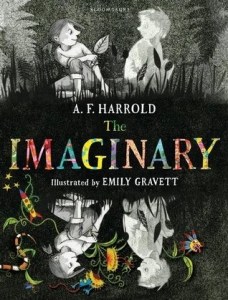
BOOK REVIEW: ‘The Imaginary’ [A.F. Harrold, Emily Gravett]

My previous news editor used to say, “Every good story begins with a question.”

He wasn’t telling us the first sentence of an article had to end with a question mark. Instead, it was his advice for finding a starting point for news coverage. Find a question, and then write an article to answer that question.

Even though his advice was meant for news, A.F. Harrold shows it’s just as relevant in fiction. In “The Imaginary” (reading level: 8-12 years), the question is: What happens to an imaginary friend who is separated from his/her child?

Plot

Imaginary

Rudger is Amanda Shuffleup’s imaginary friend. When Amanda is hit by a car and hospitalized, Rudger is suddenly left alone. Without Amanda’s imagination to keep him intact, Rudger is at risk of Fading, which happens when imaginary friends are forgotten. Fortunately, he’s found by a cat named Zinzan before he fades completely and finds haven in a library, where dozens of imaginary friends find refuge.

Why a library? As Emily, a fellow imaginary, explains: “[…] we’re imagined. Look around, this place is like an oasis: it’s made of imagination.”

Living in the library isn’t a permanent solution for imaginaries, but it fuels them long enough to find a new child. However, Rudger isn’t content with settling for a new child. He is determined to find his way back to Amanda.

As if it isn’t complicated enough to try to find her without Fading, a villainous adult who eats imaginary friends as a means of keeping his own imaginary friend alive is hot on Rudger’s trail as he tries to find his way back to his best friend.

My Thoughts

I read this book immediately after reading “Crenshaw,” another novel about an imaginary friend that left me dissatisfied. In Katherine Applegate’s “Crenshaw,” I was left wanting more time with the titular character, an oversized imaginary cat named. Not much time was spent with the imaginary friend in that book, and in the end, Crenshaw seemed more like a plot device to spout wisdom than a necessary character.

But this review isn’t about that book. Where “Crenshaw” fell short, “The Imaginary” outdid itself.

imaginary-inside

An interior illustration of imaginary friends living in the library in ‘The Imaginary’

The story is brilliantly written and illustrated. The tension of Rudger’s separation from Amanda, plus his narrow escapes from the imaginary-devouring Mr. Bunting, keep the reader turning pages. The book doesThe imaginary pagen’t shy away from being darker than the average kid lit selection (but never so dark to be nightmare-inducing).

The book also explores the power of imagination, which wins it big points from me. There’s one exchange between Amanda’s mother and another mother, in which the other mom insists her daughter needs a child psychologist because she’s “seeing things” and has an imaginary friend. Amanda’s mother, meanwhile, encourages having an imaginary friend and using the imagination.

There’s also a touching sequence near the end involving Amanda’s mother and her childhood imaginary friend. It just goes to show we never quite outgrow our imaginations. There are few messages dearer to my heart than that one.

This book gets a high score of 4 out of 5.

  • The Imaginary, by A.F. Harrold, illustrated by Emily Gravett, 2014, Bloomsbury Publishing Plc. 221 pages, readers 8 to 12 years old. $16.99 hardcover
Posted in Reading | Tagged , , , , , , | 4 Comments

How to Plan an Author Skype Visit (Fun Tips for Authors, Teachers and Librarians)

Tara Lazar's avatarWriting for Kids (While Raising Them)

I’ve done several dozen classroom Skype visits and I keep refining my techniques. (Yes, I have actual techniques!) I found that many author friends were nervous about doing Skype visits and I’m here to tell you—they’re the best thing since sliced smoked-meat knishes from Caplansky’s! (What can I say, I’m hungry and I just saw them on Food Network.)

Skype visits allow you to stay at home while spreading the joy of reading all over the world! I’ve visited Sicily, Brazil, Kuala Lumpur, and yes—even Canada—from the comfort of my laptop.

Here are my best tips for planning a fun and memorable author Skype visit…

skypevisitscreenFOR AUTHORS

Create anticipation.
I love Skype visits because I don’t have to get dressed up. I can stay in my jammies all day! I tell the kids as a children’s book author, pajamas are my “office uniform.” No suit and tie or fancy-schmancy pearl…

View original post 1,136 more words

Posted in Writing | Leave a comment

Reading books to inspire writing books

AngelPetersonWith the start of a new year comes the start of work on “The Mountain of Dempsey Molehill,” my in-progress middle grade novel.
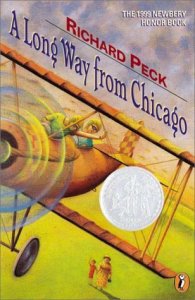
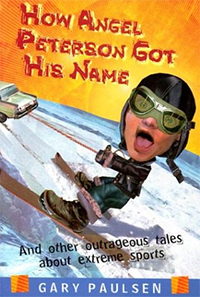
To get in the proper frame of mind, I’ve kicked off my year with reading “How Angel Peterson Got His Name.” Back in October, I read “A Long Way From Chicago.” Both books are written in an episodic manner, which is how Dempsey Molehill’s story will unfold.

Both “Angel Peterson” and “Chicago” are books I’ve read in the past, and both stuck with me. Each follows children through mischief and antics (although in “Chicago”, Grandma Dowdel is wreaking more mischief than the Chicagochildren), and both are sprinkled with humor. Their structure has inspired many of my plans for Dempsey Molehill’s structure.
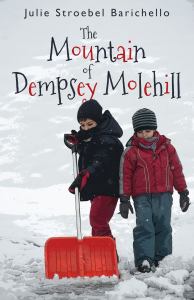
“The Mountain of Dempsey Molehill” is narrated by Dempsey, the middle child among his four siblings. The story follows a year in the life of the Molehill family — the year their father runs for mayor.

It’s a lofty goal to aim to fall among the ranks of authors like Gary Paulsen and Richard Peck. What can I say? I like to aim high. In Dempsey Molehill, I aim to capture similar mischief (and near mayhem) as Paulsen’s “Angel Peterson” plus humor and heart such as that in Peck’s “Chicago.”

10750040_844769998900549_5553541450399861407_o As I said in a previous blog post, 2016 is my year of immersion — that includes immersing myself in some of the best children’s literature on the market. Great reading is the starting point of inspiration for great writing.

Let’s hope the great books I’ve been reading lately lead to good things.

Posted in Writing | Tagged , , , , , | 7 Comments

2016: The year of immersion

New Year’s resolutions seem to have gone to the wayside for many people. The new trend I’m seeing is to assign a theme to the year by choosing a word and making every effort to live up to that word.

Jerrilyn Zavada, a columnist and reporter at the newspaper where I work, touched upon the topic in her weekend column. Blogger and writer Michelle Chalkey also has committed her year to the word presence.

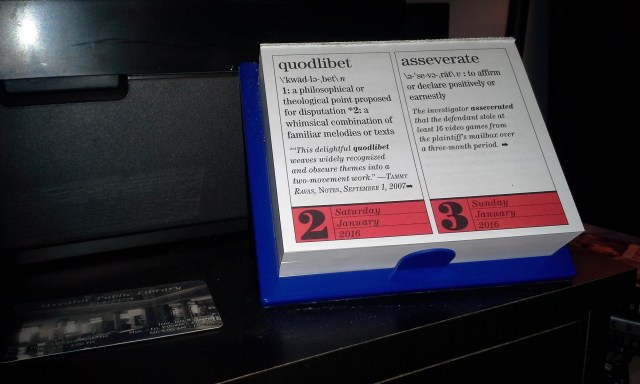
Words always are an important part of my year. I could hardly contain my excitement when I got to start a new one of these:

Calendar

But I’ve never assigned a single-word theme to a year.

This year, I’m joining the new movement and choosing a word. For me, 2016 will be the year I immerse.

You have to go a few definitions down in the dictionary to find the meaning I intend: To engage wholly or deeply; engross; absorb.

Merriam-Webster’s online dictionary couldn’t have a more perfect example of the word: She had immersed herself in writing short stories.

This is the year I want to immerse myself in my passions. I want to be deeply engaged in my writing, in my household, and in my workplace. When I participate in an event or activity, I want to be wholly engaged.

Multitasking will be minimized, to an extent. Listening to webinars while doing dishes is a positive type of multitasking to keep, but the cellphone distractions of texting while also carrying on a conversation in person have to stop. It’s time to immerse myself in conversations as I’m having them and be wholly present by giving people my attention. The person on the phone can wait until I gave them my full attention.

In a way, living with the mission of immersion is an umbrella over many resolutions. I resolve to do more work toward encouraging literacy and advocating children’s literature because I want to be immersed in my work. I resolve to be more efficient and active in the newsroom because I want to be immersed in the paper’s success. I resolve to spend more quality time with family because I want to be immersed in those relationships.

But the key of living by a word is that I’m not scrambling to fulfill a dozen goals. I’m simply reminding myself, in everything I do, to focus and give my whole attention in that moment. It’s a more efficient way to keep momentum because I don’t have to keep a scorecard of how many pounds lost or books read or words written. I just have to keep my mantra of immerse yourself going through the day.

Posted in Writing | Tagged , , , , | Leave a comment