The ultimate children’s story prompt generator

Last night I passed the Wal-Mart clearance section on my way to the auto section. My goal was to enter the store, find fuel injector cleaner, and leave with spending less than $5.

It was hard to pass up the clearance section, though. I talked myself out of a new $50 pillow-and-comforter set and $36 in matching curtains. I exercised my willpower and didn’t browse through the marked-down office supplies. And I almost made it to the automotive section empty-handed …

Until I spotted this.
FunnyPhrases

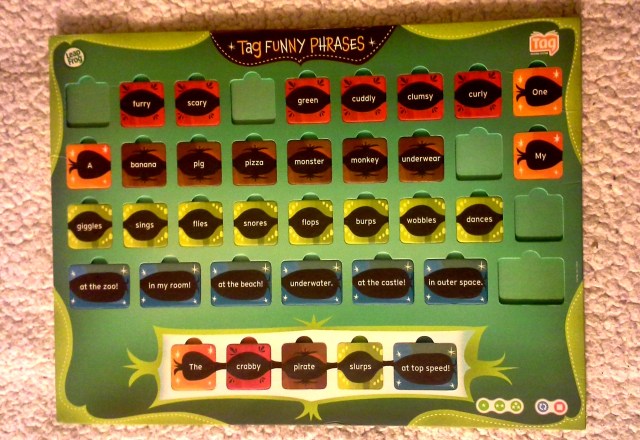
Now, this Leap Frog Tag Funny Phrases game (which was on sale for $9) doesn’t do much for my car’s ailing engine. But it solves another problem.

Recently I’ve begun experimenting with the children’s short story form, with the goal of eventually writing a picture book. Unfortunately, my practice has been stalled by lack of ideas. I have a handful of ideas for picture books I’d eventually like to write, but I’ve been saving those until I’ve had more experimentation with the form.

This delightful toy, though, is a kid lit writer’s dream of story prompt generators. Each tile has two words (one on front, one on back) to offer more than 250,000 sentence combinations.

That’s a whole lotta prompts.

All a writer has to do is select a tile, either deliberately or randomly, and place it in the corresponding color spot at the bottom of the board: orange for an article or pronoun, red for an adjective, brown for a noun (subject), yellow for a verb, and blue for a prepositional phrase.

My first creation of the night was “The crabby pirate slurps at top speed!”

The story possibilities started pouring into my mind. Why is he slurping at top speed? Does he have to eat quickly so no one steals his rations? After all, he’s among thieves and scoundrels, so it stands to reason someone would snatch his bread and watered down stew. Or maybe he has to eat hastily to get back on deck because a sea monster approaches.

Come to mention it, why is he crabby? Something must have made him grouchy. Unless, of course, he’s crabby in the sense of being crab-like. Perhaps the character is a crab who lives on a pirate ship.

Although if you’ve ever seen a crab eat, they tend to nibble more than slurp …

Anyhow, you get the point. The Funny Phrases board offers the spark to ignite a story. The majority of the stories inspired by the board and written from the prompts will never see the light of publication, but the practice and simple joy of writing make the exercise worthwhile.

The toy is meant to be used with a Leap Frog Tag Reader to help children up to to 7 learn word recognition, sentence building, and sentence structure. But I couldn’t resist adding it to my collection of writing tools. Once the husband and I have kids, the mini Barichellos of the household can commandeer the Leap Frog Tag reading system. It will be one among the many child literacy-building tools in the house.

But for the near future, I’ll be the one playing with this gem.
Posted in Writing | Tagged , , , , , , | 3 Comments

Illinois teachers, here’s an essay contest for your students

EssayContestAs a change of pace, instead of asking elementary school students to read, I’m asking them to write.

I’m excited to announce the inaugural Sarah & Katy essay contests. Two contests are open to third- and fourth-grade students in Illinois:

  • For third-graders, I’m hosting the 2016 Sarah & Katy and the Imagination Blankets Essay Contest (download the entry form and essay form).
  • For fourth-graders, I’m hosting the 2016 Sarah & Katy and the Book of Blank Essay Contest (download the entry form and essay form).

The essay prompts (included on the essay forms, which are available for download above) encourage students to exercise their imaginations and write creative stories. Three prizes will be awarded in each contest.

The first-place essay in each contest will win a free classroom visit from the author, plus personalized signed copies of both books. The second-place essay in each contest will win personalized signed copies of both books, which will be mailed to the teacher to distribute. The third-place winner in each contest will receive a personalized signed copy of the book their prompt is based on (i.e. the winning third-grader will win a copy of “Imagination Blankets” and the winning fourth-grader will receive a copy of “Book of Blank”).

The deadline to postmark essays is February 29. Teachers of winning students will be notified by March 15, and the teachers of first-place winners will be contacted to arrange a date for a classroom visit. During classroom visits, I offer a discounted rate of $5 per book (instead of the $8.99 list price) for any students who want to buy books. I also offer teachers the option of sending an advance list of students who will purchase books in order to personalize and sign each copy before the visit.

All six winning essays will be published on my website.

More information about each contest, including rules, is available on the For the Classroom page.

Interested in a school or classroom visit?

Classroom visits are open to all schools and teachers, with a variety of presentation subjects and activities included. School visits can be conducted in individual classrooms or can be presented to larger audiences in the school library or gymnasium. Virtual visits also are an option.

The standard fee for a school visit is $350 (which includes the cost of travel). Skype visits are $100. Rates are negotiable, particularly for small or rural school districts with limited funds. To discuss rates or arrange a visit, contact me at julie.stroebel.barichello@gmail.com or fill out the form on the Contact page.

Posted in Literacy and Education | Tagged , , , , , , , | 2 Comments

From the mouths (and minds) of children

Last weekend, I was visiting my parents on the same day my nieces were visiting them. Sarah marched over to me and said, “So. For the next book, Milana says to include Cloud Men, Cloud Kingdom …”

She began rattling off the list of ideas she and Milana (her best friend, who also is a character in “Sarah & Katy and the Book of Blank”) have for a new Sarah & Katy book.

Children’s imaginations are a gold mine of ideas. They are an endless resource of ideas. Just ask Ethan Nicolle, the artist behind the comic series Axe Cop.

Even though Axe Cop was launched by an artist in his thirties, the story began in the imagination of a five-year-old. On the Axe Cop website, Nicolle tells this story:

The AXE COP saga began on a Christmas visit to see my family. My father … has managed to produce a variety of children, ranging from me, a 29-year-old comic book artist, to my 5-year-old brother Malachai. … During the visit Malchai was running around with his toy fireman axe and he said he was playing “Axe Cop.” He asked me to play with him, and I asked what my weapon was … so he brought me a toy flute (actually a recorder). I told him I would rather be Axe Cop than Flute Cop, and he seemed just fine with being Flute Cop. The story that followed became more and more brilliant, until I couldn’t contain myself and I had to draw the whole thing into a one page comic. From there the saga continued, and over the course of my week-long visit we cranked out the first four episodes of AXE COP. I posted the comics to my blog and on Facebook and they got great responses. …

The writing process is basically just me quizzing Malachai as he develops the saga. … Everything in AXE COP started in Malachai’s head, all I do is sort it out and draw it. [These comics] are a fun slice of the mind of a 5-year-old boy processed through the pen of a 30-year-old comic artist.

The collaboration between adult and child brothers has resulted in an online comic series, action figures for sale at major retailers, T-shirts, and a TV show. (Heads up to parents, though — the cartoon on Fox is intended for mature audiences and may not be suitable for children. The violence in Axe Cop isn’t your Road Runner and Wile E. Coyote brand of walk-it-off violence.)

Despite the adult content in the series, the comic’s success springs from the imagination of a five-year-old and the talent/skill of an adult.

Youthful imagination plus adult skill sets. It’s a perfect match.

Unfortunately, last weekend when Sarah shared her and Milana’s ideas, I had to confess I don’t have plans for a third Sarah & Katy book in the near future.

But if a third book eventually is added to the table, there will be Cloud Men living in the Cloud Kingdom.

Posted in Unplugged imagination | Tagged , , , , | Leave a comment

Storytelling without words

There are so many ways to tell a story with words.

First-person or third-person point of view, poetry or prose, short story or novel.

But words aren’t the only way to tell a story.

Natalie “Tally” Nourigat is a writer, cartoonist, and animator from Portland, Oregon. Her artwork named Monsters and Dames turned up in my Facebook feed with a single sentence fragment: “A girl and her sea monster.” That set the stage for this story told without words:

A Girl and Her Seamonster

Four panels. No words. But they say so much about an entire lifetime.

One of my favorite parts about stories told with art is how open-ended they are. Even though so much story is told, there’s so much more story we can fill in with our imaginations.

Posted in Reading | Tagged , , , , | Leave a comment

Thoughts on the power of children’s literature

Children’s writers have a beautiful responsibility.

After all, children’s literature is the first reading material most people encounter in their lifetimes. Books written by children’s authors are the doorway to a lifetime of reading.

I’ve mentioned in the past that the majority of five-star books in my Goodreads list are children’s books. Early reading has a strong impact on creating a lifetime reading habit.

What an honor to be one of the first authors on the road to literacy and reading.

I recently learned a classroom in my city is reading “Sarah & Katy and the Imagination Blankets” together. For that reason, I have a responsibility — particularly as an independent author — to write exciting, interesting, and educational material that is free of errors. (Although not didactic in its education.) I owe it to young readers to have well-edited material. If there’s the slightest chance that one of my books will be among those that shape a child’s reading life, I owe them the best book I can offer.

Those five-star books in my Goodreads list — those favorites from my childhood — laid the foundation for joy in reading. They encouraged me to continue exploring shelves to seek out more new favorites. They opened worlds beyond my bedroom, introducing me to multitudes of people, places, situations, emotions, and ideas.

That’s the power of children’s literature. I’m grateful to be a part of it, both as a reader and a writer.

Posted in Literacy and Education | Leave a comment