A to Z: Wanted – multicultural and diverse books

Throughout April, I’m tackling 26 A to Z topics related to children’s literature. And today is M Day! Which means it’s time to talk about multicultural children’s books and diversity in literature.


Children Group Walking School Students Go Isolated Flat Vector Illustration

Fotolia | mast3r

I never had a problem finding myself in book characters.

When I was growing up, there were plenty of white, American, middle- to upper-class girls in books, such as the Sweet Valley Twins series, or the Baby-Sitters Club. Popular titles like “Ella Enchanted” featured a light-skinned, brown-haired girl on the cover. My beloved fantasy novel “Dealing With Dragons” featured a white-skinned, dark-haired Princess Cimorene on the cover.

There were plenty of girls who looked like me and my classmates. My rural Midwest school was mostly Caucasian, with a few Hispanic students. For a few years, one black student attended our school.  After she graduated, the student body reverted to 100 percent white and Hispanic.

The volume of white, middle class characters in children’s literature has led to an awareness campaign to boost diversity in children’s books.

Eleven-year-old Marley Dias knows is a young activist leading a campaign to find the color in children’s books. She spearheads the #1000blackgirlbooks initiative, which seeks books about the lives and experiences of black girls. Don’t let the hashtag fool you, though — when NPR reported about her project in February, she already had compiled more than 4,000 books about black girls.

Despite the high number of books Dias has found, the NPR article shared a discouraging statistic: “Fewer than 10 percent of children’s books released in 2015 had a black person as the main character, according to a yearly analysis by the Cooperative Children’s Book Center at the University of Wisconsin, Madison. And while the number of children’s books about minorities has increased in the past 20 years, many classroom libraries have older books.”

Hence the push to raise awareness about diversity in literature.

One of the leaders in promoting multicultural children’s literature is the grassroots campaign We Need Diverse Books. The group defines its mission as “putting more books featuring diverse characters into the hands of more children,” with the vision of “a world in which all children can see themselves in the pages of a book.”

Children of all races, ethnicity, social status, country of origin, household structure, sexual orientation, and ability deserve to see themselves reflected in literature. Those children should be able to find a mirror of themselves in fiction so they can connect and grow with characters like themselves.

Moreover, other children deserve a window. When I have children, I want to know they have literature that can connect them to other people and help my children empathize with people in situations different than their own.

Parents may be asking themselves, “Where can I find diverse books? Should I just start prowling the stacks in the library or the shelves at the local bookstore?” While that’s one way to do it, here’s another: We Need Diverse Books has aggregated blogs and websites that list and/or review different types of diverse literature. Check out their Where to Find Diverse Books page as a starting point.

If you have any favorite diverse books, be sure to share them in the comments section so I can check them out!

Posted in children's literature | Tagged , , , , , | 4 Comments

A to Z: Childhood literacy – can your child read this headline?

Throughout April, I’m tackling 26 A to Z topics related to children’s literature. In honor of the letter L, literacy is the subject of the day. Below, you’ll find excerpts of an article about childhood literacy I wrote in April 2015 for The Times newspaper, which serves La Salle County, Illinois. The version below has been edited to remove hyperlocal statistics related to the La Salle County area.
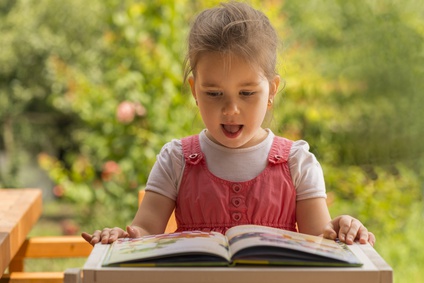

Outdoor portrait of an adorable young little girl reading a book in the garden

Fotolia | Alexandrum01

What is the link between “Goodnight Moon” and academic excellence?

Or how about “Green Eggs and Ham” and career success?

The question may seem like a riddle, but the answer is no joke.

Early childhood reading can have a lifelong impact on an individual’s success in school, the workplace, and beyond, experts say, because it is the building block of a vital skill:

Literacy.

A 2012 national study by The Annie E. Casey Foundation found children are four times more likely to leave high school without a diploma if they are below proficient reading level in the third grade. Three years earlier, the 2009 National Assessment of Educational Progress reported 67 percent of fourth-graders scored below proficient levels on reading tests.

A child’s literacy development from birth through early elementary school can be a strong indicator of later life success, according to the 2012 study.

Parents shouldn’t feel overwhelmed at the task of developing literacy, though. Teachers, librarians, and other literacy experts have plenty of recommendations to ensure strong child literacy development.

BUILDING THE FOUNDATION

The key to teaching literacy is starting early.

Really early. As in, as soon as possible after birth.

“You’re sitting in the hospital. You’ve just delivered. Start reading,” said Stephanie Benson, president of Starved Rock Reading Council, which promotes literacy in five counties in North Central Illinois.

In surveys, educators emphasized reading education begins at home.

One La Salle County, Ill., teacher conducted graduate research by surveying 110 families in a local school district. The research revealed less than one-fourth of families had reading materials in their homes. This included books, magazines, newspapers and online sources. Only one family reported having a library card.

To ensure strong literacy development, surveyed teachers said reading material is a necessity in the home.

Child reading behavior is most influenced by habits created at home. When children see parents read, they mimic the behavior. Likewise, if parents don’t read, children are less likely to do so recreationally.

Tina Sandoval, a children’s librarian at Reddick Library in Ottawa, Ill., encourages families to set aside time in which the entire family reads.

“This doesn’t necessarily need to be out loud or to each other,” she said. “Just set aside time when there’s no television or video games or cellphones and everyone reads.”

Children are more likely to read — and more encouraged — if they see their parents and siblings reading, Sandoval said.

Tools for literacy skill development aren’t limited to books, according to Elaine Robinson, a reading specialist at Marseilles Elementary School.

“Talking about reading can be as important as actual reading,” she said. “When you read, talk about what’s happening in the book, point out things on the page and ask questions.”

Robinson also encourages parents to build vocabulary through a child’s surroundings.

“Point out print when you are out running errands or going to sporting events,” she advised. This could include road signs or product packages in the store.

“Build your child’s vocabulary by talking about interesting words and objects you see.”

GOING BEYOND BOOKS

Electronic resources are popular to purchase for at-home literacy education.

Educational TV programs and apps for tablets and smartphones can help, but Benson says they should be supplemental, not the main source of literacy development.

When technology does come into play, such as watching children’s programming, Benson recommends turning on closed captioning. That way, children see the words and associate them with the content on the screen.

Cristy Stupegia, director of La Salle Public Library, offers similar recommendations. When using an e-reader, she recommends apps that include audio so children can listen and follow along with words on the screen.

“It’s just another type of interactivity,” she said. “Any time a child is exposed to anything in writing — a book, a magazine, something on the computer — that’s all time that’s invested to introduce those literacy skills as well as enhance them.”

Benson said tablets and e-readers have their place — plenty of research points to electronic reading devices encouraging people to read.

“If a child will read on an iPad, I’m all for that,” she said. “You’re reading? Keep reading. Go for it.”

But her encouragement comes with caution. Research also suggests better comprehension comes from reading print material. Readers are more likely to remember content because of how it looked on a page and where it was placed.

Old-fashioned reading material has an added benefit for infants and toddlers. Streator Public Library director Cynthia Maxwell said physical books offer tactile interactivity. This allows children to feel the book and experiment with turning pages, as well as helps develop the skill of reading left to right, top to bottom.

Sandoval, the children’s librarian at Reddick Library, added that not all books translate well into digital format, particularly picture books.

“This is especially true when picture books for children have textures or glitter,” Sandoval said. “Some of these books are even pop-ups and are interactive, which tends to get lost when using some of the electronic devices.”

WHY LITERACY MATTERS

Literacy is a cornerstone of classroom performance, said La Salle County teachers in surveys issued by The Times newspaper.

Poor literacy skills affect all areas of learning, the surveys reported. This is because reading strategies are incorporated into all school subjects.

For example, students who struggle with reading also will struggle with math because word problems will be difficult to comprehend. Science and social studies can become a challenge because the text uses higher level words.

Students also need higher level reading strategies and skills to apply information from textbooks to class assignments or discussions, teachers said.

Teacher surveys indicated additional challenges for struggling readers, such as eroded confidence, which can cause a student to stop trying.

When low literacy deprives children of basic elementary education, it can have a domino effect on the rest of their educational career, leading to higher risk of dropping out of school and lower likelihood of breaking beyond entry-level careers.

“Literacy has a critical impact on a child’s school success,” Robinson said. “Children who are reading at least at grade level by third grade are more likely to have greater academic success later in school. Children who can’t read at grade level by third grade are at higher risk for later school failure, behavior problems, frustration, absenteeism, dropping out of school and other negative outcomes.”

LEAPING HURDLES

As a grade school reading specialist, Robinson provides support and interventions to struggling readers and promotes overall literacy achievement.

Robinson recognizes the struggle some families face in carving reading sessions into their schedules, particularly when both parents work.

Parents who didn’t spend much time on reading and literacy development before their child entered school shouldn’t lose hope, though. Robinson said it’s never too late to start working with children to hone their skills.

“If your child is already in school, you can help boost your child’s reading skills by modeling good reading habits, monitoring the amount of time your child spends watching television and providing a quiet atmosphere so your child has a place to read or complete homework,” she said.

In cases where the parent struggles to read, Stupegia still urges the family to read together.

“I know parents who won’t read to their children because they can’t sound out word and don’t want to look foolish in front of kids,” she said. “Be bold. Just do it.”

Moreover, Stupegia says struggling child readers shouldn’t let themselves get hung up on a word. If it creates a stumbling block, it’s OK to move on.

“One of the things we think when we’re reading a book is it has to go word by word, step by step,” she said. “We get so focused on rote learning and making sure it’s perfectly correct — that’s intimidating to people. My advice for kids and parents alike is, if you don’t know a word, make it up, use your imagination.”

Robinson believes exposure to reading and language is more important than being able to read actual words. The solution, Robinson says, is simply to keep reading to a child and have a child “read” to parents, even if they are telling the story with their own words instead of sounding words out.

“I see some parents and families who get very frustrated if their child seems ‘behind’ their peers or isn’t reading as well or as early as their peers are,” Robinson said. “I try to stress that all children develop at different rates.”


Posted in Literacy and Education | Tagged , , , , | 1 Comment

A to Z: ‘Koren of the Quest’

Throughout April, I’m tackling 26 A to Z topics related to children’s literature. Today is all about the letter K, which has me reminiscing about the first chapter I ever wrote: “Koren of the Quest.”


I was still a kid myself when I wrote my first book children’s chapter book.

Between fifth and sixth grade, I was reading The Enchanted Forest Chronicles, which consist of four books: “Dealing with Dragons,” “Searching for Dragons,” “Calling on Dragons,” and “Talking to Dragons.” They were my newly found favorites, and my latest goal was to write a book similar to Patricia C. Wrede’s series.

That summer, I collected a ream of loose leaf notebook paper, a few sharp pencils, and a manila envelope that I labeled Top Secret. I dug out a baby name book and wrote down every name that sounded like it belonged in a fantasy story, and I took special care to outline characters based on the name’s meaning. According to the baby book, Leila meant “black or darkness of night.” So I created a character dubbed Leila the Black and Darkness of Night.

The name Koren, incidentally, was said to mean “quest.” I selected Koren as my main character, and the book would be about her quest.

I recall some details of the book better than others. There was a dragon named Tallulah. There were two kingdoms: one consisting of women, and one consisting of men. They were separated by a mountain range, and they never mingled. If either sex crossed into the other’s kingdom, it would spark war. Koren encountered and befriended a lost boy named Owen, who somehow ended up in the women’s kingdom. And Koren’s main goal in life was to get her title. To reach womanhood, every woman had to earn her title. (Such as Leila, whose title was The Black and Darkness of Night.)

I don’t recall the inciting incident that set Koren off on her quest. (I have a vague idea that her quest might have been to return Owen to his kingdom before he was found and killed.) But Koren and Owen set off together, and they eventually are joined by Tallullah and a fairy clan.

I also borrowed heavily (probably to the point of plagiarizing) from The Enchanted Forest Chronicles. I included vanishing cliffs and dragons bane and melting wizards and the sexless title King of the Dragons, which could be given to male or female dragon rulers.

I regret that, as a teenager, I found the handwritten manuscript and deemed it unworthy of keeping; after all, it was unpublishable in its current form, so I threw it away. At that point, my focus was moving toward writing books for adults.

These days, I wish I still had that folder of loose leaf pages. Even if it never got edited and polished and got bound between covers, it would be nice to have that artifact of my personal writing journey.

To the other writers out there: Do you remember your first full-length project? I’d love to hear about it in the comments.

Posted in Writing | Tagged , , , , , , | 1 Comment

A to Z: Judging a book by its cover … and other ways of choosing children’s books

Throughout April, I’m tackling 26 A to Z topics related to children’s literature. Today’s topic is a subject I addressed on my old blog, EveryJournalist Fiction: judging a book by multiple elements and what convinces us to buy books.


I have a confession.

One moment. Let me take a deep breath …

Here goes: I judge books by their covers.

I know, I know. That “don’t judge a book by its cover” adage is a time-honored favorite. We’re supposed to judge a book by its contents, not by its design.

As a reader, I should know better. Even an ugly book can have  a great story hidden between its covers. But the author side of me says covers are important. And the reader within me reluctantly admits that covers often are the first thing that attract me to a book sitting on the shelf.

As a consumer, when I go book shopping, undoubtedly there are dozens — hundreds, in fact — of books worth buying. However, when I go on a book-buying excursion, I can neither afford nor carry hundreds of books. That means the selection process has to be narrowed somehow.

Over the weekend, the husband and I went to Chipotle for lunch. With Barnes and Noble just a few streets away from Chipotle, it’s inevitable that we end up there. We’ve been slowly but surely building a home children’s literature collection in the hopes we eventually have a Baby Barichello to enjoy them. As I combed the children’s section, I found about 15 books I wanted to buy.

But with picture book prices ranging from $7.99 for paperback to $21.99 for hard cover, I had about $255 worth of books in my hand.

And $20 to spend for the day.

So, what criteria attracts me to children’s books in the first place?

Where the WIldFAMILIARITY. When it comes to picture books in particular, familiarity and name recognition go a long way. Picture books have several classics, such as “Where the Wild Things Are,” that are must-haves for every kid lit collection. During our weekend Barnes and Noble excursion, this is one of the titles I ended up buying. I want our kids to meet the Wild Things in our home and have a copy of their own.

Familiarity is the same reason I bought $50 worth of Dr. Seuss books a few weeks ago. But what about books that aren’t on my radar?

COVER/JACKET DESIGN. The first thing to catch my eye on unfamiliar books is the cover and/or jacket design. Interesting cover art is sure to make me beeline for a book. Clever covers also draw me in. “The Book With No Pictures” has the blandest cover you can imagine, but its bold declaration of being a children’s book without pictures attracted me to it.

On the flip side, a bad cover is a fast way to make me skip a book. Even though I know “Smile” is a popular graphic novel, I never picked it up at a store because the smiley face with braces didn’t capture my attention. It gave me no insight into the book, other than the assumption that a character has braces. The first time I flipped through it was when my niece shared it with me.

Smile     Sisters

Conversely, I think the cover of “Sisters” is more interesting. It’s the same design concept, but now the cover tells me something about the story: There’s some friction and conflict present.

TITLE. The next best thing to catch my eye is the title. A good title can intrigue me into plucking the book from its brothers on the shelf. It’s harder to determine what makes a good title. On our weekend excursion, I stumbled upon a copy of “Tuesday,” by David Wiesner. At first glance, it’s a dull title, but it immediately planted a question in my mind: What happened on Tuesday?

BACK COVER COPY. When I flip to the back cover, the book has passed the first two hurdles. Now I’m interested in the content and want to read what the book is about. Now is the time for the plot or character synopsis to make its mark.

TuesdayWhen it comes to picture books, the back cover copy is replaced by reading the actual book. If I like the story and interior art (because in picture books, art is part of the reading), there’s a good chance the book is coming home with me at this stage. Take “Tuesday,” for example. The title first caught my attention, and while the cover art isn’t particularly exciting, when I opened the book I found beautiful illustrations and a story (told almost exclusively in pictures) that made me laugh. “Tuesday” is now in my home collection.

FIRST PAGE. Next comes the First Page Test for chapter books. I read the opening line. On any given book excursion, I read anywhere from 25 to 40 opening lines. I dig through a lot of books. Most of the time, this is where a book loses me. (Yes, writers, your opening line matters immensely.) If a first line hooks me, I read the first page. If the book has strong opening paragraphs, it comes home with me.

EXCEPTIONS TO THE RULE. There always are exceptions. If a book was highly recommended by a friend, that gives it a boost. If I find a book written by an author I like, that also weighs in favor of purchasing it without going through as much examination.

How do you choose which books to add to your children’s literature collection or your home library in general?

Posted in children's literature | Tagged , , , | 3 Comments

A to Z: Imaginary friends popping up in kid lit

Throughout April, I’ll be tackling 26 A to Z topics related to children’s literature. Since today is all about the letter I, the topic of the day is imaginary friends.


Noni was invisible.

Not the metaphorical invisible, as in everyone ignored him or he felt largely unnoticed. Noni was literally invisible.

Except to me. I could see Noni.

The first time Noni showed up was the year my older sister started school. For the first time in my life, I was home alone all day with no one to play with. So I did what many lonely children have done: I turned to my imagination to find a friend.

And on a drive to the grocery store one morning, there he was in the back seat beside me.

I don’t remember Noni’s grand entrance into the family, but Mom likes to retell the story from time to time. I was sitting quietly in the back seat, looking out the window, when I suddenly turned to gaze at the seat beside me and said, “Noni, why is that fat lady sitting on you?”

Imaginary friends are common partners in childhood, and lately they’ve been common in children’s literature.

ImaginaryTake A. F. Harrold’s “The Imaginary,” for example. It’s a book about a girl named Amanda Shuffleup and her imaginary friend, Rudger, getting separated when Amanda is in a coma. It explores the question of what happens to imaginary friends when their children aren’t around or outgrow them.

(You can check out my review of “The Imaginary” from earlier this year.)

CrenshawKatherine Applegate’s latest chapter book, “Crenshaw,” also features an imaginary friend playing a main role. As a child, Jackson imagined an overgrown cat named Crenshaw as an imaginary friend. Even though he’s about to enter the fifth grade and considers himself too old for something as childish as an imaginary friend, Crenshaw returns when his family goes through a crisis. As the family loses their home, Jackson learns to cope with the situation.

BeekleThere’s also my new favorite picture book, “The Adventures of Beekle: The Unimaginary Friend.” I fell in love with Beekle as soon as I saw him on the cover. (Seriously, how adorable is this little guy? He reminds me of the adipose* from the Doctor Who episode “Partners in Crime, Season 4, Episode 1). Once I read the story, I loved him even more. Beekle lives on an island where imaginary friends wait to be chosen, and he waits for a child to claim his as their own. But when he continues to be overlooked, he stops waiting and instead goes seeking to find his friend.

Imaginary FredAnd, of course, there’s “Imaginary Fred.” A lonely boy named Sam wishes for a friend, and that’s how he discovers Fred, who is an experienced imaginary friend. Fred has accompanied plenty of children as an imaginary friend, and he wishes for a long-term friend. Then Sam meets a girl named Sammi, who has an imaginary friend named Frieda. The story shows the development of friendships and groups of friends.

All of the books listed above were published in 2014 and 2015. Apparently imaginary friends aren’t only a trend among children anymore; they’re a growing trend in children’s literature as well.

* Bonus: See? I told you Beekle looks like the adipose!

Beekle

Beekle

Adipose

Adipose

Posted in children's literature | Tagged , , , , , | 9 Comments