REVIEW: A Literary Tea Party cookbook

I was walking through the newsroom where I work two weeks ago when a reporter waved me to his desk.

“I know you like literary things,” he said. “Have you heard about this new cookbook that’s coming out?”

He gestured to his screen, where there was a cover image of “A Literary Tea Party” by Alison Walsh. He was writing a preview about the book’s June 5 release and interviewing the author.

Literary tea party

The preview article my newspaper published moved across my desk last week during the evening production shift, and I had the chance to read more about it. “A Literary Tea Party” takes inspiration from foods in classic literature — such as the Turkish delight in the Chronicles of Narnia and “Bread and Butter Flies” from Alice in Wonderland — and turns them into recipes that any do-it-yourselfer can put on the table.

I’m a dabbler at cooking and baking — I love homemade meals, but I would be stretching the truth to say I cook at home more than twice a week. It’s a lucky week when I put homemade meals or treats on the table three to four times.

Even so, I knew I had to have this book.

One Amazon order later, it showed up my doorstep on Saturday. Unfortunately, it arrived after I pulled a loaf of spiced banana bread out of the oven. (There goes half my homemade quota for the week.) We had four extremely overripe bananas in the fruit basket that needed to be used, so I Frankenstein’ed a surprisingly tasty recipe from a handful I found online. When the book turned up on my doorstep later that afternoon, it turns out there was a banana bread recipe inside — Beorn’s Honey Nut Banana Bread, inspired by “The Hobbit.”

I was more than a little disappointed at the timing. If only I could’ve tested a recipe the first day!

From a literary standpoint (and especially a kid lit standpoint), the choice of literary links in this book is Turkishly delightful. Titles and series represented include:

  • The Chronicles of Narnia
  • The Borrowers
  • James and the Giant Peach
  • Alice’s Adventures in Wonderland
  • The Wonderful Wizard of Oz
  • Redwall
  • King Arthur
  • The Phantom of the Opera
  • Little Women
  • Winnie-the-Pooh
  • Miss Marple and Hercule Poirot mysteries
  • Anne of Green Gables
  • Sherlock Holmes
  • White Fang
  • The Hobbit
  • A Little Princess
  • The Secret Garden
  • Romeo and Juliet
  • Treasure Island
  • Peter Pan
  • A Christmas Carol
  • The Adventures of Tom Sawyer
  • The Raven by Edgar Allen Poe

Parents, teachers, librarians, and lovers of kid lit, do you see the number of children’s titles on that list? There are even more kid-friendly titles if you’re a believer in sharing Illustrated Classics with the kiddos. (Be a believer in sharing Illustrated Classics … they’re an amazing introduction to classic literature at a young age.)

Even better, almost all of the titles on the list have multiple recipes associated with them. That makes it easy to build a themed party. Want to host a mystery-themed book club meeting or movie night? Serve up Sherlock’s Steak Sandwiches with an Agatha Christie-inspired Delicious Death Chocolate Cake for dessert.

Or how about an Alice in Wonderland birthday party for your curiouser and curiouser young reader? Bread and Butterflies and Stuffed Button Mushrooms make good finger foods, and you can stick some birthday candles in the Queen of Hearts’ Painted Rose Cupcakes.

Each recipe includes either a passage from its related book or an explanation of the recipes link to its literature.

As the title suggests, the theme of the book revolves around a tea party. Naturally, that means a hefty portion of the recipes are tea recipes, and it’s supplemented by a decently lengthy list of savory bites and desserts. As I initially fanned through the pages, I was disappointed at the long list of tea recipes for the simple reason that I’m not a tea drinker. I haven’t found a blend yet that doesn’t make me feel like

Meeko

I’m tempted to try the Anne of Green Gables-inspired Raspberry Cordial Tea, though. And honestly, I’m easily won over by names like Second Star to the Right tea, so I’m willing to give a few recipes a try.

But Walsh must have anticipated picky drinkers like me (and may even have had young tastebuds in mind), because she included a list of five tea alternatives:

  • Autumn Harvest Cider (Redwall)
  • Hundred Acre Hot Chocolate (Winnie-the-Pooh)
  • London Fog Lattes (Sherlock Holmes)
  • Raspberry Cordial (Anne of Green Gables)
  • White Witch Hot Chocolate (The Chronicles of Narnia)

The range of offerings is good, from buns and breads to cookies and eclairs, to cake and cupcakes, to doughnuts and eclairs. There’s something for multiple skill levels inside.

20180611_025222Now, I have no doubt when I try some of these recipes, mine will look like spectacular Pinterest fails. After all, I can’t make it through a loaf of simple banana bread without texting Mom to ask how long I have to let it cool before adding the icing. (Spoiler: I didn’t let it cool enough and the icing melted down the sides. Although it looked nice after, so I pretended I meant to do that.) When I try to make something technical like these Cyclone Cookies (The Wonderful Wizard of Oz), I’m sure Paul Hollywood and Mary Berry would be appalled at my spiral and layers. But Walsh makes her recipes clear and accessible to baking beginners like me, so there’s hope.

I’ll post photos and updates as I disappear into Narnia … er, my kitchen … later this week and test a few of the recipes. (And even better … taste-test them!) I’ll also post what the recipe is supposed to look like, since I don’t want to do Alison Walsh the disservice of representing her recipes solely by my (lack of) culinary skills.

My initial review: If you love books and like food, get this cookbook. I’m not much of a host, but I’m already plotting a bookish get-together for fellow readers and writers that will revolve around these recipes. I hope she releases another volume in the future with even more literary references.

In the meantime, for more literary and pop culture recipes not included in the book, you can follow Alison Walsh on her blog, Alison’s Wonderland Recipes.
Posted in Reading | Tagged , , , , , | 1 Comment

A book’s surprise literary connection to home

It’s no surprise that Richard Peck is connected to the house my husband and I bought last year.

(At least, it isn’t if you caught my story of a visit from one of the home’s former occupants and my recent ode to Richard Peck.)

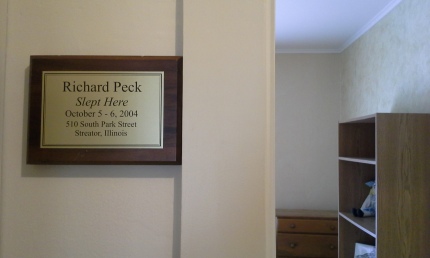
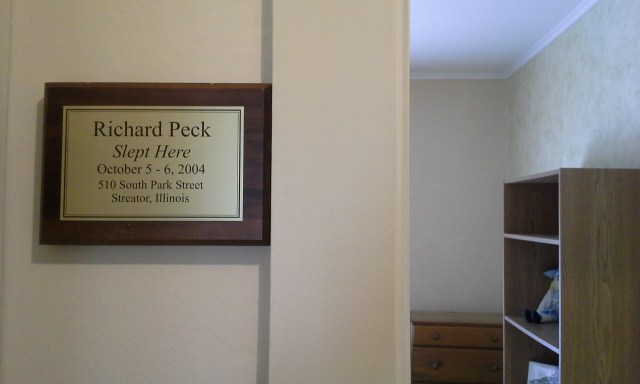
I learned in August 2017 that the family from whom we bought our house hosted acclaimed children’s and young adult author Richard Peck, thus christening the guest room as the Peck Room forever after. Because of Peck’s influence on my own reading and writing life, my husband and I carried on the tradition. A plaque outside the bedroom door — gifted to us from the home’s decades-long former family — hangs there today.

Peck Room

You can see from the date that Peck stayed here Oct. 5-6, 2004, during a round of visits to Streator schools and our gorgeous Carnegie library.

That was nearly 14 years ago. Sadly, a week ago today, I read the announcement on Peck’s Facebook page that the 84-year-old author died on May 23 after living with cancer.

20544019_683420473705_927578940396919256_oIn his honor, I decided last week to search my shelves for one of his books I hadn’t yet read. Last summer, during the annual Riverfest used book sale in downtown Ottawa, I stumbled on a copy of “Fair Weather,” a gently worn copy that had been removed from circulation at Streator High School’s library and donated to the sale. (It’s the pale blue spine, eighth from the bottom, just under “Water for Elephants.”)
The title wasn’t even on my radar when I stumbled upon it at the book sale last year. I added it to my stack merely for the sake of the author’s name — I’ve never been let down yet by a Richard Peck book, and like the others, this one didn’t disappoint.

In fact, it came with a bonus surprise.

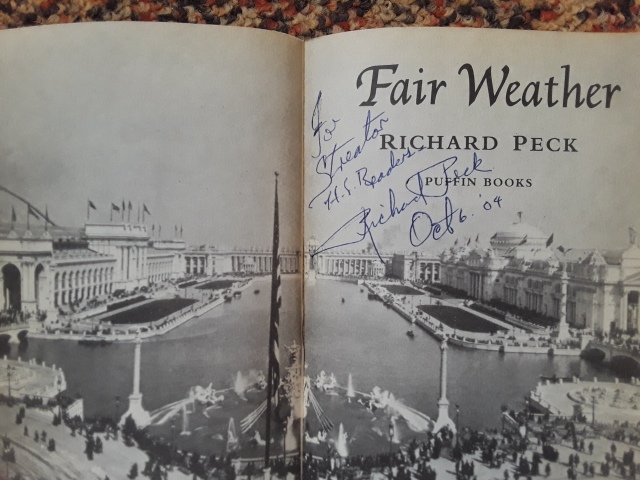
When I opened to the title page, I found Peck’s blue-inked penmanship:

20180531_174533

The note reads, “For Streator H.S. readers – Richard Peck Oct. 6, ’04”

This book was signed for the local high school during Peck’s two-day stay at my home.

I never had the opportunity to meet Richard Peck, and his visit to Streator only accounted for two days out of his 84-year life. But I am endlessly overjoyed every time his visit ripples into my life.

20180531_174513.jpgThis book — particular this specific copy of this book — felt like the appropriate farewell to a beloved writer. It was a fitting conclusion to my brief, distant connection to Peck.
But there will always be a bond between writer and reader when a book is in hand. Every time I crack the well-loved spine of “A Long Way From Chicago,” the divide is closed, because he’ll be right here in the home he visited for two days in 2004, telling me a story.


Posted in Reading | Tagged , , , , | Leave a comment

Thank you for the stories, Richard Peck

I met Richard Peck through Grandma Dowdel.

She’s not my grandmother. In fact, she’s his. Not in the way you might expect, though.

Grandma Dowdel is a character in Richard Peck’s novels “A Long Way From Chicago,” “A Year Down Yonder,” and “A Season of Gifts.”

I first met Grandma Dowdel when my Aunt Robin — a children’s librarian — gifted “A Long Way From Chicago” to my parents, sisters, and I. The fearless, confident, mischief-making old woman won me over from the first pages. Her spirit of mischief has stuck with me for well over a decade, and I’ve revisited those books numerous times to meet her again.

Grandma Dowdel’s spirit of mischief has heavily influenced all of the Molehill children in my next novel, “The Mountain of Dempsey Molehill.” I keep a copy of Peck’s books close at hand in my writing room.

Peck’s influence on my life as both a reader and a writer made the news of his death this week particularly saddening to me.

PeckPost

Richard Peck has another small influence on my home. When we purchased our house last year, we learned from the previous owners — one of them an English teacher and longtime supporter of the local library — that Peck stayed in their home during his visit to Streator in 2004.

They were honored and overjoyed by having Peck as a guest — so much so that they displayed a plaque in the house and dubbed the guest room as the Peck Room.

They were generous enough to pass the plaque on to us, and it is proudly displayed outside the bedroom door.

Peck Room

After my parents learned of Peck’s connection to my new home, my family became especially devoted fans. Although it’s a small connection, our love of his books made it feel like a bond. One of the housewarming gifts from my parents was Peck’s only picture book, “Monster Night at Grandma’s House.”

Over a 45-year writing career, Peck produced 43 books — nearly a book a year, and the majority of those for children and young adults.

He gave us an extraordinary gift in his stories and writing. I’ll miss seeing his name on newly released titles. But I’m grateful for the literary legacy he left behind.

Thank for the stories, Mr. Peck. Your pen may rest now, as may you.

Posted in Reading | Tagged , , | 1 Comment

Dear Opossums, I owe you an apology

In June 2017, I came home from a late-night shift in the newsroom and found a surprise waiting for me in the garage.

Somehow, a baby opossum Houdini’ed its way inside and was perched on the hood of my husband’s car.

Baby Possum

It took some work to shoo this guy out of the garage. Particularly since it adopted an “If I can’t see you, you can’t see me” method of hiding and tucked its nose in the corner farthest from the door to cower. Some gentle nudging with a broom eventually steered it out the door.

Having grown up in rural soybean-and-cornfield Illinois, ‘possums and I are no stranger to each other. They were frequent visitors to my childhood home year-round, often displacing our barn cats from their warm pet houses in the winter and forcing us to regularly evict them from the straw-and-blanket-lined pet homes.

In fact, they’re still frequent visitors to my parents’ home. That’s where my niece, Katy, first encountered them … and was terrified by them and “their ugly triangle heads,” as she put it.

Katy’s fear of opossums is what inspired the opossum army in “Sarah & Katy and the Imagination Blankets.” In the imaginary land of Katarah, opossums are the antagonist who are trying to take over the kingdom.

Possum Army

The Sarah & Katy books were written for my nieces Sarah and Katy, so the incorporation of fearsome opossums was a nod to the real Katy’s fear — and the book gave her a chance to see read about herself overcoming them in the story. Unfortunately, I’ve also done opossums a disservice by reinforcing the scary stereotype.

Even though opossums are fierce on the surface (I have to confess it’s a little off-putting when you’re in close quarters with a hissing ‘possum who seems to unhinge its entire face when it opens its mouth), they get an unnecessarily bad reputation.

The National Opossum Society reports this North American marsupial keeps a clean environment from which we benefit, calling them “nature’s little sanitation engineers.” They eat insects, carrion, and overripe fruit, plus catch and consume small rodents around the  yard. They also eat 90 percent of ticks they encounter, consuming as many as 5,000 in a season, according to the Cary Institute of Ecosystem Studies. If there’s one critter I consider my mortal enemy, it’s a tick … so the enemy of my enemy is my friend, right?

Like most wildlife, they can carry fleas, but they don’t carry rabies and are impervious to Lyme disease. And they’re not likely to bite you, anyway. The Cary Institute reports their first line of defense is drooling and hissing as a bluff. The big-bad-possum act works … especially on Katy. But when it fails, the opossum’s next line of defense is fainting and … well, playing possum.

Sure, possums aren’t cute and cuddly looking like cats, rabbits, and raccoons. At best, they’re just so ugly they’re almost cute. But they’re largely harmless, beneficial, and pretty interesting fellows. (Did you know opossum ancestors were alive while dinosaurs roamed the earth? Read more here.)

A few more tidbits, courtesy of the Opossum Awareness & Advocacy blog:

  • Opossums are North America’s only marsupial, carrying their newborns in a pouch. (Fun fact: They can have around 25 babies, or joeys, in one litter. Not so fun fact: Only about a dozen survive.)
  • Female opossums are called jills. Males are called jacks.
  • They’re nomadic and nocturnal.
  • The O at the beginning of their name is important. The possum is a mammal native to Australia; the opossum is native to North America.

Making Amends

As an apology to making out opossums as a vicious army, I’m taking two steps. The first is a donation to the Opossum Awareness & Advocacy nonprofit based in Vermont, which shares the following mission statement:

Our mission is to spread awareness about opossums’ many attributes, including the fact they kill ticks and mice that carry Lyme and other infectious diseases, and in doing so to improve the public’s regard and treatment of this very undervalued marsupial.

We also seek to complement other awareness and advocacy efforts, including but not limited to, the appreciation and preservation of wildlife, and the awareness and amelioration of Lyme Disease.

The second step is sharing opossum education and advocacy groups, including:

  • Opossum Awareness & Advocacy: An opossum advocacy group launched in May 2017. www.opossumpower.org Follow on Facebook at fb.com/opossumawarenessandadvocacy.
  • The National Opossum Society is full of trivia and information to help you learn about our marsupial friends at opossum.org.
  • Opossum Society of the United States: Under the General Information tab on this group’s website, there’s information about what to do for orphaned or injured opossums, tips for coexisting with them, and information for wildlife rehabilitators and veterinarians. Follow at opossumsocietyus.org.
  • See the cute and loveable side of opossums at fb.com/possumcore. You’ll find photos and memes galore.

A final note

You’ll be happy to know my niece no longer finds opossums terrifying. In fact, the last one Katy found wandering around my parents’ property was christened Louise. Who could be afraid of a critter named Louise?

Posted in Writing | Tagged , , | 2 Comments

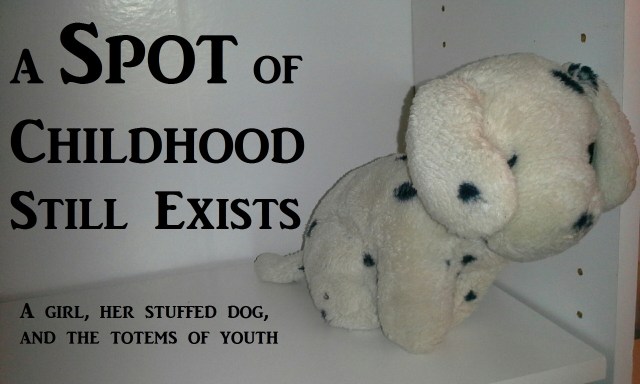
A Spot of Childhood Still Exists

SPOT

In December 1992, I was given a very special task: I got to help Mom wrap a Christmas present for my older sister, Jenny.

In July of that year, Disney released the VHS cassette of “101 Dalmatians.” Unbeknownst to me at the time, the Disney classic was to be one of our Christmas gifts. Because of the movie’s release, stores were full of plush Dalmatian toys that holiday season, and Mom commissioned me to help wrap one such toy puppy for Jenny.

There are few details I remember about wrapping that present. I can’t tell you the color or pattern of the Christmas gift wrap. I don’t remember if I filled out the gift tag or if Mom wrote “To Jenny.” I don’t even recall if the gift was meant to be from me (I suppose it was, since I was let in on the secret).

Two details, however, stand out now that 26 years stand between then and now:

  1. I was absolutely green-eyed with jealousy, because I wanted that Dalmatian.
  2. I was too young to realize that Mom’s general method of gift-buying was if one daughter got a toy, the other daughters got a similar one.

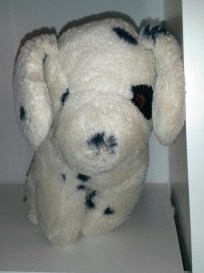
Spot CroppedMy green eyes faded back to their usual blue on Christmas morning when I unwrapped my own stuffed Dalmatian. And with a five-year-old’s usual brand of creativity, I christened him Spot. (This was a step above my stuffed hippo named Mr. Hippo, and my carnival goldfish named Fish.)
Spot was THE toy of my childhood. He was the velveteen rabbit to my Boy. (And, quite inspired by that book, I wholeheartedly believed that if I loved him enough, he would turn Real, with a capital R.)

And oh, how Spot was loved. From my fifth Christmas onward, we were inseparable. Not a night passed that Spot wasn’t cradled in my arm, his head tucked under my chin. If I awoke in the middle of the night and he had fallen from the bed, I panicked until he was recovered. (I remember one particular tearful night when Spot got kicked down to the end of the bed beneath my covers, and I assumed he had fallen on the floor. I was in hysterics and had the bedroom light blazing, searching under my bed and Jenny’s and generally tearing the room apart until Mom woke up and came to the rescue.)

Teddy bear defender

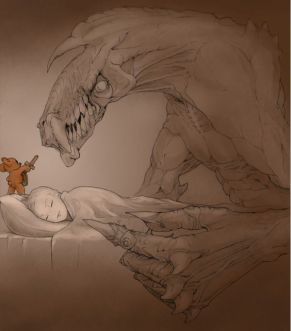
Stuffed animals: Defenders of dreamers, protectors of sleepers

He was my companion — and, often, my guard dog. His tail got stretched to twice its length from my habit of swinging him like a mace to bop my sisters any time they picked on or displeased me. His plastic nose detached after one too many whacks, which led to another batch of hysterics until Mom sewed the hole on his face and drew a new nose with permanent black marker.

And, as every child with a stuffed animal knows, Spot protected me at night from the monsters in the shadows. As long as your arms are under the blankets and your stuffed animal is in bed, you’re safe.

There was almost never a night without him. He came on every vacation — and bless Mom for double, triple, and quadruple checking he was safely stowed in the car before we drove home. When college rolled around, he came with me. (There was one agonizing week without him … Mom suggested I leave him home because my floormates might tease my graying, ratty, bald-at-the-seams childhood toy. On move-in day, nearly everyone in my dorm could be seen carrying their loved-to-tatters childhood companions; my parents delivered Spot the next weekend.)

Even when my husband and I first lived together, Spot was in the crook of my arm those first few nights. Nineteen years of falling asleep with Spot was a tough habit to break, but finally he got retired to a shelf for his own protection.

Adults and Their Toys

Spot still lives on a shelf today, where every so often I pick him, squeeze my fingers into his once-soft, now-coarse fur, and let myself soak in the nostalgia.

Not everyone is so nostalgic about their childhood toys, though. Last week I read Christopher Milne’s memoir “The Enchanted Places: A Memoir of the Real Christopher Robin and Winnie-the-Pooh,” when I came upon this passage:

So, if I am asked, ‘Aren’t you sad that the animals [his childhood stuffed toys] are not in their glass case with you today?’ I must answer ‘Not really,’ and hope that this doesn’t seem too unkind. I like to have around me the things I like today, not the things I once liked many years ago. I don’t want a house to be a museum. When I grew out of my old First Eleven blazer, it was thrown away, not lovingly preserved to remind me of the proud day I won it with a score of 13 not out. Every child has his Pooh, but one would think it odd if every man still kept his Pooh to remind him of his childhood.

pooh group1628604

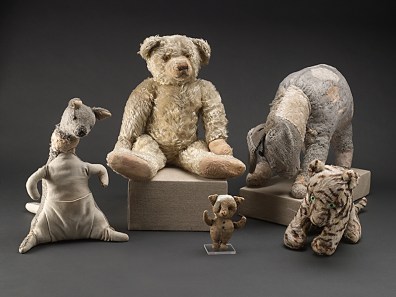
Christopher Robin Milne’s original Winnie-the-Pooh toys on display at New York Public Library.

I felt a certain measure of embarrassment when I read those words, because I knew upstairs I had my own Pooh as my totem of childhood. Whereas Christopher Milne (the son of A.A. Milne, upon whom Christopher Robin is based in the Winnie-the-Pooh books) detached from his childhood toys and donated them to New York Public Library, I quite happily kept mine. If he were alive today to meet me, it’s probable he would think me odd.

A Reddit thread about what adults did with their childhood toys has a range of answers. Some adults expressed little to no attachment to pieces of childhood. Others donated or sold the majority of old belongings, keeping just one or two particularly meaningful items. Among the 41 responses:

  • I didn’t have many significant toys, but when I went away to college the process of getting rid of them was set rolling. The stuff I didn’t really care about was donated at that time. Later, when my mum was trying to sell her house, I had to make the harder decisions. I kept the stuff that was really special (like my baby blanket/stuffed animals). […]
  • I was actually really lucky. My parents sold everything of mine that I couldn’t carry with me when I moved out so I didn’t have this problem [of deciding what to do with toys] at all.
  • The childhood mementos I still have are in a box in a safe dry place. I’d probably never let a kid near them. I don’t want to think of those lovely things with bite marks, scuffs, missing parts, sticky matted fur, etc. Maybe if I hold on to them long enough, they’ll become worth something and I can sell them to an adult who can see the value in them.
  • I have a lot of old toys lying around my parents’ house too, and they may be selling it sometime in the next couple of years now that my brother and I have moved out, so I have to get rid of most of them. I have been selling quite a few on eBay. […]
  • Most of my toys have gone to second hand shops. The sentimental ones I keep on a shelf in my room and a few went to my young cousins and nieces.
  • I still have the ones that were meaningful to me. My family and I donated everything else as I outgrew them. Nobody’s going to want the ones I still have now. (Seriously, I’m sure the kids will be killing each other over a grungy 30 year old stuffed horse)
  • Most of my stuff got sold off in garage sales as I got too old for them. The only things that are left now are stuffed animals. As my niece gets a little older I’m going to let her have her pick of them and then donate the rest. I’m keeping the ones that are the most important to me and I’ll probably never get rid of those.
  • I lugged my toys around for years. It wasn’t until I was in my last place that I finally said – I gotta get rid of these! […]
  • I wasn’t much of a fan of toys even as a kid. I’d get a few, maybe play with them a bit, then hand them down to my siblings or give them to thrift shops. If I really liked them, I just set them on my desk or dresser or something as decoration. I certainly don’t lug them along into my adult life. Really, I got rid of most everything I had when I joined the Army at 18. Now my only “toys” are an old stuffed bear a police officer gave me when I was 11 after taking pictures of my then-recent bullet wound (long story) which I keep in the corner of my room, and a few Mass Effect figurines (which are not for playing with) that decorate my desk and shelves. If you like your toys, keep them. If you don’t have space for them, box them up and store them. There’s no reason to have to give them away if that’s not what you want to do.

While not all of the responders above enthusiastically hold onto childhood mementos, most display some level of sentimentality over at least one or two possessions from youth. Christopher Milne would have plenty of others besides me to consider odd for keeping mementos of childhood.

A Chicago Tribune report  reassured me and somewhat reinforced my sentimentality for Spot. Psychologist and author David Palmiter said of sentimental childhood objects: “There isn’t really a mandate to give it up. It will naturally become less important or used when they no longer need it.”

Although I no longer need Spot to fall asleep or to keep teasing sisters at bay, on a deeper level, I believe I’ll always need him. And though his role has changed, I don’t consider him less important. Spot is a link to childhood, which is a time of life I hope never to lose touch with. Reason and logic and practicality have their place in adulthood, but so does a childlike lens of viewing the world. There is a magic, a hope, a sense of endless possibility and wonder in childhood to which I hug as tightly as I ever hugged Spot.

There comes a comfort in the knowledge that a corner of a shelf — a spot in my house — is reserved for a tangible piece of childhood.

Posted in Children and Family | Tagged , , , , | 2 Comments