Writing characters you love that readers will love

During her last week of school, my niece’s class voted on their favorite characters in Sarah & Katy and the Imagination Blankets.

The runaway favorite was Ruddy, the slightly paranoid cardinal who is convinced everyone and everything wanted to eat him.

A flash of red caught Sarah’s eye among the branches of a magnolia tree. She left Dragon’s side to go investigate the tree. Behind the white and purple flowers of the tree was a cardinal. When he spotted her, he gave a startled peep and ducked behind another flower.

“Please come out,” Sarah said. “I won’t hurt you. Cardinals are my favorite bird.”

The bird peeked his orange beak around the flower’s petals. “Really? Are you sure?”

Sarah nodded fervently.

The cardinal hopped to the edge of the branch until he was face-to-face with Sarah. He turned his head to and fro nervously. “Do you promise not to eat me?”

Sarah made an X over her heart. “Cross my heart and hope to die.”

“You hope to die? That’s a silly thing to hope for. That’s the silliest thing — LOOK OUT HE’S GOING TO EAT YOU!”

The cardinal darted back into the branches as Dragon joined Sarah.

In the weeks I spent writing Ruddy’s character, I frequently laughed out loud over my keyboard. Each opportunity to make Ruddy shout “He’s going to eat me!” kept me in giggles.

It turns out the character I had the most fun writing is the one others had the most fun reading.

That’s a good sign for writers. If you really enjoy writing a character or chapter — if it brings your creative energy to life — chances are the reader will enjoy it, too.

Posted in Writing | Tagged , , , , | 1 Comment

The challenge of making writing a priority

Summer is a tough season to be a writer.

In the winter, it feels warm and cozy to curl up with a blanket and a laptop. No one questions an inclination to stay home and write rather than venture onto the social scene.

Then summer comes. Invitations pour in for cookouts, pool parties, weekend getaways, and family reunions. The calendar squares start to fill up on weekends.

Summer becomes my writerly season of saying, “No.”

It’s nothing personal when I turn down social invitations. Time for writing needs to fit in somewhere, and that time can be hard to find around full-time jobs and household chores. Social time is important, but it can’t be the priority on every day off. Writing has to be a priority some days.

It can be a challenge to explain to family and friends why staying home to write isn’t blowing them off.

Taking time to focus on writing isn’t saying our writing is more important than them. But it does say our writing is important.

Time spent writing is just as important as time spent working and time spent socializing. No one will take our work as writers seriously unless we set the example and take ourselves seriously.

Part of taking ourselves seriously is making time to work on our writing projects.

Posted in Writing | 2 Comments

6 literary dads whose kids we’d love to be

In honor of Father’s Day coming on Sunday, I’m jumping on the literature blogging bandwagon and sharing a list of the best father figures novels have to offer.

Which of these awesome characters would you love to call Dad?

Atticus Finch1. Atticus Finch (To Kill a Mockingbird)

Atticus is bound to be on every list of great literary fathers. He serves as a moral compass for his family and community, values education, and deeply loves his children. His patience and endearing wisdom make him my favorite book dad. Atticus embodies a sense of constancy and security.

Arthur Weasley2. Arthur Weasley (Harry Potter series)

Arthur is a high-spirited family man. What he can’t provide his family in money, he makes up for in love and attention. Arthur not only extends a paternal affection to his children; he and Molly extend their affection (and protection) to anyone who enters the Weasley house. When you’re invited into Arthur Weasley’s home, you’re family.

Hans Hubermann3. Hans Hubermann (The Book Thief)

Oh, Hans. I adored him from the moment he met Liesel at the car and welcomed her into his home as his foster daughter. He plays the opposite to his loud, abrasive wife; Hans is quiet and gentle. He helps pull Liesel out of her shell by teaching her to read, and he gives her a sense of security in the absence of her mother. Despite rising tensions in Nazi Germany, Hans also sticks to his sense of morality and treats Jewish neighbors with dignity and kindness.

4. Daniel LeBlanc (All the Light We Cannot See)

Daniel is a single father raising a blind daughter, but he doesn’t let life’s setbacks sour his disposition. He carves perfect replicas of the city for Marie-Laure to memorize and teach her to navigate on her own. He pinches pennies earned at his museum job to buy her Braille editions of 20,000 Leagues Under the Sea. He ensures his daughter is protected and self-sufficient. When his life is endangered in an effort to protect a priceless French museum display from Nazis, he leaves Marie-Laure with her great uncle in another city and another city carved in miniature for her to find her way around.

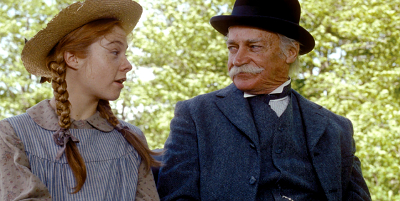
Matthew Cuthbert5. Matthew Cuthbert (Anne of Green Gables)

Matthew is more of a father figure than a father. Although he wanted a boy to come help on his farm, he warmed up to Anne’s endless chatter on their ride home. He is the reason Anne was able to stay at Green Gables, convincing his sister to allow her to remain. Despite his shy and reserved nature, he takes joy in spoiling Anne and playing a paternal role to the orphaned girl.

6. Honorable mention: Etienne LeBlanc (All the Light We Cannot See)

Technically he is Marie-Laure’s uncle, but he stands in as a father figure for her during her father’s absence. Etienne captured my heart during the scene when he lets his imagination run free with Marie-Laure and they spend time together reading and playing. Etienne is a recluse who fears leaving the house, but his love for Marie-Laure trumps his fear when she fails to return home one day.

Posted in Reading | Tagged , , , , , , , , | 4 Comments

Girls and Graphic Novels by Emily Meixner

Like Emily Meixner’s niece, my 8-year-old niece loves graphic novels. The genre is one readers of all ages and genre preferences can enjoy. Take a few moments out of your day to read Meixner’s account of her niece’s love of this novel form, her own experience with them, and a list of recommended graphic novel reading.

CBethM's avatarNerdy Book Club

My eight-year-old niece loves graphic novels.  She ingests them voraciously, and when I saw her during the winter holidays, ninety percent of that time she was reading.  Truth be told, I didn’t actually see her all that much – I just saw her fingers and the top of her head.  That’s her in the photo below reading through dinner at a local restaurant.

niece smileWatching her that particular night as she tuned out everyone else at the table, I was reminded of myself at that age, hunkered down, hidden behind the newspaper and magazine rack at my dad’s pharmacy with a stack of Richie Rich and Archie comics in my lap.  Watching my niece tear through Raina Telgemeier’s Smile, I remembered how I would sit legs-crossed, shoulders hunched forward, my lower back pressed against that green wooden rack as I poured over each new volume, imaging what it might be…

View original post 903 more words

Posted in Writing | Leave a comment

Behold the mighty Glomtom!

On Wednesday, I visited first- and third-graders at Dwight Grade School. During the visit, the students helped me on a special project for Book 2 in the Sarah & Katy adventures (coming in December 2015).

Dwight VisitThe first part of our project focused on choosing a name for a new creature, which will make its debut in the sequel to SARAH & KATY AND THE IMAGINATION BLANKETS. Students voted for their favorite imaginary name from a list of five options: Weepeggle, Looncan, Glomtom, Hoppler, and Fluffster.

Glomtom won with 18 votes, taking a short lead over Fluffster’s 16 votes. The others didn’t break double digits. (In fact, poor Weepeggle got no votes at all.)

With their help, I was able to choose a name for a creature. The trouble was, even though I now knew the Glomtom’s name, I didn’t know what it looked like. So the second part of the activity was a contest to describe the Glomtom.

The contest included filling out a worksheet to tell its color, whether it is furry/scaly/feathery/bald, one of its features, its silliest feature, its special ability, and its weakness.

The struggle with contests is choosing a winner. First- and third-graders can create a multitude of imaginative Glomtoms. After much review (and having to call in a second opinion from my husband to help narrow the selection), I picked a winner.

Or rather, winners. The contest resulted in a tie between first-graders Zander and Brooklyn.

MEET THE GLOMTOM

So how did the winners describe the Glomtom?

  • From Zander: The Glomtom is covered in green and black scales. One feature you can’t miss about him is his eyes: one is red, and the other is blue. Be careful if you run into the Glomtom near water — his special ability is that he’s a great swimmer! Don’t shake his hand when you say hello, either, because he has claws.
  • From Brooklyn: Even though the Glomtom is scaly, he has a tiny bald patch. He also has an unusually large nose for the size of his face. The Glomtom has a BIG appetite, which turns out to be his weakness — if you dangle a book under his unusually large nose, he can’t resist it. He LOVES munching on the pages of a book!
Posted in Writing | Tagged , , , , , , | 1 Comment