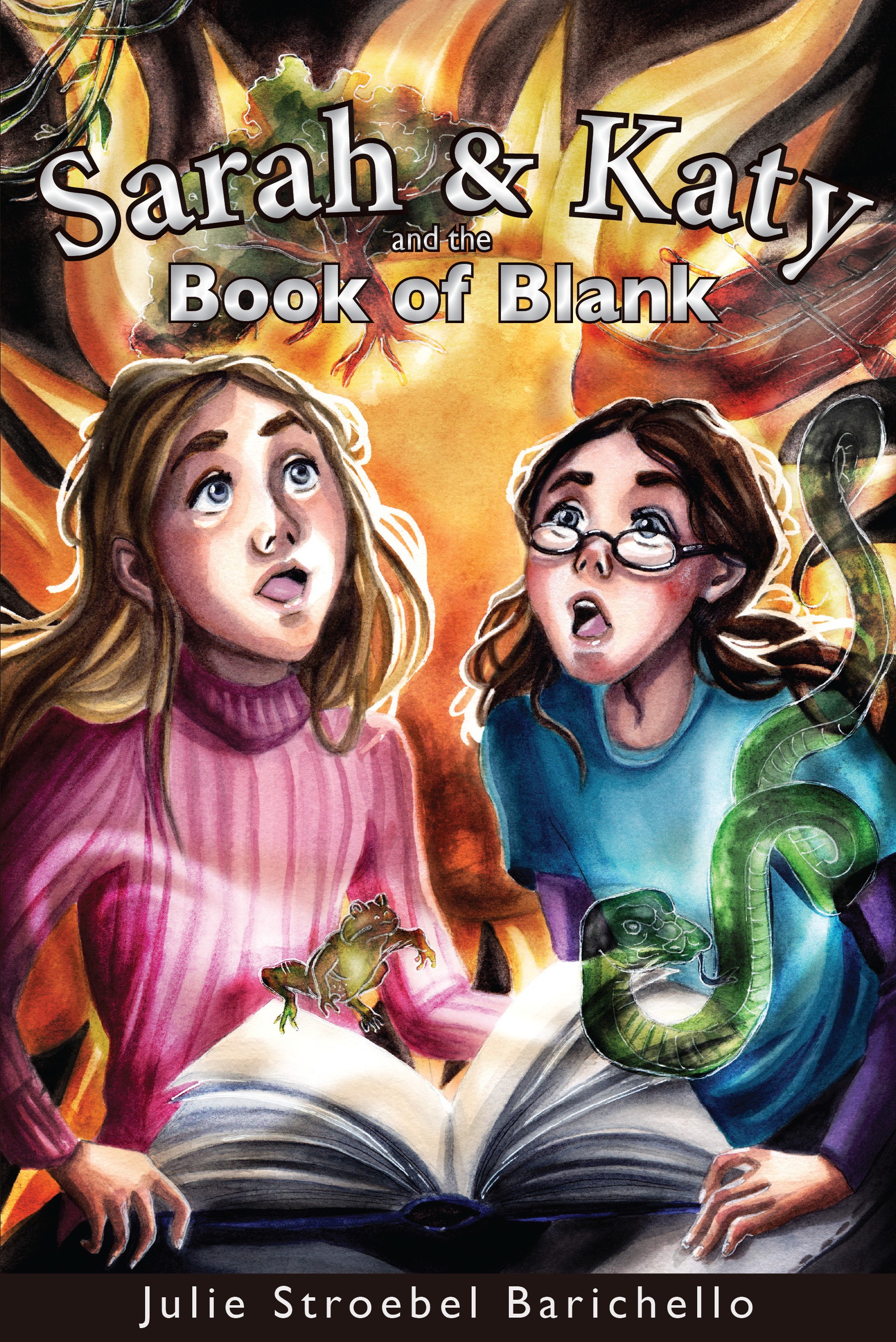
Cover reveal for Sarah & Katy and the Book of Blank

SKBB Cover Mystery

(Just so you know: This isn’t the cover. It’s just a teaser.
Scroll to the end to see the real thing!)

There are a lot of exciting moments as an independent author.

There’s the moment we type the final period on the first draft. There are all of the discoveries as we research the publishing process, such as how to acquire a Library of Congress Control Number or when we purchase a formatted copyright page.

But one of the most exciting moments — second only to holding the freshly published book in hand —  is when we get to see the cover.

I have the great fortune of partnering with Hannah Jones, who specializes in fantasy/fairy tale, children’s book, and fashion illustration. The anticipation of seeing her bring the story and characters to life is like a months-long Christmas. She captures the magic and imagination of the story. (Check out more of her artwork on her Facebook page. Her portfolio is extensive and gorgeous.)

Yesterday the cover art arrived in my inbox. Every time I see an email from Hannah, there’s that split second in which I wait to open it. There is joy in savoring the heightened anticipation. But then the curiosity and excitement get the best of me, and I urge my computer to download the attachments faster.

Upon seeing the completed cover art for the first time yesterday, I couldn’t be happier. And I couldn’t wait to share it.

So, ready to see the cover of “Sarah & Katy and the Book of Blank”?

Without further ado …

SKBB Cover

  • “Sarah & Katy and the Book of Blank” will be released Tuesday, Nov. 24.
Posted in Writing | Tagged , , , , , , | Leave a comment

20- and 30-somethings should see the ‘Goosebumps’ movie

GoosebumpsSaturday night the husband and I went to the Roxy to catch a late showing of “Goosebumps.”

The movie hit theaters a week ago, but I wasn’t sure if I wanted to see it. The premise intrigued me — rather than using one or two books as a basis for plot, the story features author R.L. Stine as a main character, and all of his monsters have cameos. They quite literally come to life out of the pages of his original manuscript.

There’s a risk when a story becomes too self-aware. I had my doubts when Slappy (the ventriloquist dummy from Night of the Living Dummy) emerged from a book and greeted R.L. Stine (played by Jack Black) with full awareness of being a book character. There’s a high risk of being cheesy.

And while there are people who argue the book series was cheesy, the film was the perfect pitch of entertaining, funny, and homage to one of the most popular book series of my childhood. The movie never took itself too seriously, but it didn’t parody or cheapen its source material, either (which was my fear, since the film was self-aware of the book series’ content).

The majority of theatergoers Saturday night were 20- and 30-something parents with young children. (I thing the hubby and I were the only two viewers without kids.) The movie has a couple of jump-worthy moments (like when a crow burst out from behind a tree), but nothing too scary for youngsters. And there’s more than enough comic relief to keep parents amused — I particularly enjoyed Stine’s character puffing indignantly at being characterized as a lesser Stephen King. (In real life, Stine is frequently dubbed “the Stephen King of children’s literature.”)

My favorite part of the film, though, is the very open nod to the source material. If you grew up in the ’90s, you know the Goosebumps books.

RLStine

R.L. Stine

From 1992 to 1997, R.L. Stine was a powerhouse of book production. His publishing history is enough to make any kid lit author feel sheepish. I feel strained putting out one book per year; there were stretches in which Stine put out one book per month. From January 1994 through December 1997, one Goosebumps title came out every month.

In every book order, kids would track down the newest title. The copies at the library were tattered by the end of the school year — how could they not be, with the number of book bags they got stuffed into and the number of hands eagerly turning pages?

Even though the tone of the film and its source material are targeted toward kids, 20- and 30-somethings still ought to see it. The phrase “For old times’ sake” is fitting in this instance — it’s nice to tap into the inner child and find some joy in a movie that lets us relive a popular literary series from our elementary school days.

A film for readers and writers

As an adult who grew up on a diet of Stine’s books, I liked the movie. As a writer, I loved the movie.

I’m one of those obsessive writers who collects anything writing-themed: books, art, knick knacks, and movies. “Goosebumps” just got added to my list of bookish flicks.

The plot emphasizes the idea of stories coming to life and the power of storytelling. Too bad for the movie version of Stine that the stories he brought to life were monsters that terrorize a town. Writing is a prominent element throughout the film, ranging from jokes about book sales numbers to playing a role in saving the day. Writers also will appreciate the special effects of ink swirling off the page to come to life as characters.

A bonus to this film is this generation of parents can share it with the next generation. The movie can introduce the Goosebumps series to a new wave of readers and offer an extra chance for parents to bond with young readers.

One more thing …

When I was 9 years old, “Night of the Living Dummy II” aired on the Goosebumps TV series.

The aftermath is one of my sister’s favorite stories to retell among family. When the episode ended, I desperately needed to go to the bathroom, but I was too terrified to go in there alone. I was certain Slappy would spring out from behind the shower curtain, peek from the cabinet under the sink, or burst from the toilet when I lifted the seat. (That last one generates the most laughs from my sister.)

In the movie, when Slappy emerges from the book, R.L. Stine groans. He acknowledges that, of all the monsters he created, Slappy was the worst one to have to face. Slappy goes on to become the primary antagonist of the movie.

At least if I had to be terrified of an R.L. Stine character as a kid, it was the one considered to be the scariest of all. There’s some vindication in that.

Although I doubt it will stop my sister from teasing me …

Posted in Writing | Tagged , , | Leave a comment

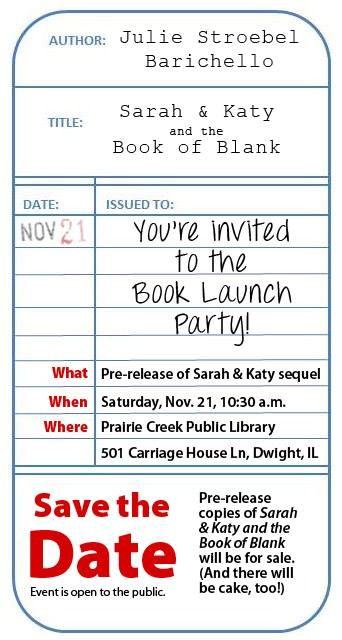
Pre-release book party — save the date!

Even though “Sarah & Katy and the Book of Blank” won’t officially be for sale until Tuesday, Nov. 24, there will be a pre-release book party at Prairie Creek Public Library in Dwight, Ill., on Saturday, Nov. 21.

And you’re invited!

The public is welcome to attend the book launch party. Copies of the new book, as well as copies of “Sarah & Katy and the Imagination Blankets,” will be for sale. (Book of Blank will be $10 per copy; Imagination Blankets will be on sale for $5 per copy.)

In addition to getting first-edition copies and reading the new book before it hits store shelves, those who attend will have a chance to enter their names in a raffle for a Sarah & Katy-themed gift basket. (And did I mention there will be cake?)

Mark the date on your calendars — I hope to see you there!

Save The Date


Posted in Reading | Tagged , , , , | Leave a comment

Redefining ‘Sarah & Katy and the Book of Blank’

All year I’ve referred to “Sarah & Katy and the Book of Blank” as the sequel to “Sarah & Katy and the Imagination Blankets.”

All year, I’ve been uncomfortable with that definition.

While Book of Blank takes place in the same general time and setting of Imagination Blankets, each book stands alone. Book of Blank doesn’t build upon Imagination Blankets like a sequel would; it simply takes Sarah’s and Katy’s characters on a new adventure.

Aside from Sarah and Katy, no recurring characters appear in the second book. We don’t meet Bast, Jelani, Ruddy, or Destrian Wain again. (Much to my nieces’ disappointment … they’ve already wrangled that information out of me and aren’t pleased that I’m not bringing back their favorites.) Instead we get a host of brand new characters. And no references are made to the events of Imagination Blankets (except one allusion to Katy losing her shoe).

It seems disingenuous to call Book of Blank a sequel when I know it’s a standalone book. It also feels incorrect to call it Book 2, because at this stage I’m not sure I will build Sarah & Katy into a full-fledged series (although I want to keep the option open).

That’s why I was relieved this morning when I read Lisa Graff’s blog post, “The Case for the Companion Novel,” at Nerdy Book Club.

Companion novel. That feels like the genuine and correct classification for Book of Blank.

The two books clearly are linked, but it’s a loose connection. Dubbing Book of Blank as the companion is the perfect definition.

And now that classifying the book is out of the way, I suppose it’s time to finish book production. The book release date is one month from this Saturday; my emotions are a blend between “Hooray!” and “Yikes!”

Posted in Writing | Tagged , , , , , | Leave a comment

Kid lit is worth writing — and reading

Not long ago, I attended a small, informal gathering of fellow writers. We “talked shop” in the usual way: asked how each other’s projects were coming along, shared our hopes for our own projects, and discussed the woes of writing.

These get-togethers tend to be group therapy. Venting is part of the agenda. We complain about writer’s block, rejection letters, failed projects, or the writing process in general. Releasing the frustrations of the job typically leave us refreshed and ready to return to the keyboard.

It was at one such gathering I was taken by surprise when a friend and writer whom I respect turned to me and asked, “So how is your book doing?”

“Really well,” I replied. “I sold 25 copies during a school visit, and the class was really excited to talk about it.”

“It must be nice to have a built-in audience,” she replied. “It’s so much easier writing for kids.”

The conversation turned to how much more complex writing for adults is. As the only kid lit writer at the table, I was caught by surprise and didn’t know how to respond. Their talk had touched a nerve, a silent fear: Was I a lesser writer for setting aside my adult fiction and pursuing children’s books instead? Was I a sellout, taking the easy road?

For days after, I mulled over the conversation. I was restless until I found solace in my book shelf.

Looking through my book collection, I was reminded many of my most lasting favorites (not to mention many of the classics) on my shelves are in the realm of kid lit.

Alice in Wonderland, The Wizard of Oz, Peter Pan. No one would think to snub these or discount them for their kid lit status. References to these stories are prevalent in culture and society. They are told and retold, revised and reimagined.

And the wonderful thing about kid lit is readers of all ages can enjoy it.

The mistake readers can make about kid lit is that it is unsophisticated. But David Beagley, a university lecturer in children’s literature, says kid lit can be as complex as adult literature. The difference is not the quality of the literature.

The difference is simply the age of the audience.

In a 2012 lecture series at La Trobe University’s Bendigo campus in Victoria, Australia, Beagley tells his students of children’s literature, “Children are not simple-minded.”

Nor is their literary taste.

“Children are readers as much as adults are readers,” Beagley said. “The fact they read something different doesn’t make them any less a reader or appreciater of their literature.”

Writing kid lit has its advantages over writing adult literature. The turnaround time for finishing a draft typically is shorter because the word count is lower. The fans are always excited to meet an author. The language is simpler in some ways, although there’s a case to be made for writing with the goal of elevating a child’s vocabulary. (And it’s amazing what kids can learn simply by context.)

Despite some of the advantages, the stories are not lesser products. The Wizard of Oz has political interpretations, but it also addresses good versus evil and the importance of family. These are themes that are relevant to both children and adults. In Matilda, we experience both the thrill and fear of childhood. The book, while lighthearted in many ways, also addresses abuse.

Kid lit tackles serious issues. Fewer pages and simpler vocabulary does not equal lesser literature.

“It has value as a creation in itself, an artistic creation,” Beagley said. “It should be judged by that inherent literary value.”

Posted in Writing | Tagged , , , | 6 Comments