A to Z: A Grimm topic related to fairy tales

Throughout April, I’ll be tackling 26 A to Z topics related to children’s literature. After yesterday’s look at fantasy titles, I’m going to shift gears and take a Grimm look at fairy tales for today’s G theme.


Once upon a time …

Actually, that’s a bit of a misleading beginning for a blog entry about the Brothers Grimm. “Once upon a time” was a popular translation for fairy tales written by Charles Perrault (who penned variations of perennial favorites like Cinderella, Little Red Riding Hood, Puss in Boots, the Tales of Mother Goose …)

For the Brothers Grimm, I ought to have started this post by saying: Es war einmal …

(Or, translated, “It was once …”)

So let’s start over, shall we?
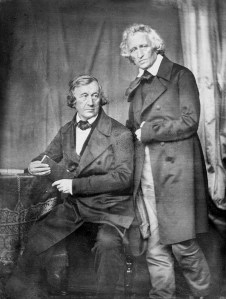
Wilhelm and Jacob Grimm, 1847; daguerreotype by Hermann Blow

Wilhelm and Jacob Grimm, 1847; daguerreotype by Hermann Blow

Es war einmal two brothers, Jacob and Wilhelm Grimm, began collecting folk stories and compiling them in a collection called “Children’s and Household Tales.” The tales traditionally were kept alive through oral tradition, but the Brothers Grimm took the initiative to preserve them in a more permanent format in the early 1800s.

Jacob and Wilhelm’s first collection of stories was released in 1812. More than two centuries later, the fairy tales they had the foresight to preserve have become the foundation and reference point for multiple adaptations across all forms of media.

The Brothers Grimm are a household name these days, and many of their stories continue to be household stories. (Although most are told through Disney-fication.) Children and adults alike recognize stories like Hansel and Gretel, Rapunzel, Cinderella, Little Red-Cap (aka Little Red Riding Hood), and Snow-White and Rose-Red.

But just how many fairy tales did the Brothers Grimm collect? How many can the average person name off the top of their head? A few months ago, I could probably come up with ten to fifteen.

Even though I could count the number of titles I knew on my fingers and toes (and still have five toes to spare), I considered my fairy tale familiarity to be high. I figured I would recognize the majority of tales in a Grimm collection.

Boy, was I wrong.

GrimmSeveral months ago during a regular Barnes & Noble excursion, I encountered a Pantheon edition of “The Complete Grimm’s Fairy Tales.” The husband and I are slowly but surely building a collection of children’s books so by the time a Baby Barichello enters the scene, we’ll have a well-stocked library. So I figured I’d buy the collection.

When I got home, I sank into a bubble batch and decided to pass the time by brushing up on fairy tales. When I turned to the table of contents, I found a few more tales than the fifteen I could name off the top of my head.

In fact, I found 195 more. The Grimms collected and recorded 210 folk tales.

And I didn’t recognize the majority of them. There were titles like:

  • Donkey Cabbages
  • The Seven Swabians
  • The White Bride and the Black Bride
  • The Sparrow and His Four Children
  • The Three Sluggards
  • The Peasant in Heaven
  • Lean Lisa

With nearly 200 “new” fairy tales to learn, I dove into the full collection. I was excited to discover that I did know a few of the tales, even if I didn’t recognize them by name. Growing up, one of my favorite VHS cassettes was a collection of fairy tales, including a cartoon of The Wolf and the Seven Little Kids. The fifth story in the Grimm collection — was you guessed it — a telling of The Wolf and the Seven Little Kids. The cartoon version was an old favorite, and the discovery of the source material was a joyous, geeky moment.

The original tales are darker than the Disney versions, but not so dark that they’re inappropriate to children. Any violence in the stories is unglorified and not graphic (most sentences are as simple and concise as, “He cut off the troll’s head” — no blood and guts). In fact, the tellings aren’t any scarier or more graphic than the animated telling of The Wolf and the Seven Little Kids shared above.

A complete collection of Grimm’s fairy tales is a book I recommend for any family, whether the household consists of adults only or children as well. The tales are a cultural and literary root, and it’s a great feeling to dig deep and familiarize yourself with original translations of stories that have become ingrained in our culture. Plus, it’s nice to learn some new fairy tales along the way.
Posted in children's literature | Tagged , , , | 2 Comments

A to Z: 5 favorite fantasy books for young readers

Throughout April, I’ll be tackling 26 A to Z topics related to children’s literature. Today’s F theme has a bit of alliteration: Here are five of my favorite fantasy novels (and series) for young readers.


Dragons. Magic. Princesses (preferably the feisty variety, not damsel in distress). Swords. Myths.

All of those elements and more are pieces in the fantasy genre. And all of those elements are enough to run away with a young reader’s imagination.

My imagination did run away with those bits of stories in grade school. The fantasy genre played a prime role in developing my love of literature. Certain books ignited my imagination more than others, though.

Five of those fire-breathing, imagination-sparking fantasy books/series are listed below. In no particular order of preference:

  1. The Enchanted Forest Chronicles: Remember that earlier mention of the feisty variety of princess instead of the damsel in distress? That’s largely referring to Princess Cimorene, the lead character in Patricia C. Wrede’s Enchanted Forest Chronicles. In the first book of the quartet, Cimorene decides to run away from her royal boring life to become a dragon’s princess. The dragons are surprised when Cimorene volunteers for the job — after all, most dragons have to kidnap their princesses, and then they turn the girls into servants to clean their caves, do their cooking, etc. Kazul agrees to take Cimorene on board as her captive princess. Thus begins Cimorene’s life of keeping princes at bay (won’t they ever give up on trying to “rescue” her?), battling evil wizards, and keeping Kazul’s household in order. In subsequent books, Cimorene and Kazul venture into the Enchanted Forest for more adventures together.
  2. The Chronicles of Prydain: Raise your hand if you’ve ever seen the Disney animated film “The Black Cauldron.” I can’t see how many hands are raised out there, but I’m betting not many. It’s a surprisingly dark story for Disney to adapt without … well, Disney-fying it. But the movie is pretty much as grim as its source material. Lloyd Alexander’s novel “The Black Cauldron” is Book 2 in the Chronicles of Prydain. They follow the adventures of an assistant pig-keeper, a princess, a hairy creature named Gurgi, a wandering bard, a dwarf, and a cast of other unlikely heroes, adventurers, and villains as they try to reclaim Prydain from evil. The books are age-appropriate, although a bit creepy at times. After all, dead bodies are reanimated using the black cauldron and essentially become a zombie army. But there’s enough comic relief (particularly from Gurgi and the witches Orddu, Orwen, and Orgoch) to make the enjoyable.
  3. Harry Potter: This is an obvious series to include, but it’s obvious for a reason: Because J.K. Rowling constructed an amazing fantasy world with memorable characters, moments, and details. This series has reeled many young readers into the world of literature — and the fantasy genre. I was skeptical throughout the opening chapters of Book 1 — Harry’s life on Privet Drive with his dull, grim aunt and uncle didn’t immediately grasp my imagination. But as the story unfolded about an average boy going to the wizarding school (which also happens to be a boarding school), I was pulled into the classroom alongside Harry during the school day and participated in his after-hours mischief at night. The authenticity of school life boosted by the fantastical element of magic classes makes the books relateable to young readers while also serving as a form of escape. It’s a rare balance.
  4. James and the Giant Peach: What I really wanted to list in this spot was Roald Dahl, but since he’s an author and not a book or series, I picked my favorite among his titles. Even so, I’m going to recommend all of them. Dahl brings magic into a world parallel to our own, but fantastic things can happen … such as a boy escaping his horrid caretakers by flying away in a giant peach accompanied by human-sized bugs. Or a gentle young schoolgirl who develops the power of telekinesis. Or a poor young boy who wins a golden ticket and gains entrance to a chocolate factory beyond imagination.
  5. The Last of the Really Great Whangdoodles: You didn’t think I’d put together a list of my favorite fantasy books without including this one, did you? Like Harry Potter, “Whangdoodles” begins in our world. Three ordinary children meet an ordinary (ahem … well, actually, a rather eccentric) professor who helps open their minds and cross into Whangdoodleland. Once the story shifts into Whangdoodleland, there are plenty of fantastical elements and creatures — including sidewinders, Gazooks, tree squeaks, the Whiffle Bird (ah, good old Whiffle Bird), the Slippery Prock, the High-Behind Splinter Cat … This book eternally tops my list of favorite fantasies because it opens children’s minds to the magical worlds that can be found in their own backyard. (Oh, and a bonus? The professor is a firm believer in science and even performs a major DNA experiment in Whangdoodleland. It’s never going to a book added to the STEM curriculum, but it’s a nice addition.)
Posted in children's literature | Tagged , , , , , , , , | 5 Comments

A to Z: The never-forgotten letter to Eric Carle

Throughout April, I’ll be tackling 26 A to Z topics related to children’s literature. Children’s author Eric Carle — and the letter I wrote to him in grade school — are in the spotlight for today’s E theme.


Every person in the class wanted to ask Eric Carle the same question:

“Will you dedicate your next book to me?”

Our teacher said only one student could ask, though. I don’t recall who got the honor; I only remember it wasn’t me.

My grade school class had spent the past week listening to our teacher read Eric Carle’s books aloud. We read “Brown Bear, Brown Bear, What Do You See?” and “The Very Busy Spider” and “The Very Quiet Cricket” and “The Grouchy Ladybug.” We skipped my favorite (“The Very Hungry Caterpillar”).

At the end of the week, we were given the assignment to write a letter to Eric Carle. My letter was mostly the same as my classmates’. I told him I loved his books and he was one of my favorite authors and to please write back soon.

After we sent the letters, I wondered if Eric Carle would read the letters. Would ours stand out among the hundreds of letters he must get from other classes?

I don’t remember the exact words of my letter, nor do I remember the response it received. But I remember a particular feeling. I knew I wanted to be an author, and I knew I wanted someone to ask me to dedicate a book to them.

Fast forward twenty years. The memory of the letter had been dormant for at least a decade and a half.

In December 2014, I gave my nieces Sarah and Katy copies of their namesake book. The book release was small and sales were low. I wasn’t a household name like Eric Carle or Beverly Cleary, but I had two big fans.

Several weeks later, during a library book signing, Katy’s best friend Ryan bounded up to the table and said, “Can I be in the next book?”

The dormant memory of the letter flared to life, plus the memory of my teacher saying one student could ask Eric Carle to dedicate a book.

And even though I knew I was an independent author with low sales and a limited release, I realized Ryan viewed me the same way I viewed Eric Carle: An author whose book(s) I enjoyed.

The feeling of wanting to be an author and be asked to dedicate a book flooded over me, as tangible as it had been when writing the letter. It was one of those rare moments of realizing a childhood dream has been fulfilled. Even though Ryan technically didn’t request a dedication, she requested to be part of a future book.

The memory of the letter clung to me in the days after the book signing. I made a note to include Ryan somehow in a future book. (Incidentally, she gets name-dropped twice in “Sarah & Katy and the Book of Blank.”)

For the record, Eric Carle didn’t dedicate a book to anyone in my class. But he did send a letter back. The day our teacher read it aloud was a bright spot in the school year. The excitement we felt at being acknowledged by an author strengthens my resolve to write back to each child or class who takes the time to write to me.

After all, one of them might ask me to dedicate a book to them. And in the process, they might daydream of one day being a writer who will be asked by someone else to dedicate a book to them …

Posted in children's literature | Tagged , , | 9 Comments

A to Z: A program near and D.E.A.R. to the hearts of readers

Throughout April, I’ll be tackling 26 A to Z topics related to children’s literature. For “D” day, I’m honoring one of my favorite programs of all time: D.E.A.R.


It was always my favorite week of the school year.

On Friday of the previous week, all students were sent home with a reminder to bring a book to class every day. Not a textbook, but rather a novel or other volume to read for pleasure. If we didn’t bring a book, we’d be assigned one or sent to the library to find one.

When Monday rolled around, I would wait all morning (and usually a good chunk of the afternoon) waiting to hear the ping of the PA system, when the principal or a secretary would announce to the school at large, “It’s time to drop everything and read!”

There was always a delightful scramble when pens and paper would be pushed aside, students would grab their books, and everyone would dash for the best reading spots in the classroom. I was slightly disappointed on the days when I missed out on a bean bag, but the disappointment was fleeting. It was the middle of the school day, and I got to kick back and read!

DEAREven though D.E.A.R. Week — or Drop Everything and Read Week — is a childhood memory, the program still is going strong. In fact, April is a month-long celebration of D.E.A.R., with one date in particular honored as National D.E.A.R. Day. Mark your calendars for a week from today — D.E.A.R. Day is Tuesday, April 12.

The mission of D.E.A.R. is to remind people to make reading a priority in their lives. On April 12, families are encouraged to participate in D.E.A.R. by setting aside 30 minutes to read, either individually or aloud together.

Schools and libraries nationwide continue to honor the program as well. The American Library Association encourages readers to “drop” in during Drop Everything and Read to find a comfortable place to sit and curl up with a book. Some schools devote an afternoon to D.E.A.R., while others take a full week to devote a half hour a day to reading.

This year’s D.E.A.R. Day has an extra bit of significance. The day was designated on April 12 because that date coincides with Beverly Cleary’s birthday. Cleary was born April 12, 1916, which means this year marks her 100th birthday.

Cleary is perhaps best known for her books about Ramona Quimby. Cleary’s own children participated in D.E.A.R. when they were in school, which led Cleary to include a passage about the program in her 1981 book “Ramona Quimby, Age 8.”

To learn more about D.E.A.R., check out the program’s website at dropeverythingandread.com.

Posted in children's literature | Tagged , , , , , , | 2 Comments

A to Z: The story of Cleovet

Throughout April, I’ll be tackling 26 A to Z topics related to children’s literature. Today’s prompt is the letter C, which seems like a good opportunity to tell the story of Cleovet.


From the imagination of Katherine Paterson came Terabithia. From the imagination of Julie Andrews Edwards came Whangdoodleland.

Both of those imaginary worlds were rooted in my mind early in childhood. By fourth grade, I had been introduced to each book, and I fell in love with the idea of finding a magical land in your own backyard.

In “Bridge to Terabithia,” Jesse and Leslie imagine a magical kingdom in the woods, on the other side of a creek. Their kingdom is inspired by the Chronicles of Narnia, which Leslie loved and shared with Jesse. Meanwhile, in “The Last of the Really Great Whangdoodles,” three children and a professor transport themselves to Whangdoodleland using the power of imagination.

One of my favorite scenes in “Whangdoodles” is this one:

The professor spoke quietly. “[…] Look at the garden and imprint the scene upon your memory. Very slowly close your eyes and remain aware of it all—just as we have always practiced.”

The children had the odd sensation that the world was beginning to spin and tumble around them. The professor’s voice continued. “Feel your minds opening, floating. Remember where we are going. Reach out for it. Reach. It’s there. Right there. Open your eyes now, and look. Look, dear children, and you will see that it is time we were on our way.”

Ben, Lindy and Tom became aware of the most incredible light. It surrounded them. It was dazzlingly bright and for a moment it was hard to see anything at all.

But as their eyes adjusted to the brilliance, they saw that the garden hedge in front of them was spinning around like a pinwheel on the Fourth of July. There was the sound of a rushing wind and they felt themselves being pulled forward as if by unseen hands.

The professor was smiling and nodding his head and beckoning. “Come along, come along.”

Their vision gradually focused and then, quite suddenly, everything became crystal clear. In front of them the hedge had twisted into a long mossy tunnel. The children knew that at the other end of it lay the most wonderful of all surprises.

I spent countless hours in my own backyard, gazing intently into the tangle of branches in our lilac bushes and imagining a magical new world opening up to me. Like Leslie being inspired by Narnia, I was inspired by Terabithia and Whangdoodleland.

And one summer, I discovered Cleovet.

Geographically, Cleovet is a small place. It’s a circle of rocks in Mom’s garden, and a shaded patch of ground carpeted in pine needles and ceilinged by oak and pine branches. I was between fourth and fifth grade when that small patch of yard expanded into an entire kingdom. Instead of swinging over a creek on an enchanted rope like Jesse and Leslie, or walking through a tunnel in a hedge like the Whangledoodleland adventurers, the path to Cleovet was walking around the rock garden three times. But there were rules. You had to walk barefoot (flip flops got abandoned in the dirt), and your feet couldn’t slip off the rocks, or you’d have to start over.

Cleovet overlapped the real world. A twirling baton hooked through a belt loop in the real world was a sword hanging by my side in a sheath in Cleovet. Birds roosted overhead in the real world were spies or messengers in Cleovet. A ring of rocks in the real world was a mighty castle in Cleovet.

I was the queen of Cleovet, and my companion ruler was King Panther, the large black cat who trailed my every step as a child. There were evil sidewinder armies to battle (inspired by Edwards’ sidewinders in “Whangdoodles”) and deadly tree giants to escape (loosely inspired by Don Quixote’s windmill giants, which I encountered in an episode of “Wishbone”). The bald stalks of white dandelions became a particularly vicious enemy called pigweeds. Baton-swords did an excellent job of chopping down pigweeds.

In times of famine, I would gather food for the people of Cleovet, which consisted of filling a sand pail with seeds from broadleaf plantains (an Illinois weed that grows tall stalks full of small buds; pinching the stem at the base and then running your fingers up it can strip a stalk of its pearls in seconds, although it will stain your fingertips green after a while). After collecting a bucketful, I would scatter the buds all over the yard, feeding the people of Cleovet. (And, I’m quite sure, spreading the weeds all over the yard in the process.) But the real world was a secondary consideration. My entire focus was Cleovet.

That was the power of storytelling. I grew up living in a backyard kingdom, where dozens of creatures and friends and foes buzzed and breathed in my mind. There was an enormous sense of wonder in me as a child: If all of these creatures and places could live in my mind, so real I could practically see them in front of me, did I have a world inside my head? Was our world just a place inside God’s head, where he imagined us into existence? Perhaps the entire universe was simply God’s imagination, telling stories of people and places and things just as I did in the backyard.

As winters and new school years came and went, I spent more time reading and writing, and less time playing. Places like Cleovet began to be bound to the page instead of linked to a specific location. Cleovet itself slipped further away, tumbling into memory instead of an active and alive place.

As an adult, there’s still a flicker of Cleovet tucked away in my mind. Sometimes during visits to my parents’ house, I wander out to the rock garden and try to sense some of the magic that once resonated there. My imagination still sparks at the site of the rock circle. There’s even a new addition of a brick-paved circle filled with purple sand, which my nieces played in. In the back of my mind where Cleovet survives, that sandbox is actually a bottomless purple pool that’s a portal to other kingdoms.

But try as I might, the kingdom is locked to me. Even walking barefoot around the rock circle three times doesn’t transport me to Cleovet anymore. As much as my imagination sparks, it won’t ignite. These days, I need paper as fuel to ignite my imagination. The stories only come to life in words for me now. They don’t come alive before my eyes.

Cleovet is still in there, though. I’m saving it. Someday, at the right time and with the right story, I’ll bring it to life on the page. I’ll return there, if only as a spectator to the events unfolding on the page instead of an active participant in the story.

Posted in children's literature | Tagged , , , | Leave a comment