A to Z: A third-grade kid lit quilt

Throughout April, I’m tackling 26 A to Z topics related to children’s literature. I’ve waited all month to make it to Q, just so I could share the best third-grade class project in history. I present to you a post about Mrs. Wilkinson’s kid lit quilt.


It’s a coincidence that the blue-and-white quilt I received last year ended up in my possession.

But I’m glad it did. It’s a treasure I’m happy to have.

QuiltClassThe path to getting the quilt all began in Mrs. Wilkinson’s third-grade class. (There I am, in the middle of the third row.)

Each year, Mrs. Wilkinson had a literary art project for the class. Every student was given a square of white fabric. Our task was to choose a book, read it, and then illustrate a scene or symbol from the book on the cloth. The medium of illustration was our choice. Some of us used markers. Others used fabric paint. One ambitious artist even used a variety of materials to glue onto the cloth, such as feathers for a head dress and cotton ball clouds.

QuiltJulieOnce the artwork was finished, we turned in our squares for Mrs. Wilkinson to stitch into a checkerboard pattern of alternating illustrated squares and deep blue squares. The finished product featured a classic children’s library; our quilt featured titles like “Charlotte’s Web,” “Old Yeller,” Black Beauty” … one overachiever even illustrated “Moby Dick” (the Illustrated Classic version, not the unabridged behemoth).

QuiltBritt(Incidentally, the “Moby Dick” artist was my goodnatured rival for being top student in the class. I spent 10 years of school competing with classmate Nick Madison for straight A’s. It lasted right up to high school graduation, in which we both were vying for valedictorian.)

By fourth grade, I had forgotten about the quilt. It remained with Mrs. Wilkinson, and other projects eventually engaged my attention.

QuiltMarkAlmost two decades later, my third-grade teacher happened to be on the library board at the same library where my sister worked. Their conversation turned to my children’s writing one day, and Mrs. Wilkinson mentioned to my sister that she still had the kid lit quilt my third-grade class created. She said since I was writing children’s books of my own now, perhaps I’d like to have the book-themed quilt my class created. She passed it along to my sister, who in turn passed it over to me.

Unfolding the quilt opened up a lot of memories. I remembered working on my “Charlotte’s Web” illustration. I agonized over how to draw a spider web, and I was devastated to discover another classmate selected the same book. (We were the only ones to duplicate a title … and I was horribly jealous to see her spider web was infinitely better than mine.) I remember making sure Templeton the rat was included in my drawing, because he was my favorite character.

Eventually my third-grade class’s kid lit quilt will be displayed on a wall in my writing room. And when I have children of my own in the future, we may have to create a household kid lit quilt. Perhaps we’ll do one drawing per year, illustrating their favorite book that year. Or we’ll create a reading list together and do one illustration for each book on the list. The pattern of the quilt is simple and one that can be easily duplicated. Then we’ll have a customized, personalized storytime quilt to snuggle under and display in the future.


QuiltFull

Posted in children's literature | Tagged , , , , | 1 Comment

A to Z: This month (and this post) is all about poetry

Throughout April, I’m tackling 26 A to Z topics related to children’s literature. We’ve made it all the way to P, and I’m joining plenty of other bloggers by honoring poetry today since April is National Poetry Month. So let’s take a look at my favorite children’s poet, shall we?


Rhythm and rhyme. They go together like any cliche favorite you can think of: Macaroni and cheese. Peanut butter and jelly. Peas and carrots. (Although I’ve never been much of a peas and carrots person myself.)

Rhythm and rhyme are a perfect pairing. But they also work out well in a trio. When children’s literature joins the duo, they create a powerful mix.

For young readers developing literacy skills, rhythm and rhyme assist with memory. One of the earliest books I ever read was “The Foot Book.” The following passage sticks with me even though I haven’t read the book in years, simply because the rhythm and rhyme made it easy to commit to memory:

Left foot. Right foot. Feet. Feet. Feet. Oh, how many feet you meet!

The rhythm, rhyme, and repetition of poems make them perfect for developing readers. And poetry written for children has an added benefit: It generates an early appreciation for the writing form that hopefully will excite them to sample other types of poetry as they get older.

Although many books I read as a child featured rhyme schemes, there was only one children’s poet in my early literary diet. To this day, Shel Silverstein remains one of my favorite poets. For years, he was the only one I knew.

shelsilversteinShel Silverstein was a man of many talents. Not only is he a beloved writer whose books are recognized by both name and style; he also was a cartoonist who illustrated his own books, a singer-songwriter, and a screenwriter.
And let’s admit it: He was a pro at looking like the toughest children’s poet on the block. Just check out that mug.

“Shel invited children to dream and dare to imagine the impossible, from a hippopotamus sandwich to the longest nose in the world to eighteen flavors of ice cream to Sarah Cynthia Sylvia Stout who would not take the garbage out,” says the biography on his website, shelsilverstein.com. “He urged readers to catch the moon or invite a dinosaur to dinner — to have fun!”

His website biography says Shel did not originally plan to write and draw for children — but millions of readers are eternally grateful he ended up on that path.

His poetry collections are recognizable on any bookstore or library shelf: white covers, black line art in Shel’s signature cartoon style, bold titles.

covers

Like “The Foot Book,” many Shel Silverstein poems are memorable to me because of their rhythm and rhyme. But the content made a difference, too. Their humor and wackiness made them a joy to read.

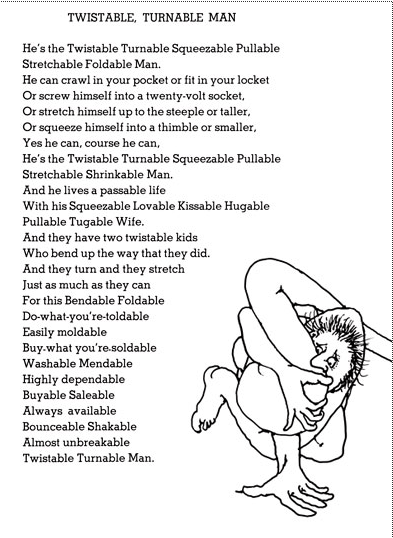
My favorite Shel Silverstein poem, “Twistable, Turnable Man,” comes from “Where the Sidewalk Ends.” The first time I heard it was when an elementary school teacher read it aloud to the class. We insisted she read it over and over, faster and faster, until she was too tongue-tied to manage it again.

Since we can’t properly celebrate National Poetry Month without reading a bit of poetry, I’ve shared “Twistable, Turnable Man” below.

TwistableTurnable

If you have a favorite poet or poem, please feel free to share it below in the comments!

Posted in children's literature | Tagged , , , , | 2 Comments

A to Z: Out loud is one of the best ways to read

Throughout April, I’m tackling 26 A to Z topics related to children’s literature. We’re more than halfway through the alphabet. Today is all about O and reading out loud.


How do you typically spend 15 minutes?

Maybe you spend two sets of 15 minutes watching a sitcom on TV, or three sets of 15 minutes watching a drama on Netflix. Fifteen minutes can pass quickly while driving to a destination, or prepping dinner, or making a phone call.

But what about reading aloud to your children?

A YouGov survey of parents with children up to age 8 shows 46 percent of parents read out loud to their children every day, but only 34 percent said the reading sessions last 15 minutes or more. The nonprofit organization Read Aloud 15 Minutes is trying to boost those statistics to make lengthier family reading sessions the norm.

Experts list a variety of reasons why reading aloud is beneficial to young children, including:

  • Language development
  • Literacy skill building
  • Brain development
  • Bonding
  • Transfer of knowledge
  • Instilling a love of reading

The Read Aloud 15 Minutes organization touts some impressive numbers. Reading out loud for 15 minutes every day for five years would tally up to 27,375 minutes, or 456.25 hours. That’s a lot of hours to bond with children over a brain-boosting activity.

ReadAloud

An infographic about the benefits of reading aloud

There are a lot of ways we spend 15 minutes a day. Making a goal to spend a quarter hour or more reading together with children is a positive priority to make at home.

Below is a video of Dr. John Hutton explaining more about reading and brain development.

Posted in Literacy and Education | Tagged , , , , | 2 Comments

A to Z: How many Newbery Honor Medal winners have you read?

Throughout April, I’m tackling 26 A to Z topics related to children’s literature. I’m a day late on N day, but I couldn’t bring myself to skip it entirely. Today’s topic is too much fun — it’s all about Newbery Honor Medal books today!


While browsing a list of Newbery Honor Medal books, I began to wonder how many of them I’ve read. Below is a list of every medal winner from 1922 through 2016, with the titles I’ve read listed in bold.

One thing is clear — I haven’t read enough Newbery Medal winners. Out of 94 years of awards, I’ve only read 37 of the medal winners. Looks like I have a new reading goal!

Take a look at the list to tally how many you’ve read, too.

  • The Story of Mankind by Hendrik Willem van Loon
  • The Voyages of Doctor Dolittle by Hugh Lofting
  • The Dark Frigate by Charles Hawes
  • Tales from Silver Lands by Charles Finger
  • Shen of the Sea by Arthur Bowie Chrisman
  • Smoky, the Cowhorse by Will James
  • Gay Neck, the Story of a Pigeon by Dhan Gopal Mukerji
  • The Trumpeter of Krakow by Eric P. Kelly
  • Hitty, Her First Hundred Years by Rachel Field
  • The Cat Who Went to Heaven by Elizabeth Coatsworth
  • Waterless Mountain by Laura Adams Armer
  • Young Fu of the Upper Yangtze by Elizabeth Lewis
  • Invincible Louisa: The Story of the Author of Little Women by Cornelia Meigs
  • Dobry by Monica Shannon
  • Caddie Woodlawn by Carol Ryrie Brink
  • Roller Skates by Ruth Sawyer
  • The White Stag by Kate Seredy
  • Thimble Summer by Elizabeth Enright
  • Daniel Boone by James Daugherty
  • Call It Courage by Armstrong Sperry
  • The Matchlock Gun by Walter Edmonds
  • Adam of the Road by Elizabeth Janet Gray
  • Johnny Tremain by Esther Forbes
  • Rabbit Hill by Robert Lawson
  • Strawberry Girl by Lois Lenski
  • Miss Hickory by Carolyn Sherwin Bailey
  • The Twenty-One Balloons by William Pène du Bois
  • King of the Wind by Marguerite Henry
  • The Door in the Wall by Marguerite de Angeli
  • Amos Fortune, Free Man by Elizabeth Yates
  • Ginger Pye by Eleanor Estes
  • Secret of the Andes by Ann Nolan Clark
  • …And Now Miguel by Joseph Krumgold
  • The Wheel on the School by Meindert DeJong
  • Carry On, Mr. Bowditch by Jean Lee Latham
  • Miracles on Maple Hill by Virginia Sorensen
  • Rifles for Watie by Harold Keith
  • The Witch of Blackbird Pond by Elizabeth George Speare
  • Onion John by Joseph Krumgold
  • Island of the Blue Dolphins by Scott O’Dell
  • The Bronze Bow by Elizabeth George Speare
  • A Wrinkle in Time by Madeleine L’Engle
  • It’s Like This, Cat by Emily Neville
  • Shadow of a Bull by Maia Wojciechowska
  • I, Juan de Pareja by Elizabeth Borton de Trevino
  • Up a Road Slowly by Irene Hunt
  • From the Mixed-Up Files of Mrs. Basil E. Frankweiler by E. L. Konigsburg
  • The High King by Lloyd Alexander
  • Sounder by William H. Armstrong
  • Summer of the Swans by Betsy Byars
  • Mrs. Frisby and the Rats of NIMH by Robert C. O’Brien
  • Julie of the Wolves by Jean Craighead George
  • The Slave Dancer by Paula Fox
  • M. C. Higgins, the Great by Virginia Hamilton
  • The Grey King by Susan Cooper
  • Roll of Thunder, Hear My Cry by Mildred D. Taylor
  • Bridge to Terabithia by Katherine Paterson
  • The Westing Game by Ellen Raskin
  • A Gathering of Days: A New England Girl’s Journal, 1830-1832 by Joan W. Blos
  • Jacob Have I Loved by Katherine Paterson
  • A Visit to William Blake’s Inn: Poems for Innocent and Experienced Travelers by Nancy Willard
  • Dicey’s Song by Cynthia Voigt
  • Dear Mr. Henshaw by Beverly Cleary
  • The Hero and the Crown by Robin McKinley
  • Sarah, Plain and Tall by Patricia MacLachlan
  • The Whipping Boy by Sid Fleischman
  • Lincoln: A Photobiography by Russell Freedman
  • Joyful Noise: Poems for Two Voices by Paul Fleischman
  • Number the Stars by Lois Lowry
  • Maniac Magee by Jerry Spinelli
  • Shiloh by Phyllis Reynolds Naylor
  • Missing May by Cynthia Rylant
  • The Giver by Lois Lowry
  • Walk Two Moons by Sharon Creech
  • The Midwife’s Apprentice by Karen Cushman
  • The View from Saturday by E.L. Konigsburg
  • Out of the Dust by Karen Hesse
  • Holes by Louis Sachar
  • Bud, Not Buddy by Christopher Paul Curtis
  • A Year Down Yonder by by Richard Peck
  • A Single Shard by Linda Sue Park
  • Crispin: The Cross of Lead by Avi
  • The Tale of Despereaux: Being the Story of a Mouse, a Princess, Some Soup, and a Spool of Thread by Kate DiCamillo, illustrated by Timothy Basil Ering
  • Kira-Kira by Cynthia Kadohata
  • Criss Cross by Lynne Rae Perkins
  • The Higher Power of Lucky by Susan Patron, illustrated by Matt Phelan
  • Good Masters! Sweet Ladies! Voices from a Medieval Village by Laura Amy Schlitz
  • The Graveyard Book by Neil Gaiman, illustrated by Dave McKean
  • When You Reach Me  by Rebecca Stead
  • Moon over Manifest by Clare Vanderpool
  • Dead End in Norvelt by Jack Gantos
  • The One and Only Ivan by Katherine Applegate
  • Flora & Ulysses: The Illuminated Adventures by Kate DiCamillo
  • The Crossover by Kwame Alexander
  •  Last Stop on Market Street by Matt de la Peña
Posted in children's literature | Tagged , , , , | 11 Comments

A to Z: Wanted – multicultural and diverse books

Throughout April, I’m tackling 26 A to Z topics related to children’s literature. And today is M Day! Which means it’s time to talk about multicultural children’s books and diversity in literature.


Children Group Walking School Students Go Isolated Flat Vector Illustration

Fotolia | mast3r

I never had a problem finding myself in book characters.

When I was growing up, there were plenty of white, American, middle- to upper-class girls in books, such as the Sweet Valley Twins series, or the Baby-Sitters Club. Popular titles like “Ella Enchanted” featured a light-skinned, brown-haired girl on the cover. My beloved fantasy novel “Dealing With Dragons” featured a white-skinned, dark-haired Princess Cimorene on the cover.

There were plenty of girls who looked like me and my classmates. My rural Midwest school was mostly Caucasian, with a few Hispanic students. For a few years, one black student attended our school.  After she graduated, the student body reverted to 100 percent white and Hispanic.

The volume of white, middle class characters in children’s literature has led to an awareness campaign to boost diversity in children’s books.

Eleven-year-old Marley Dias knows is a young activist leading a campaign to find the color in children’s books. She spearheads the #1000blackgirlbooks initiative, which seeks books about the lives and experiences of black girls. Don’t let the hashtag fool you, though — when NPR reported about her project in February, she already had compiled more than 4,000 books about black girls.

Despite the high number of books Dias has found, the NPR article shared a discouraging statistic: “Fewer than 10 percent of children’s books released in 2015 had a black person as the main character, according to a yearly analysis by the Cooperative Children’s Book Center at the University of Wisconsin, Madison. And while the number of children’s books about minorities has increased in the past 20 years, many classroom libraries have older books.”

Hence the push to raise awareness about diversity in literature.

One of the leaders in promoting multicultural children’s literature is the grassroots campaign We Need Diverse Books. The group defines its mission as “putting more books featuring diverse characters into the hands of more children,” with the vision of “a world in which all children can see themselves in the pages of a book.”

Children of all races, ethnicity, social status, country of origin, household structure, sexual orientation, and ability deserve to see themselves reflected in literature. Those children should be able to find a mirror of themselves in fiction so they can connect and grow with characters like themselves.

Moreover, other children deserve a window. When I have children, I want to know they have literature that can connect them to other people and help my children empathize with people in situations different than their own.

Parents may be asking themselves, “Where can I find diverse books? Should I just start prowling the stacks in the library or the shelves at the local bookstore?” While that’s one way to do it, here’s another: We Need Diverse Books has aggregated blogs and websites that list and/or review different types of diverse literature. Check out their Where to Find Diverse Books page as a starting point.

If you have any favorite diverse books, be sure to share them in the comments section so I can check them out!

Posted in children's literature | Tagged , , , , , | 4 Comments