6 literary dads whose kids we’d love to be

Julie Stroebel Barichello's avatarJulie Stroebel Barichello | Author

In honor of Father’s Day coming on Sunday, I’m jumping on the literature blogging bandwagon and sharing a list of the best father figures novels have to offer.

Which of these awesome characters would you love to call Dad?

Atticus Finch1. Atticus Finch (To Kill a Mockingbird)

Atticus is bound to be on every list of great literary fathers. He serves as a moral compass for his family and community, values education, and deeply loves his children. His patience and endearing wisdom make him my favorite book dad. Atticus embodies a sense of constancy and security.

Arthur Weasley2. Arthur Weasley (Harry Potter series)

Arthur is a high-spirited family man. What he can’t provide his family in money, he makes up for in love and attention. Arthur not only extends a paternal affection to his children; he and Molly extend their affection (and protection) to anyone who enters the Weasley house. When you’re…

View original post 372 more words

Posted in Writing | 1 Comment

Thoughts sparked by the death of Lois Duncan

The news of Lois Duncan’s death reached me today.

Lois, a revolutionary author who essentially created her own genre of young adult suspense, died yesterday at her home at 82 years old.

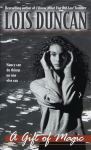
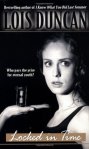
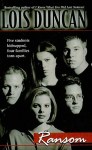
Her best-known title is probably “I Know What You Did Last Summer,” which was turned into a blockbuster movie in 1997, back when I was 10 years old. I never saw the movie, but I read the book.

In fact, I read nearly all of her books. When I was in junior high, the girls of Mazon-Verona-Kinsman Middle School went through a Lois Duncan craze. Mystery and suspense novels were kept on a small, three-shelf bookcase near the back of the library, close to the card catalogue (back when we still had physical cards in drawers and hadn’t fully transitioned to online catalogues).

I frequented the shelf to check out Nancy Drew mysteries. One day I noticed a group of girls — popular girls — from my class clustered around the shelf. I drifted over to see what they were reading. Each had a Lois Duncan book in her hand.

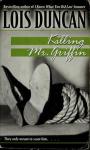
After they wandered away, I checked the shelf to see if any books were left. There were a few, so I picked up “Killing Mr. Griffin.” If popular girls were reading these books, I figured I’d read them, too. That would give me a talking point with them, and maybe I could merge into their clique. I didn’t know enough about celebrities or our middle school basketball program to connect with them over those topics, but I could definitely talk books.

They saw through my plan pretty quickly. A couple of them also resented that I would check out a Lois books they hadn’t read yet, so they had to wait an extra week or two before they could read it.

Even though everyone could see through my plot, the unanticipated side effect was that I became a fan. And on a fortunate thrift store excursion, I hit the motherlode: nearly all of Lois’ books, priced at 25 cents each.

The popular girls were able to borrow the library copies, unhindered by me. And I was able to read them all first. I even found a couple titles our school library didn’t even have.

I became obsessed, reading one after another. As soon as the last page was turned in one book, I closed the cover and opened the next. After a reading diet almost exclusive to fantasy, animal tales, and sanitized mysteries like Nancy Drew, I expanded my tastes.

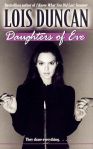
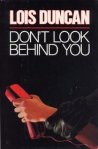
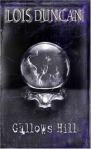
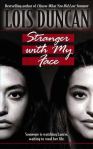
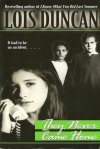
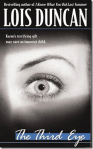
My imagination ran away with “Stranger With My Face.” What if I could project myself out of my body and roam the world? I daydreamed about going into witness protection and fleeing a hitman, like April in “Don’t Look Behind You.” I commiserated with the girls in “Daughters of Eve” — and was horrified by their deeds. My love of supernatural stories was satisfied with “The Third Eye” and “Gallows Hill.”

I never became one of the popular girls, but I found a new author whose books I loved. I read twelve of her novels before I moved on to other books, but hers remain some of my most memorable reading in junior high.

Lois’ writing career understandably tapered off after the murder of her daughter. She once posed the hypothetical to the press: How could she keep writing about young women in peril after her own daughter was killed? The murder remained unsolved, so she took it upon herself to pursue answers. She later wrote the nonfiction book “Who Killed My Daughter?”

(For those interested, BuzzFeed did an in-depth article in 2014, “Who Killed Lois Duncan’s Daughter,” which is worth a reader.)

I hope Lois rests peacefully now. In her honor, I may pick up one of her books and read it before bed tonight. I may rest uneasily after, thinking I see hitmen in the shadows or an evil twin will snatch my body, but that’s a compliment to her writing.

Goodbye, Lois. Thanks for all the books.

Posted in Reading | Tagged , , , , , | 1 Comment

Reliving a ‘cool’ childhood memory

I was seven years old the first time my family had central air in our house.

One week that summer turned into one of those sweltering Illinois days, when the air is so thick it feels like you’re breathing through a damp rag. Every lungful of air is hot and damp, more like swallowing than breathing. It’s the kind of weather in which you sweat in any spot your skin is touched, whether by fabric or watch bands or other skin.

Air conditioning was a new experience. I could belly flop to the carpet in front of a vent, bare legs and feet scissoring the air as I watched an afternoon marathon of PBS cartoons. The unexpected side effect of the cold air downstairs was the hot air rising upstairs — our bedrooms remained hot and sticky.

Because our bedrooms were uncomfortable, Mom let my sisters and I sleep downstairs. We made a living room campsite of blankets and pillows. It was an adventure.

Future summers didn’t have hot streaks quite as intense as that summer, and though I often hoped for a repeat of the downstairs sleepover, our bedrooms were kept cool enough with fans and nighttime breezes.

This weekend, as temperatures hit mid-90s in north-central Illinois, the husband and I decided to turn on our window unit air conditioner. It lasted about 10 minutes before it conked out, leaving the ceiling fans to push hot air from one end of the house to the other.

The husband’s parents extended some relief by loaning us a smaller window unit to cool our rec room. The bright side was we had a comfortable place to relax and work during the day. The down side was our bedroom was still an oven.

So we took a page from childhood and folded down the futon, put an air mattress on it and slept in the rec room with cold air blowing across our feet.

It was a perfect blend of reliving a childhood joy while also doing something non-routine.

Posted in Writing | 1 Comment

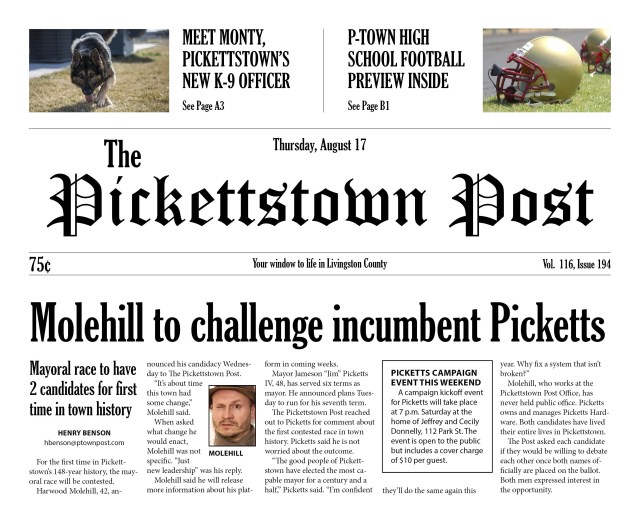
Writing update: Work is underway on ‘The Mountain of Dempsey Molehill’

I took some time off work last week to get to know Dempsey Molehill.

Dempsey lives in Pickettstown, Illinois, and just started fifth grade at Pickettstown Unit School. Even though it’s June in the rest of Illinois, it’s August right now in Pickettstown.

That’s because Pickettstown and all of its residents exist in a Scrivener file on my laptop.

For the past week, I’ve been working on the opening chapters of “The Mountain of Dempsey Molehill.” So far, it’s been slow going. For every 3,000 I write, about 1,500 end up in my “cut scenes” Scrivener document.

Even though I know the Molehills pretty well, I’m still trying to get inside Dempsey’s head. I’m certain he’ll open up to me soon enough, and then it will be easier to tell his family’s story through his perspective.

In the meantime, here’s a sneak peek at what’s happening in Pickettstown and the Molehill family.

PickettstownPost

Posted in Writing | Tagged , , , , , | Leave a comment

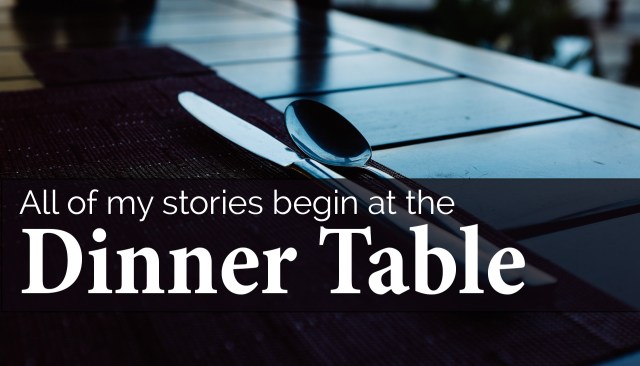
All of my stories begin at the dinner table

DinnerTableStories

I wasn’t the first storyteller in my family.

Even though I’m the first to write stories down and publish them, there’s a long history of tale-spinning in my family. Anyone who has sat at our dinner table can confirm it.

When I was growing up, dinner was a family affair. We all sat down together and ate together. Sometimes we would talk about our day, but my favorite evenings were when Dad would start telling childhood stories. All of them are based on true events that transpired in his childhood, although the details have been smoothed in some places and embellished in others over the years. Hearing them was like rereading a favorite book — even though I’d heard them before, I never tired of hearing them again.

Dad is a storyteller, even if he never defined himself as one. He foreshadows and teases to humorous endings to keep the listener hooked. He sprinkles in dialogue and pauses at the right places. He laughs at the end, and everyone laughs with him.

I’m the youngest of three daughters, and with each new husband who married into the family, the dinner table stories got retold. (Not that we ever needed a new audience or an excuse to retell them.) In recent years, a few new chapters have worked their way into these retellings — stories from my and my sisters’ childhoods as well as those from Dad’s.

Holiday dinners at my parents’ house have developed a tradition of their own. Everyone eats, then the kids go off to play while the adults linger, and a few of the stories get told again. There are perennial favorites, such as Uncle Fred’s elephant trap, or Uncle Ben’s bazooka. Pets is a topic unto itself. There are dozens of family stories about dogs and cats we’ve had.

Every so often, though, a new story surfaces. Just last weekend, I heard a story about a mulberry-loving neighbor who would lay a sheet under our mulberry tree and shake berries down, then bundle the sheet and carry it home over his shoulder like Santa with a sack of toys.

There are times when I’m at home with the husband that I say, “Have you heard the story about the time …” at which point he’ll remind me, “Yes, I’ve heard that one several times.” And he’ll tell me how the story ends, just to confirm he has indeed heard that one already.

I keep a journal of the stories now, writing them down whenever they float to the surface or when I hear a new one. I collect them partially to preserve the family history, but also as inspiration and fiction fodder. The very stories that get retold over and over in the dining room shaped me as a person, as a storyteller, and as a writer. They are a part of me, and I see their influence in every story I generate. Here and there, pieces of the tales get woven into my writing. It’s never the identical story, fact for fact and word for word, but the spirit of the telling lives on.

And for my family, they’ll know the story behind the story. The original tale can always be found at the dinner table.

Posted in Writing | Tagged , , | 1 Comment