Top 5 children’s book picks

Growing up, my sisters and I were allowed one hour of TV time per day. That meant the other 23 hours had to be occupied by other activities.

Aside from sleeping and school, much of the day was spent daydreaming, imagining, and reading.

In fact, much of the night was spent reading, too — the garage light shone through my bedroom window, leaving enough light to read by. I spent many nights with a book hidden under my pillow until my parents came in to say goodnight.

Of the hundreds of books I read throughout grade school, a handful made their way onto my reading list again and again. Here are five of my enduring favorites:

TIME CAT by Lloyd Alexander

822630

Jason is a young boy who is grounded after a series of mishaps one afternoon. Gareth is his black cat lounging lazily in his bedroom.

As Jason bemoans his sentence to spend the afternoon in his room, he is shocked to hear Gareth reply. More shocking than the fact his cat can talk, however, is the fact Gareth can travel to any time and place in world history. Each cat is given nine lives — or rather, the ability to visit nine different lifetimes.

Together, Gareth and Jason wander through history, making some of the most memorable friends (and enemies) along the way.

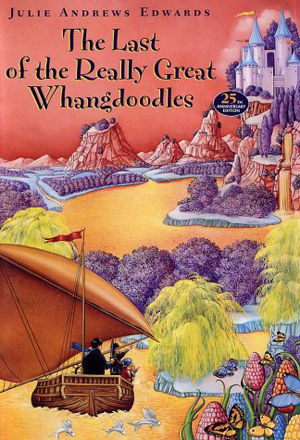
THE LAST OF THE REALLY GREAT WHANGDOODLES by Julie Edwards
10336

When it comes to books about the power of imagination, this one takes the crown.

Siblings Ben, Tom and Lindy Potter meet the eccentric Professor on a trip to the zoo one day. The Professor tells the children about the magnificent Whangdoodle, which is far better than any creature in the zoo — and also happens to not exist.

Except the Whangdoodle does exist, in Whangdoodleland. The only way to get there, however, is by using the imagination.

I was enchanted by this book from the first reading. The idea of traveling to an exotic, magical land through imagination is a surefire way to encourage young readers to exercise their imaginative muscles.

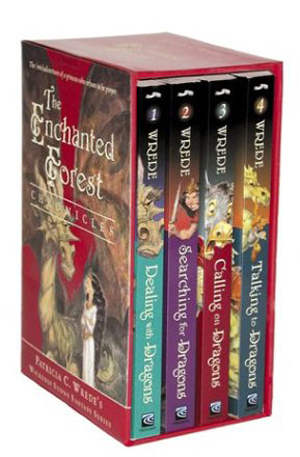
THE ENCHANTED FOREST CHRONICLES by Patricia C. Wrede
86238

Technically this is a series of four books, not a single book. However, I never read one without reading the other three immediately after. The only thing that could have made the flow from one book to the next faster would be if a single volume was released.

This is a young adult fantasy series following the adventures of Princess Cimorene, the dragon Kazul and the residents of the Enchanted Forest. Cimorene isn’t your cliched Disney-style princess, which makes her excellent role model for young girls. Cimorene isn’t the type of princess to get kidnapped by dragons and wait for a prince to save her — in fact, Cimorene is the kind of princess to run away from home, volunteer to be a dragon’s housekeeper and scoff at any prince who attempts to “rescue” her.

PONY PALS by Jeanne Betancourt

1001505

This 44-book series is about two things almost every little girl desires: friendship and ponies. I originally begged for the books because they were about owning ponies, but what hooked me into reading others in the series was the bond among Lulu, Anna and Pam.

In the first book of the series, the trio become best friends and form their own club, bonding over their shared interest in ponies. The idea of lifelong friendship and creating a club caught my fancy and carried me through three additional books in the series. Although I never had to opportunity to buy or check out the remainder of the series, I reread books 1 through 4 frequently.

BRIDGE TO TERABITHIA by Katherine Paterson

BridgeTerabithia6

This is another book that championed the power of imagination. Jesse and Leslie befriend each other as fifth graders when Leslie moves into the school district. Leslie, who doesn’t have a television (can we say “unplugged imagination,” anyone?) spends much of her time outdoors, and Jesse joins her in imaginative play in the woods near their house.

Leslie and Jesse create the imaginary kingdom of Terabithia, where they are the rulers. In Terabithia, they have a series of imaginary escapades.

This book inspired me to create my own imaginary kingdom of Cleovet in my mother’s backyard garden. This is the kind of book that helps bring a child’s imagination to life.

Posted in Reading | Tagged , , , | Leave a comment

Does anyone remember these?

As a grade school student, I lived for book orders.

Does anyone else remember how exciting it was when the teacher handed these out?

Scholastic book orders

The annual Scholastic fliers distributed at the end of the day never made it into my backpack as instructed by the teacher. Instead, I clutched mine in hand as I boarded the bus, then spent the half hour ride home going over every book and trinket in detail. I would circle the ones I wanted with a marker (which inevitably turned out to be half the book order), then would hand it to Mom upon walking in the door.

It’s worth noting that my sisters and I grew up in a rural township with the nearest town having a population of 250 and sporting nothing more than a bank, a post office and a Methodist church. (The bank eventually closed; the United States Postal Service has murmured about cutting the post office hours or possibly closing it, too.) Needless to say, we did not live in a library district, and the out-of-district fees were exorbitant.

For that reason, Mom always made an effort to stock our personal libraries with new material to carry us through winter and summer breaks, when we had no access to school libraries. Between book orders and a nearby thrift store (where children’s books were 10 cents), we had well-stocked shelves.

The only day better than when the fliers were handed out were the days the orders arrived. Like the fliers, the books never made it into my backpack. The bus ride home was spent reading a new book. I still remember devouring the first two chapters of the first Pony Pals book on the bus. I subsequently ordered books 2 through 4 from book orders.

IMG_0808

They look a little worse for the wear these days, but I still have them and cherish them. Unfortunately, I ran out of book orders to buy the rest of the series because I entered junior high.

Now that I’m thinking about the Pony Pals books, it may be time to track down the rest of the series. Not for myself, of course. For my nieces.

Maybe I’ll even host a story hour for them and read the books out loud. For the children, of course.


Posted in Reading | Tagged , , , | Leave a comment

On editing: My methods of self-editing fiction

“Writing without revising is the literary equivalent of waltzing gaily out of the house in your underwear.”
― Patricia Fuller


Every writer, be she traditionally published or self-published, needs an editor. That is non-disputable.

(Well, I suppose it is disputable, but for any work to be polished, it needs an editor.)

When I say editor, I mean a person other than writer. However, writers can take a few steps to improve their writing before handing the work over to another editor.

For SARAH & KATY AND THE IMAGINATION BLANKETS, I used a three-step self-editing process.

Macro edit: Content

My first step after completing a manuscript’s first draft is to relax and take a few days off.

Months of writing have paid off with a completed book; that merits a mini celebration. That also means the writer should take a short break from the book to “zoom out” and gain a wide-angle perspective of the story as a whole.

As soon as the writer has had a long enough break — be it two days, two weeks, two months, or however long the individual writer believes she needs — sit down with the manuscript and read it straight through. Do this in as few sittings as possible to help catch problems with pacing and how the story flows. (If you get bored with a section that drags on or think the action moves too quickly in places, readers will, too.)

The point of the macro edit is to read for content. Are there holes in the plot? Do main and supporting characters have complete arcs? Do all characters, scenes, and chapters serve a purpose? Now is the time to address those questions. If there are problems, flag those spots. After finishing a complete read-through, go back and rewrite the problem sections.

Micro edit: Grammar, spelling, punctuation, etc.

This edit is done after rewrites are completed from the first edit. Keep your macro editing cap on your head in case the newly written content doesn’t flow, but now is the time to put on the micro editing gloves and start sifting through words with a fine-tooth comb.

Unlike the macro edit, the micro edit is accomplished in multiple sittings. This is a slower paced process with heavy attention to small details: no typos, proper use of there/they’re/their, consistent punctuation (go either all or nothing on the Oxford comma; no halfsies), proper tenses used in each scene, etc.

For micro edits, editing software can helpful. In the past, I have used the free version of the Pro Writing Aid. This tool is handy, although writers should be warned to use it with a grain of salt.

(Speaking of a grain of salt, be on the lookout for cliches during the micro edit.)

Pro Writing Aid catches general spelling errors, cliches, redundancies, overuse of words, repeated words and phrases (such as if you start three or more sentences with the same word), vague or abstract words, overuse of adverbs, and a handful of other grammar edits. The program will catch some items it’s easy to overlook (like overused words), but this is no replacement for a personal edit. It works best as a tool to assist micro editing; it should not be the sole source of micro editing.

Final edit: Read aloud

After the macro and micro edits are finished, reading aloud is a great way to catch missed details.

When I read aloud, I can hear how the words flow and catch awkward phrases. I also am more likely to find omitted words, any remaining typos, and can determine how realistic the dialogue reads.

Words out loud sound different than words read silently, so I consider the final edit to be a crucial portion of the editing process, particularly for children’s fiction. During my final edit, I try to imagine how the book would sound if read aloud during Story Hour at the library or to a classroom of second-graders. If any sentences, paragraphs, or chapters read poorly during this round of editing, they need to be changed before going to my editor. When rewriting the content I’ve flagged, I make sure to reread it out loud to make sure the new sentence is a better replacement for the previous one.

Handing over the manuscript

When I am happy with the self-edited product, I hand it off to an editor. This sometimes includes handing it over to a beta reader; my beta reader methods vary. Sometimes I share the text with them as soon as I have finished a macro edit; other times I share it after I have completed my three-step editing.

However, as important as the self-editing process can be, having an additional editor is the most important step of all. The editor is the objective expert who will guide the writer toward a polished, completed project worthy of publication.

Posted in Writing | Tagged , , , , | Leave a comment

Unplugging children’s imaginations

One of the themes in SARAH & KATY AND THE IMAGINATION BLANKETS is unplugging the imagination.

This doesn’t mean disconnecting from the imagination. It simply means using the imagination without the help of batteries or power cords.

I grew up in a household that required my sisters and I to be unplugged most of the day. Mom assigned each of us one hour of TV time Monday through Friday. (Saturday mornings were flexible — we were allowed to watch a full stretch of Saturday morning cartoons. I used to think this was Mom’s way of taking pity on us for her strict Monday through Friday rules; in retrospect, I think it was a way to keep us quiet so our parents could get the rare morning to sleep in.)

The hour of TV time included television programs, movies and video games. If we wanted to watch a 90-minute Disney movie, we had to bargain with a sibling to pool time. The same with Nintendo. In the days before a save option was built into games, we needed more than an hour if we wanted to get past World 3 in Mario 3.

I’m not a mom yet, although my husband and I are planning (and hoping) to be parents within the next year or so. One of the parenting dilemmas I face is, how plugged in will my child be?

Today, there are a lot more screens to look at. Televisions, computers, tablets, phones. (When I’m an old lady, I’ll be telling kids, “When I was your age, phones didn’t have screens! When I was your age, tablets didn’t exist!”) An hour of screen time probably won’t cut it by the time my kids are walking and talking.

Luckily, this mom has a solution: How I limited screen time by offering my kids unlimited screen time.

Her Momentum Optimization Project, better know in her house as The List, outlines a set of rules her children have to follow before they can have unlimited screen time. The rules require the children to read, finish homework, accomplish something creative and tackle chores first.

Her philosophy is:

 If I start my day by sitting at the desk at, say, 5:00am, and digging in on actual work, I’ll keep going all day. If I start the day by, say, cleaning the kitchen or folding laundry or phaffing about on the interwebs, I’m in trouble. … I think of it as Newton’s Law of Personal Momentum, for I am an object that will either stay at rest or stay in motion, based on where I am at 5:30 a.m. … I know that if I get them up and out the door bright and early, they’ll be out playing all day. But let them sit down in front of a screen, and they’ll stay there all day. Like me, they are all about momentum.

Sounds like sound reasoning to me. I’ll have to keep her Momentum Optimization Project in mind when I have kids. It looks like a great way to keep imaginations unplugged.

Posted in Unplugged imagination | Tagged , , , | Leave a comment

Book release butterflies

As a kid, the moment I finished a story I hurried to Mom or the nearest teacher so they could read it.

As an adolescent and adult, I was stingier with my writing than Gollum was with his ring. (Minus hissing “My precioussss.”)

When I was in grade school, I was confident parents and teachers thought everything I wrote was cute. I ran to the adults to get the obligatory pat on the head, then went my merry way feeling like I just earned a million dollars.

But as I got older and my writing started to feel more serious, ambitious, or exploratory, the worry set in, “What if they hate it?”

(“They” meaning pretty much everyone in the world.)

Writing stems from a personal part of ourselves. It’s daunting to open ourselves to scrutiny when we share that work.

For years, I have shared writing sparingly, hoarding projects that I didn’t deem polished enough for public eyes. Every so often I would pass a chapter here or an idea there to my husband or a member of my writing group. Otherwise, I would write and rewrite and delete and start over and edit and reread …

Honestly, it’s a wonder I ever finish writing anything.

As the release date for SARAH & KATY AND THE IMAGINATION BLANKETS inches closer, those old butterflies are stirring again in my stomach. The excitement of launching my first book is coupled with the cautious hope of the story being well-received (and the nervousness that it won’t be).

At the end of the day, I keep taking a deep breath and reminding myself I really need only two fans: the two grade schoolers for whom the book was written. The story started off as a Christmas gift for my nieces, so as long as they like it, I achieved the original goal.

Lucky for me, those two grade schoolers tend to be easy to please with Christmas gifts.

Posted in SKIB | Leave a comment