
When the original Home Alone film was released in 1990, one of my friends wasn’t allowed to watch it.
On its surface, the movie is just a family comedy. Unruly eight-year-old Kevin McCallister accidentally gets left home alone for a week when his family travels to Paris, and he gets into increasingly wild mischief as he booby traps his house to protect it from robbers.
My friend’s mom saw it through a different lens. It was a how-to manual for her own mischief-making son. She was especially worried about the scene where Kevin rides his sled down the stairs and out the front door, because their home had a similar configuration, and it wouldn’t be out of character for her son to try the same.
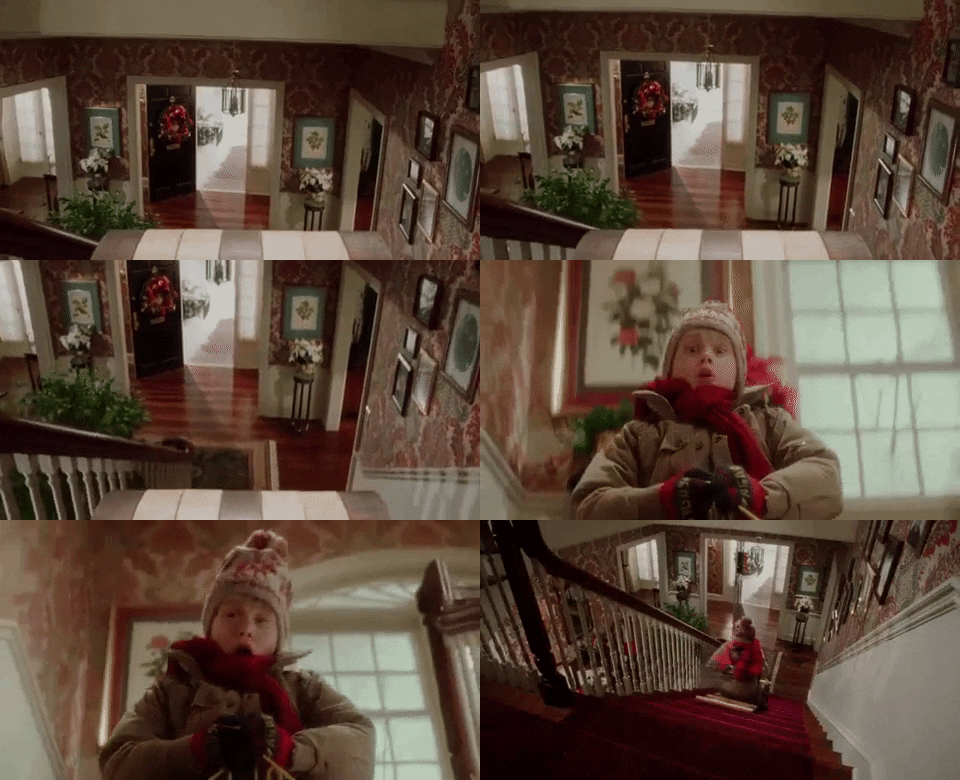
For an adult audience, Home Alone is a classic movie with slapstick violence. For younger viewers, it might be a funny film – or it might be an idea generator for copycat antics.
Creating a mischief-packed scenario in children’s media – be it film, television, literature, music, etc. – requires creators to walk a fine line. We want it to be entertaining. We want it to be believable. We want the stakes to be high. But we don’t want to have to add a big, red warning label that says, “Kids, don’t try this at home.”
In writing The Mountain of Dempsey Molehill, I’ve found myself walking a wobbly tightrope in a few chapters as I try to balance humorous mischief with authenticity – and without giving young, impressionable readers any bad ideas. The premise of the middle grade novel is five siblings with a penchant for mischief try to be on their best behavior the year their dad runs for mayor. Unfortunately, wherever the Molehill kids go, mischief is sure to follow.
One chapter in particular raised red flags for beta readers and has gone through multiple revisions. Seventh-grader Dempsey and his best friend Cooper are cleaning the garage when they find a moldy old encyclopedia that includes the chemistry for gunpowder. They decide to make their own (it’s surprisingly easy to make a basic form – it takes three ingredients, all of which can be found in the average garden shed), and their experiment causes a small fire.

A challenge I faced was writing the chapter with enough detail that it feels authentic without turning it into a how-to guide on homemade gunpowder. The first draft included the three ingredients by name; it didn’t take long for a nagging voice in my head to say, “Maybe that’s not such a great detail to include…” My most recent draft is less specific on those details.
What’s also important is the character’s intent. A growing criticism I’ve seen about Home Alone is that some viewers believe Kevin is a psychopath who derives thrill from creating chaos and pain. Rather than seeing slapstick humor in the robbers suffering blowtorches on their scalps and nails in their feet, the audience sees a remorseless child inflicting serious injury.
That’s not the message I want to send with Dempsey and Cooper and their gunpowder experiment.
In early drafts of the manuscript, science-loving Dempsey knew from the start what they were creating. One beta reader asked, “But why? What would be the point of them making it when they know there’s nothing they can do with it?”
That was a good point. Knowingly making gunpowder is just asking for trouble.
In the latest revision, when the boys find the water-damaged encyclopedia, part of the page is too damaged to read – including the “gunpowder” label at the beginning of the encyclopedia article – but the chart for the gunpowder formula is intact. Intrigued, they try to guess what it is, which leads them to test the recipe to see if they can deduce its purpose. It’s a mix of simple curiosity and dumb luck that they find the three ingredients in the garage and successfully create a basic black powder.
Revisions are still in progress for the latest version of the book, but fortunately the gunpowder chapter is moving in a better direction. The Molehill kids might not necessarily set a good example, but ultimately I hope they don’t set a bad example.
 Julie Stroebel Barichello | Author
Thank you for sharing this story anout the MAYHEM in your MG novel. I think Gordon Korman is the master of creating believable pranksters who learn from their mistakes and wayward ways. Good for your BETA readers for asking important questions. I learned from you today! Beth
LikeLiked by 1 person
Gordon Korman’s “The Unteachables” has been on my to-read list for a while. Now that you mention him, I should move that one up the stack. And I am so fortunate to have great beta readers!
LikeLike